Guides / Cost
Extruded 6063 and 6082 Motor Housings: When a Profile Beats Billet
Written by the team that reads your RFQPublished How we write these
A round motor housing cut from solid aluminum bar turns most of the bar into chips. A housing that starts as an extruded tube or finned profile arrives close to final shape and needs only the ends and the bores machined. That one difference changes material cost, cycle time and lead time, which is why buyers of cylindrical housings often ask if a profile would be cheaper.
This guide compares the two usual extrusion alloys, explains when a profile beats billet and shows what the drawing and the RFQ should carry for an extruded housing.
What extruded housings are
In extrusion, a heated aluminum billet is pushed through a shaped die and comes out as a long profile of constant cross section. The profile is cut to length, aged to its temper and then machined.
For motors the common shapes are:
- Plain round tube, machined into a housing with bored ends and a finished outside.
- Finned profile, with cooling fins on the outside and a round bore inside, used on air cooled motors.
- Square or rectangular profile, common for servo and small industrial motors, with a round bore inside and flat mounting faces.
- Hollow profile with channels, used to carry coolant inside the wall.
The same shape runs along the whole length, so the profile suits housings that are long in one direction and simple in section. Flanges, end covers and mounting features are machined or added as separate parts.
6063 and 6082 compared
Both belong to the 6000 series, the Al-Mg-Si alloys that are heat treatable and widely extruded. They behave differently in use.
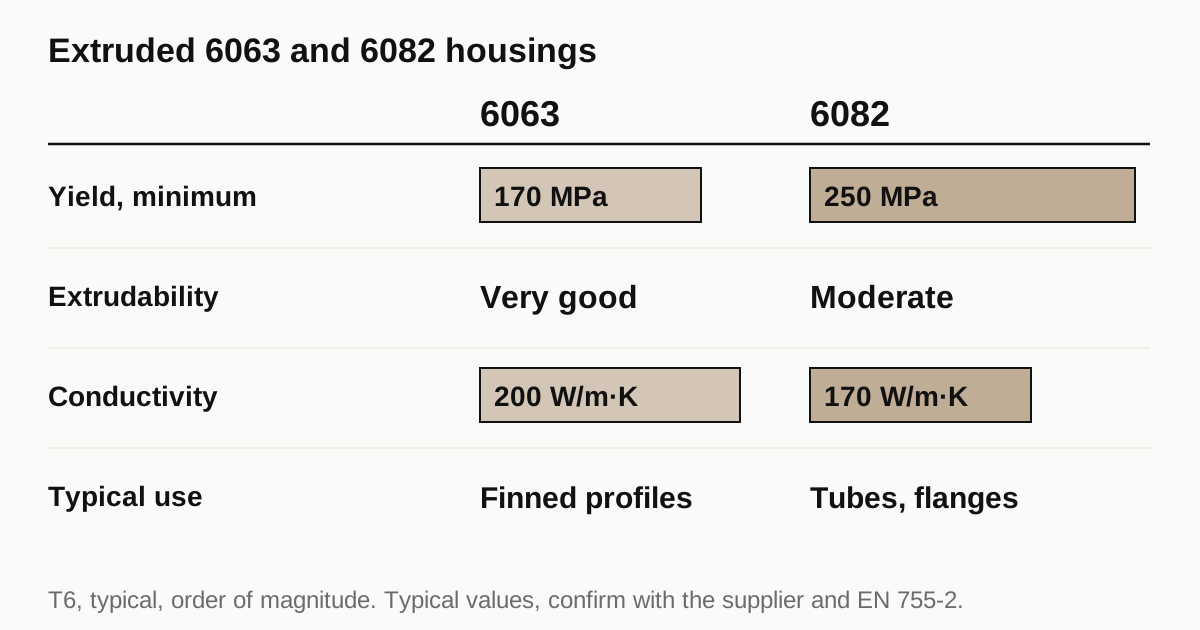
6063 is the extrusion workhorse. It flows through the die easily, so it makes complex thin walled profiles with fine fins. It has good surface finish and anodizes well. It is the weaker of the two.
6082 is stronger and tougher. It is harder to push through a die, so very fine or intricate shapes cost more or are not practical. It suits structural housings, mounting flanges that take load and sections that need stiffness.
| Property (T6 temper, typical) | 6063 | 6082 |
|---|---|---|
| Minimum yield strength, order of magnitude | About 170 MPa | About 250 MPa |
| Extrudability into complex shapes | Very good | Moderate |
| Thermal conductivity | About 200 W/m.K | About 170 W/m.K |
| Anodizing look | Clean, bright | Good, slightly darker |
| Typical use in motor housings | Finned cooling profiles | Structural tubes, mounting sections |
Values are typical figures that vary with wall thickness, temper and the standard used. The strength minimums come from standards such as EN 755-2, which should be checked for the exact section. Do not treat the table as a specification.
What a profile saves
Compare a 120 mm diameter housing with a 90 mm bore, cut from solid bar against cut from a tube.
- Material. The bar route turns the whole core into chips. The tube route keeps the wall and loses little.
- Roughing time. Boring out a large core takes time. A tube starts with the bore nearly done.
- Tool wear. Less metal to remove means less wear.
- Lead time. Standard tube is available from stock. A custom profile waits for the die.
The saving grows with the size of the bore and the length of the part, and with the quantity ordered.
What a profile costs
- Die cost. A custom profile needs a die. The die is a one off cost and a lead time item, often several weeks for the first profile.
- Minimum order. Extruders run a minimum weight or length per press run. Small orders either pay a setup surcharge or pile up stock.
- As-extruded tolerance. The profile comes out within the dimensional tolerances of the extrusion standard, which is looser than a machined part. The housing has to leave machining stock on the surfaces that matter.
- Straightness and twist. A long profile may bow or twist slightly. The shop either straightens it or leaves enough stock to cut it out.
- Weld seams in hollow shapes. A porthole die joins the metal inside the die, leaving longitudinal seams. For a coolant channel, ask the extruder how seams are controlled and tested.
Billet when it is the right choice
Billet and bar stock win in several cases.
- Small volumes. Under a few dozen pieces, the die cost cannot be recovered.
- Shapes that do not suit a constant section. A housing with different features along its length is awkward to extrude.
- Fast prototypes. Billet is available on the day, and a die takes weeks.
- Highest stability. Some designs value the uniform grain and stress state of rolled or forged bar.
The guide on billet prototype housings covers the case where billet is used to prove a design before tooling is cut.
Machining an extruded housing
An extruded profile is easy to machine, with a few points to watch.
- Residual stress. Extrusion and quench leave stress in the profile. Heavy cuts on one side can bend the part. Shops machine both sides in balance and may rough, rest and finish.
- Thin fin tips. Fins can chatter. Fixturing needs to support them or the fin edges are left as extruded.
- Wall thickness variation. The bore position is machined, but the wall thickness around it follows the profile. If the wall is thin on one side the bore may break through, so check the section against the bore size.
- End faces. Facing both ends in one setup keeps them parallel and square to the bore.
The related guide on machining thin-wall housings covers clamping and relaxation in more detail.
Need a quote for this part? Get a quote for your motor part
Tempers and what they mean for machining
An alloy name alone does not say how the metal behaves. The temper does.
T5 means the profile was cooled after extrusion and artificially aged, with no separate solution heat treatment. It is common for 6063 and gives moderate strength with good surface and dimensional stability.
T6 means the profile was solution heat treated, quenched and aged, giving higher strength. It is the usual temper for 6082 and often specified for 6063 where the higher strength helps.
Quench and distortion. The quench that makes T6 can bend long thin profiles. A profile that is straightened after the quench carries stress from the straightening. Machine shops know that a stretched and aged profile is flat and stable, while a bent and pressed one may move when material is removed.
For a buyer, the practical lesson is to state the temper on the drawing, not just the alloy, and to ask the shop whether the profile it quotes is stretched and straightened. A change of temper after the quote changes both strength and machining behavior.
Finishing an extruded housing
Extruded 6063 takes anodizing well, which is why it dominates visible housings. The surface is clean and the finish is uniform along the length. 6082 anodizes acceptably, with a slightly darker tone, which matters only if appearance is a requirement.
Where a housing is painted or powder coated instead, the extruded surface needs a cleaning and conversion step first. Fin roots hold coating unevenly, so the coating thickness at the fin base can differ from the tip. If thermal performance matters, note that a thick coating on the fins reduces heat transfer slightly. The guide on coatings for aluminum motor housings compares the finishes.
Machined surfaces on an anodized housing are a separate question. Bores and mounting faces are normally machined after extrusion and before anodizing, with masking if the finish should not coat them. The drawing should say which surfaces are anodized and which are bare, since anodize adds a few micrometers of thickness to anything it covers.
Questions to ask the extruder or the shop
- Which alloy and temper are available on a short lead time?
- Is there a standard profile close to the drawing that avoids a new die?
- What is the minimum run, and what happens to the leftover stock?
- How are straightness and twist controlled on the length I need?
- For hollow profiles, how are the weld seams made and checked?
- What stock allowance does the shop leave for machining the outside?
The answers make the two routes comparable, and they are more useful than any single price. A shop that works with extruded housings regularly has a standard answer to each.
Cost comparison approach
Ask for two quotes on one RFQ: one for the extruded route and one for billet. Request the following on each.
- Material and form: tube, profile or bar, with alloy and temper.
- Tooling cost and who owns the die.
- Minimum order quantity of the profile.
- Machining time and any stress relief step.
- Price at three quantities, such as 50, 500 and 2,000.
The crossover quantity is where the profile route becomes cheaper in total. It is different for every geometry, so rely on the shop quotes and not a rule of thumb. The cost guide covers the other drivers.
Checklist before you send the RFQ
- State alloy and temper for the housing, with the standard.
- Give the profile drawing or a reference to the standard profile.
- State bore and outside finish requirements after machining.
- Show wall thickness at the thinnest point.
- State annual volume and the order size.
- Ask for profile and billet prices on the same RFQ.
When the drawing is ready, send the RFQ and we quote the finished parts and place the work with a partner shop that machines motor housings. Replies come within 24 business hours.
Standards and references
- Extrusion, overview of the process, dies and profile types. Background on solid, hollow and porthole dies.
- Aluminium alloy, overview of the 6xxx series and tempers. How 6063 and 6082 sit within the Al-Mg-Si family.
- EN 755-2, Aluminium and aluminium alloys, extruded rod/bar, tube and profiles, mechanical properties. The standard that sets minimum strength by alloy, temper and wall thickness. Check the current edition.
- EN 755-9, Extruded profiles, tolerances on dimensions and form. Dimensional limits of an as-extruded profile, which decide how much machining stock is needed.
Figures on this page are typical ranges drawn from the standards above and from ordinary shop practice. They are not a specification for your part. The partner shop that prices your part confirms what it can hold on your geometry.
Frequently asked questions
Is an extruded housing always cheaper than one cut from billet?
Not always. A profile saves material and machining time, but the die has a one off cost and the supplier sets a minimum order. For small batches the die cost can outweigh the saving. The crossover depends on the geometry and the quantity, so request prices for both routes on one RFQ.
Can a profile have a water jacket built in?
A hollow profile can include channels, made with a porthole die that welds the metal back together inside the die. The weld seams need attention for pressure use. Many designs instead machine a groove and add a cover or a sleeve to form the jacket.
Why would a designer choose 6082 over 6063?
6082 is stronger. It suits housings that carry structural load, take mounting loads or have thin walls that need stiffness. 6063 extrudes more easily into complex shapes and has better thermal conductivity, which favors finned cooling profiles.
Need a quote for this part?
Send the drawing. We quote the finished parts, place the work with a partner shop and reply within 24 business hours.
Get a quote for your motor part