Guides / Cost
Rotor Shaft Grinding or Hard Turning: Which Finish Does a Bearing Journal Need?
Written by the team that reads your RFQPublished How we write these
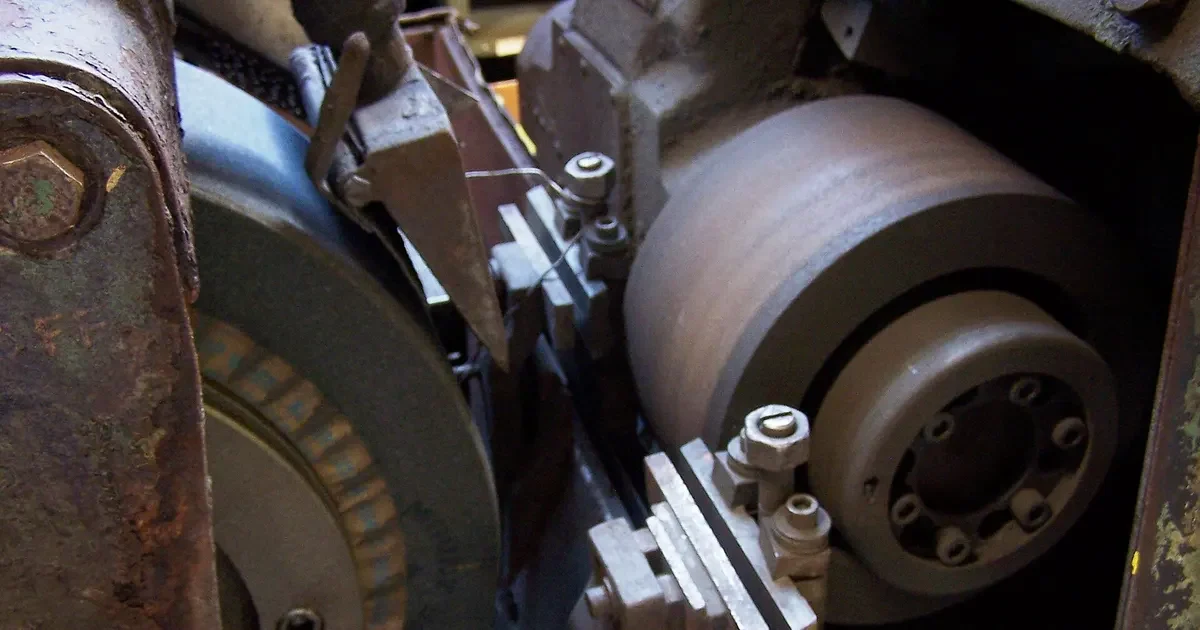
Once a rotor shaft is hardened, its bearing journals have to be brought back to size. Two processes do the job: cylindrical grinding and hard turning. They reach similar numbers on a drawing and differ a lot in how they get there, what they cost and what they leave behind on the surface. Choosing between them well starts with what the journal has to do.
This guide compares the two methods in the terms a buyer needs for an RFQ: what each can hold, where each fits and what to write on the drawing.
What the journal has to do
A bearing journal carries the inner ring of a bearing. For a normal electric motor the fit is an interference fit, so the shaft diameter has to stay in a narrow band. Roundness matters because an oval journal passes its error to the bearing ring when pressed on. Surface finish matters because a rough surface flattens under the ring and loosens the fit over time.
A second kind of journal carries a seal. A rotary lip seal rubs on the shaft, and the surface has to be smooth and free of spiral marks that could pump oil along the shaft. Seal standards and seal makers define what they accept.
Many shafts carry both kinds. The method has to suit the stricter of the two.
Hard turning in brief
Hard turning cuts hardened steel, commonly in the range above 50 HRC, with a cubic boron nitride insert on a lathe. It replaces the grinder for finishing operations on suitable shapes.
Strengths
- One setup. The journals can be turned in the same clamping as the other shaft features, which keeps them coaxial by construction.
- Fast cycle on simple cylinders, and no wheel dressing or grinding coolant cleanup.
- Flexible on profiles. A single tool can follow a radius or a shoulder without a formed wheel.
Limits
- The tool leaves a feed pattern, a fine spiral on the surface. That can be acceptable for a bearing seat and unacceptable under a lip seal.
- Tool wear changes the diameter slowly over a run, so the process needs offsets and checks.
- Poorly controlled cutting can leave a thin altered surface layer with unfavorable residual stress. A shop that hard turns bearing journals should be able to say how it controls this.
- The rigidity of the machine and the shaft decides what is possible. Slender shafts deflect under the tool.
Grinding in brief
Cylindrical grinding removes material with an abrasive wheel. For journals the shop uses either plunge grinding, where the wheel is as wide as the surface and feeds straight in, or traverse grinding, where the wheel moves along the shaft.
Strengths
- Reaches tight size and roundness limits repeatably, with fine surface finish.
- Plunge grinding leaves no spiral lead, so it suits seal surfaces.
- The process is well understood and measured in process, with gauging that compensates for wheel wear.
Limits
- A separate machine and operation, with its own setup, queue and handling.
- Work holding between centers calls for accurate center holes in the shaft, which have to be prepared before hardening.
- Wheel dressing, coolant care and burn control add skill and time.
Side by side
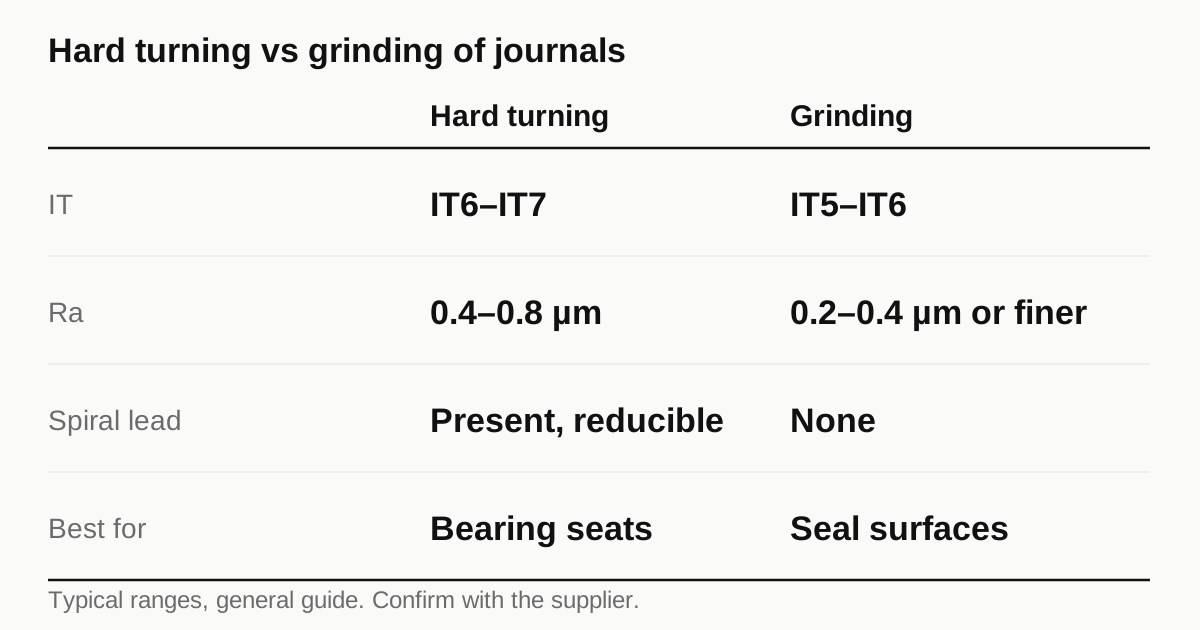
| Factor | Hard turning | Cylindrical grinding |
|---|---|---|
| Typical accuracy class | Often IT6 to IT7 with a good process | Often IT5 to IT6 |
| Typical surface finish | Ra 0.4 to 0.8 micrometer is common | Ra 0.2 to 0.4 micrometer or finer is common |
| Spiral lead on surface | Present, can be reduced | Absent in plunge grinding |
| Setups | Same as turning | Separate |
| Cycle time on a simple journal | Short | Longer |
| Best for | Bearing seats, moderate limits, mixed profiles | Seal surfaces, tightest limits, high volume of a stable design |
These ranges are typical and general. What a given shop actually holds depends on its machine, its tooling and the shaft design. The reference on bearing fit tolerances shows the size band each IT grade gives for a chosen diameter.
Where each method wins
Hard turning fits when
- the journal is a bearing seat with an ordinary fit class,
- the shaft has a profile that a single tool can follow,
- the shop already turns the shaft and holds the journals in the same setup, and
- batches are moderate and the cost of an extra operation is felt.
Grinding fits when
- the journal carries a lip seal or any surface where lead matters,
- the roundness or cylindricity limit is at the tight end,
- the surface finish is very fine, or
- volumes are high enough that the grinder cycle is spread thin.
For many shafts the best answer is both: hard turn the bearing seats and grind only the seal surface. The grinding queue then holds one journal instead of the whole shaft. The cost guide for motor housings and shafts explains how a blanket finish note can send every diameter through the slower route.
The route a shaft takes before the finishing step
Neither finishing method works on a shaft that arrives in poor shape, so it helps to see the whole route. A typical hardened rotor shaft goes through these stages.
- Rough turning from bar in the soft condition, leaving stock on every journal for later finishing.
- Cutting the soft features, such as keyways, splines and threads, while the steel is still easy to cut.
- Heat treatment. Through hardening, case hardening or induction hardening raises hardness on the surfaces that need it.
- Straightening, if heat treatment bent the shaft. Slender shafts often need it.
- Finishing the journals by hard turning or grinding to final size.
- Final inspection of size, roundness, runout between journals and surface finish.
The allowance left in step 1 has to cover the movement of step 3 and 4 and still leave enough case in step 5. If the allowance is too small, the finishing pass does not clean up the surface and the shaft is scrap. If it is too large, the finishing pass cuts deeper into the hardened layer than the designer planned. A shop that processes motor shafts regularly knows the movement of its own heat treat route and sets the allowance from experience. A new route needs a trial batch to find it.
Need a quote for this part? Get a quote for your motor part
Runout between journals
A rotor shaft has at least two bearing journals, and what the motor feels is how well they share an axis. Finishing both journals in one setup is the most reliable way to make them coaxial. Hard turning has a natural advantage here because the journals are cut in the same clamping. Grinding between centers keeps them coaxial too, provided the center holes are accurate and the shaft is not moved between the two journals.
Where journals are ground in separate setups, the shop has to re-clock the shaft, and every re-clocking adds a small error. If the drawing calls for tight runout between the journals, ask how the shop makes sure both are finished in one reference. The guide to bearing fits, concentricity and runout explains why runout, not concentricity, is normally the right callout.
Inspection that fits the method
The finishing method sets how the shop checks the shaft.
- Hard turned journals need frequent size checks, because tool wear moves the diameter. A shop may measure every few parts and adjust the offset when the reading drifts.
- Ground journals are often gauged in process, with a gauge that stops the wheel feed at size. The check after grinding confirms the gauge rather than driving the process.
- Roundness and runout are measured on a roundness machine or on a bench with V blocks and an indicator, depending on the limit. A limit of a few micrometers needs the better method.
- Surface finish is measured with a stylus profilometer on a sample. A lead pattern is checked with a specific procedure when a seal specification requires it.
Ask which of these the shop will run on your shaft and what record it will provide. A measurement report with actual readings is a useful thing to request on the first batch even if later batches only need a certificate of conformity.
Writing the callout
State results, not processes, unless a downstream rule requires a process.
- Size class and limits for each journal.
- Roundness or cylindricity with a numeric value, only where the bearing needs it.
- Ra only on surfaces that need it, with the measuring method if it matters.
- A lead restriction on seal surfaces, naming the seal specification the supplier works to.
- The hardness range and the case depth from heat treatment, since the finishing step has to leave enough case.
On shafts that are induction hardened, the finishing allowance has to remove distortion without cutting through the hardened layer. The related guide on induction hardened journals covers that limit.
See also: rotor shaft machining, the overview of journals, drive ends, steel grades and inspection.
Questions to ask a shop
- Which journals do you grind and which do you hard turn, and why?
- How do you control tool wear on a hard turned journal across a batch?
- Do you plunge grind seal surfaces?
- What gauge checks the journal in process, and what is the action limit?
- Do you need center holes prepared before hardening?
Checklist before you send the RFQ
- List each journal with its function: bearing seat, seal surface or both.
- State size class, roundness and Ra only where each is needed.
- Name any seal specification that restricts surface lead.
- Give hardness and case depth from heat treatment.
- State the batch size and whether a trial run is acceptable.
When the drawing is ready, send the RFQ and we quote the finished parts and place the work with a partner shop that machines motor parts. Replies come within 24 business hours.
Standards and references
- Hard turning, overview of finishing hardened steel with a single point tool. Background on CBN tooling and the surface it leaves.
- Cylindrical grinder, overview of plunge and traverse grinding. The machine type used for journal grinding in section 3.
- ISO 286-1, ISO code system for tolerances on linear sizes. The IT grades and shaft classes mentioned throughout.
- ISO 6194-1, Rotary shaft lip type seals, nominal dimensions and tolerances. Sets the shaft surface requirements for lip seals, including the surface lead restriction.
Figures on this page are typical ranges drawn from the standards above and from ordinary shop practice. They are not a specification for your part. The partner shop that prices your part confirms what it can hold on your geometry.
Frequently asked questions
Can hard turning replace grinding on a bearing journal?
On many journals it can. A well controlled hard turning process reaches the size and finish a normal bearing fit needs. Grinding stays the safer route when the journal also has to meet a tight roundness limit, or when a lip seal rides on it and the seal maker forbids a spiral lead on the surface.
Which finish is cheaper?
Hard turning is often cheaper per part when the shop already turns the shaft in the same setup and has CBN tooling in place, because it saves a machine, a queue and a handling step. For small batches or very tight limits, grinding can cost less in total because the shop avoids scrap and tool development.
Does the finish method belong on the drawing?
Usually the drawing states the result, not the process: size class, roundness and Ra. Naming the process is only worth doing when a downstream requirement, such as a seal specification, depends on it.
Need a quote for this part?
Send the drawing. We quote the finished parts, place the work with a partner shop and reply within 24 business hours.
Get a quote for your motor part