Guides / Buyer Guide
Anodize, E-Coat or Powder Coat: Choosing a Finish for Aluminum Motor Housings
Written by the team that reads your RFQPublished How we write these
Bare aluminum forms its own thin oxide and resists corrosion in many settings. A motor housing that lives outdoors, in a damp factory or near salt air needs more. Three finishes cover almost every request: anodizing, electrophoretic coating (e-coat) and powder coating. They are not interchangeable. Each one changes thickness, heat transfer, conductivity and the way the finish handles the housing’s shape.
This guide compares the three on the points a buyer feels, and lists what the drawing has to say for the shop to quote the finish properly.
Anodizing
Anodizing is an electrochemical treatment. The housing is the anode in an acid bath, and current grows a layer of aluminum oxide from the surface. The film is part of the metal, not a paint on top.
What it gives. A hard, thin, wear resistant film that can be dyed. Sulfuric acid anodizing, often called Type II, is the common decorative and protective version. Hard anodizing, Type III, gives a thicker, harder film.
Growth. The film grows both inward and outward. A rough rule is that around half the film thickness lies inside the original surface and half builds up outside it, so each surface grows by about half the film thickness. Confirm with the finisher.
Electrical behavior. Anodic film insulates. A housing needs a bare spot for earth bonding, which means masking or removing the film locally.
Alloy effect. Wrought alloys such as 6061 and 6063 give a clear, even film. Die cast alloys with high silicon give a grey, patchy film.
Limits. It protects less well than paint against chlorides unless it is sealed well. It does not hide machining marks, and it shows scratches and defects.
E-coat
An electrophoretic coating, or e-coat, is a paint that is applied from a water based bath with electric current. Charged paint particles move to the housing and deposit as an even film, then the part is rinsed and baked.
What it gives. An even film over the whole part, including recesses, internal cavities and edges, which other coating methods struggle to reach. Corrosion protection is good, and the film is thin and smooth.
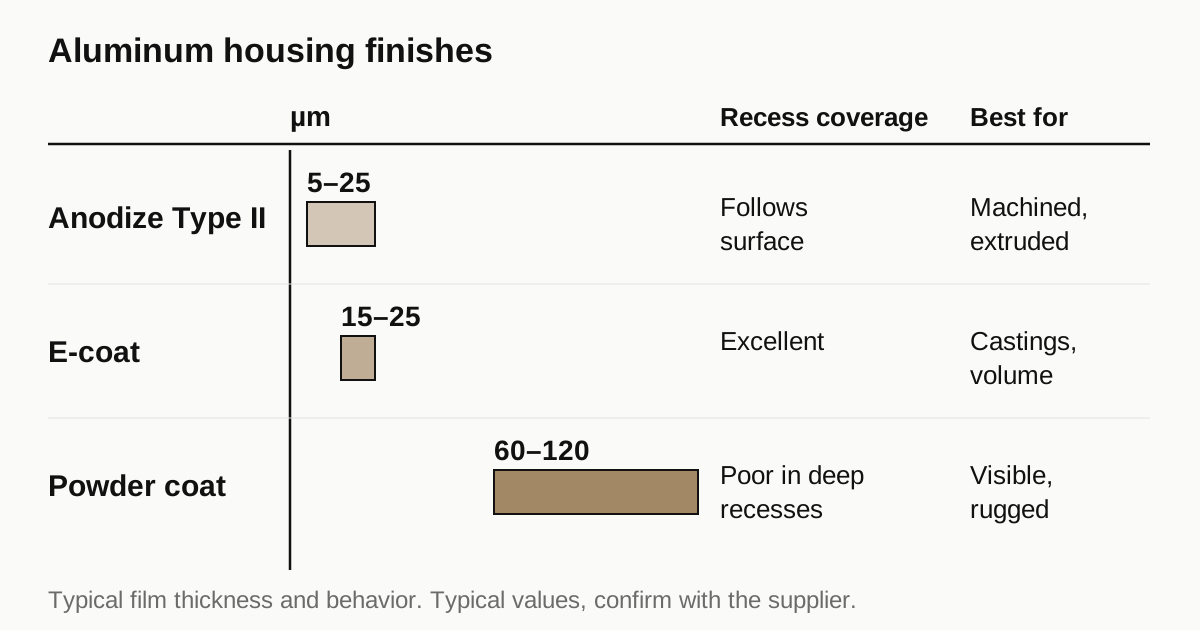
Thickness. A typical film is in the range of 15 to 25 micrometers, and the bath controls it closely.
Electrical behavior. The film insulates, so earth points need masking.
Process notes. The housing must conduct, so aluminum needs a pretreatment such as a conversion coating. The bake runs at a temperature that the housing, any seals and any impregnation sealant have to survive.
Limits. Colors are limited, mostly black and a few others. A bath is a big investment, so e-coat suits volume. Small runs usually go elsewhere.
Powder coating
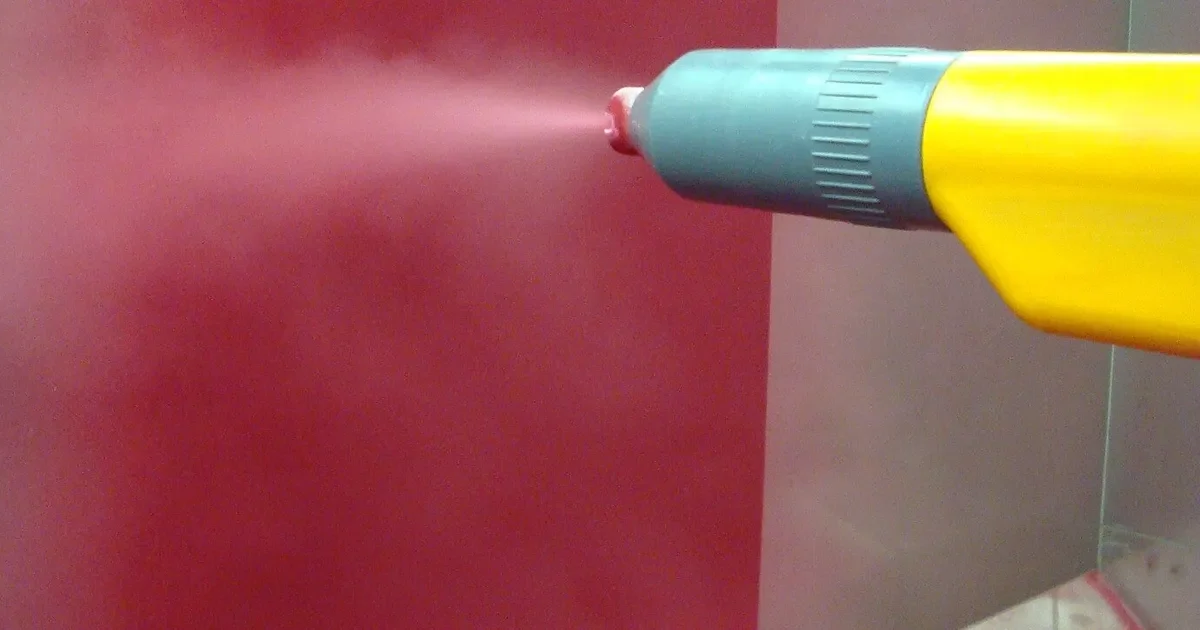
Powder coating sprays dry charged powder onto a grounded part, and an oven cures it into a continuous film.
What it gives. A thick, tough, chip resistant finish in almost any color and texture.
Thickness. Typically 60 to 120 micrometers. That is several times thicker than anodize or e-coat.
Reach. The electric field keeps powder out of deep recesses and sharp internal corners, a behavior known as the Faraday cage effect. Fins with narrow gaps coat poorly at the root.
Heat. The thicker film insulates thermally. For a finned housing, a heavy coat at the fin base can reduce cooling slightly.
Dimensional effect. At that thickness the coating changes fits. Bearing bores, spigots and mounting faces have to be masked.
Limits. Cure temperature is higher than for many liquid paints. Thick film can crack at the edge of a fastener hole.
Side by side
| Factor | Anodize | E-coat | Powder coat |
|---|---|---|---|
| Film thickness, typical | 5 to 25 micrometers (Type II); thicker for hard anodize | 15 to 25 micrometers | 60 to 120 micrometers |
| Coverage in recesses | Good, follows surface | Excellent | Poor in deep recesses |
| Corrosion protection | Moderate unless well sealed | Good | Good |
| Color range | Limited, dyed | Mostly black | Very wide |
| Effect on heat transfer | Small | Small | Moderate on fins |
| Electrical insulation | Yes | Yes | Yes |
| Best for | Machined and extruded parts | Complex castings in volume | Visible, rugged surfaces |
The thickness figures are typical ranges and differ by process and finisher. Treat them as orientation and confirm with the supplier.
Masking and fits
Every one of these finishes adds thickness to the surface. A bearing bore with an H7 tolerance leaves a few tens of micrometers of room, so even a 20 micrometer film changes the fit. The usual practice is to mask the critical surfaces during coating or machine them after coating.
State on the drawing:
- Which surfaces are coated.
- Which surfaces are masked, such as bores, spigots, mounting faces, threads and earth contact spots.
- Whether any surface is machined after coating.
- The coating thickness limits on surfaces that mate with other parts.
The bearing seat fit reference shows how little room an H7 bore has, which helps to judge how much film it can take.
Pretreatment decides how long the finish lasts
Paint on aluminum holds only as well as the surface under it. Before e-coat or powder coat the housing goes through cleaning and a conversion treatment, which etches the surface lightly and leaves a thin film that paint bonds to. Older processes used chromate conversion. Many finishers now offer chrome free alternatives, and customers sometimes require one because of material restrictions.
Three points matter to a buyer.
- Cleanliness of the housing. Cutting oil, fingerprints and polishing compound cause blisters. The housing should arrive at the finisher clean and dry, and the shop that machines it should say how it cleans.
- Casting skin and machined surface. A cast surface and a machined surface react differently to etching. Where both appear on one part, the finish may look different on each, and the drawing or a sample should say what is acceptable.
- Time between machining and coating. Fresh machined aluminum oxidizes within hours. A long delay can weaken adhesion, so the schedule between machining, cleaning and coating is part of the process.
Need a quote for this part? Get a quote for your motor part
Sealing anodized housings
An anodic film is porous. Right after the bath it has microscopic pores that hold dye and also hold moisture and salt. Sealing closes them, by hot water, nickel acetate or another seal. A poorly sealed film passes a visual check and fails in salt air. The drawing should state the sealing requirement or name the standard, such as ISO 7599, and the film thickness class.
Hard anodizing is usually left unsealed or lightly sealed when wear resistance matters more than corrosion resistance. If a housing needs both, say which is the priority.
Anodizing also leaves a different surface from the one that went in. A machined, smooth surface stays smooth. A bead blasted surface turns matte and uniform, and many decorative housings use bead blasting before anodizing for that reason. Name the pre-finish on the drawing if it matters.
Rework and touch up
A scratch on a coated housing can be repaired, but the repair depends on the finish.
- Anodize cannot be touched up. A damaged part is stripped and anodized again, with allowance for the material that strips away.
- E-coat can be touched up with paint, though the repair is not the same quality. A badly damaged part is stripped and recoated.
- Powder coat can be sanded and recoated, or stripped.
Stripping a housing removes a little metal and can change dimensions, so a part that has been through the process twice may need a larger machining allowance. For this reason, parts that have to be coated and finish machined after are usually coated in the rough state and machined at the end.
Cost and lead time
| Factor | Anodize | E-coat | Powder coat |
|---|---|---|---|
| Setup cost | Low to moderate | High for a bath, low per part in volume | Low |
| Best volume | Small to large | Large | Small to large |
| Typical added lead time | Short | Short if the line is running | Short |
| Rework | Strip and redo | Touch up or strip | Sand and recoat or strip |
E-coat prices drop sharply per part as volume rises, since the line is a fixed cost shared across many pieces. Powder coat and anodize have a flatter curve. For prototypes and short runs, powder coat and anodize are normally the practical choices. For high volume cast housings, e-coat is common. The cost guide lists the other drivers of housing price.
Interaction with other steps
- Casting porosity. Trapped sealant or moisture in porous castings can bubble out during a bake. Impregnation before coating helps. See the guide to casting porosity.
- Leak testing. Test before coating when possible, or make sure the coating does not hide a leak.
- Thermal performance. The guide on aluminum thermal conductivity shows how the material choice affects cooling, and the coating adds a second layer to consider.
Testing a finish
Corrosion requirements are usually written as hours in a salt spray test, referring to ISO 9227. Adhesion is checked with a cross-cut test or a pull-off test. Thickness is measured with an eddy current gauge or a section. Name the test, the hours and the pass criterion on the drawing, since “good corrosion protection” cannot be quoted or checked.
Checklist before you send the RFQ
- State the environment: indoor, outdoor, washdown, salt air.
- Name the finish and any thickness range.
- Mark masked and machined-after surfaces.
- State the corrosion test and hours if required.
- Say if earth bonding points need bare metal.
- State color and gloss if the appearance matters.
When the drawing is ready, send the RFQ and we quote the finished parts and place the work with a partner shop that machines and finishes motor housings, with replies within 24 business hours.
Standards and references
- Anodizing, overview of the electrochemical process and film types. Why the film grows into and out of the surface.
- Powder coating, overview of application and cure. Electrostatic spray and bake, and why recesses coat poorly.
- Electrocoating, overview of electrophoretic paint. How an e-coat bath builds an even film on complex shapes.
- ISO 9227, Corrosion tests in artificial atmospheres, salt spray tests. The test commonly named when a corrosion requirement is written.
- ISO 7599, Anodizing of aluminium and its alloys, general specifications for anodic oxidation coatings. Thickness classes and sealing requirements for anodic films.
Figures on this page are typical ranges drawn from the standards above and from ordinary shop practice. They are not a specification for your part. The partner shop that prices your part confirms what it can hold on your geometry.
Frequently asked questions
Which finish is best for an aluminum motor housing?
There is no single best. Anodize suits machined or extruded parts and keeps heat transfer high. E-coat suits complex shapes and gives even coverage in recesses. Powder coat suits visible, rugged surfaces and offers the widest color range. The duty, the shape and the alloy decide.
Does the coating change the dimensions of a bearing bore?
Yes, all three add thickness, and powder coat adds the most. A bore, spigot or mounting face that has a close fit should be masked or machined after coating. The drawing should state which surfaces are coated, masked or machined after.
Can a die cast housing be anodized?
It can, but cast alloys with a high silicon content give a dull, uneven grey film that protects well enough but looks poor. If appearance matters, e-coat or powder coat is the usual choice on a die cast housing.
Need a quote for this part?
Send the drawing. We quote the finished parts, place the work with a partner shop and reply within 24 business hours.
Get a quote for your motor part