Guides / Buyer Guide
High Pressure Die Casting, Gravity Casting or Sand Casting: Which Blank to Machine a Motor Housing From
Written by the team that reads your RFQPublished How we write these
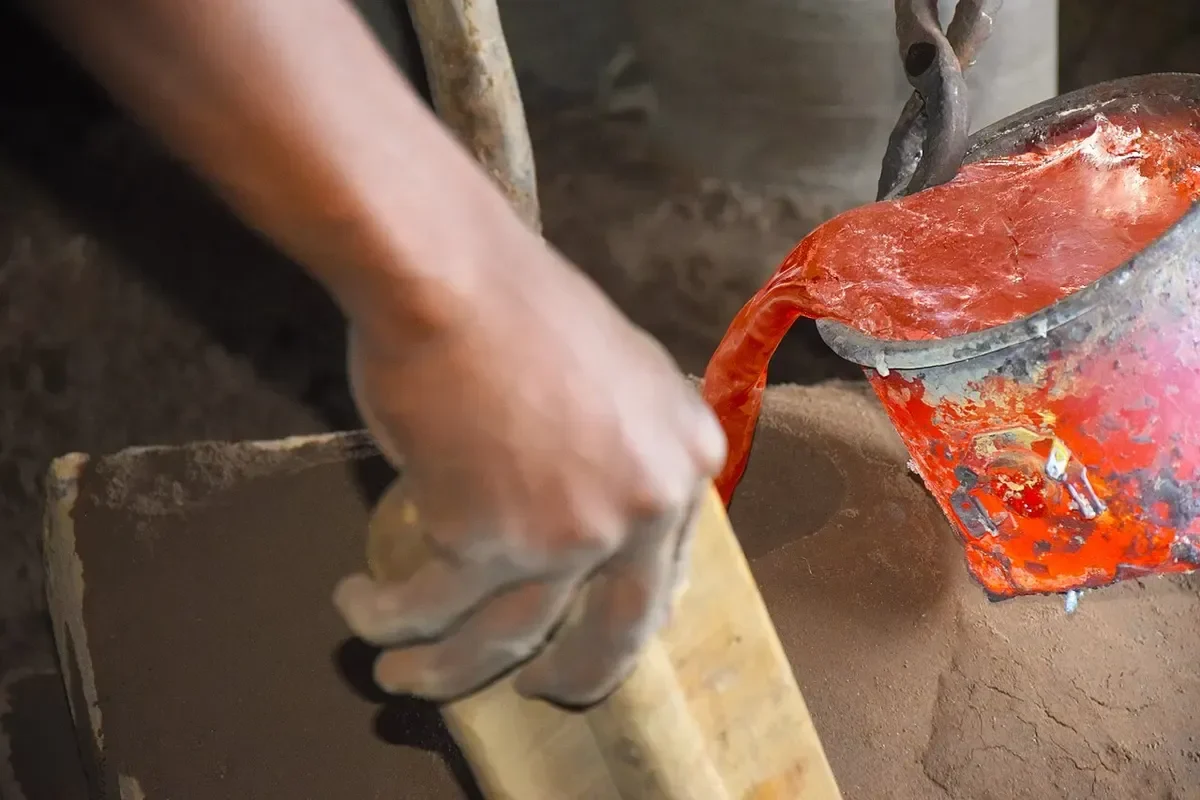
Choose the blank by volume, wall thickness and duty, then tell the machining shop which one you chose. High pressure die casting suits high volumes, thin walls and a fine as-cast surface. Gravity (permanent mold) casting suits medium volumes, thicker sections and parts that need a heat treated alloy. Sand casting suits large housings, low volumes and early prototypes. Whichever you pick, the bearing bores, flange faces and pilots are machined afterwards, so what matters most is how each route behaves under the cutter.
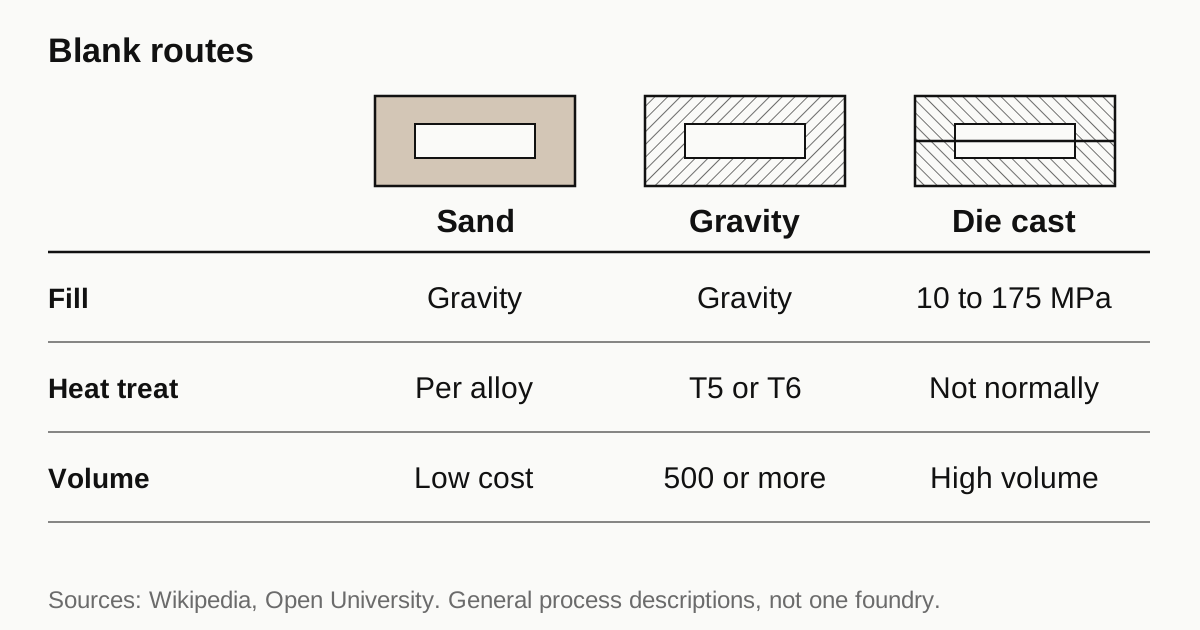
How the three routes differ
| Sand casting | Gravity (permanent mold) | High pressure die casting | |
|---|---|---|---|
| Mold | Sand packed round a reusable pattern | Metal die, metal poured under gravity | Hardened steel die, metal injected at pressure |
| Fill | Poured by gravity | Poured by gravity, less turbulence | Injected, 10 to 175 MPa for aluminum |
| Wall thickness | No single figure, rough surface | 3 to 50 mm | Down to about 0.75 mm |
| Draft | Pattern must lift out of the mold | 2 to 3 degrees | From 1:100 (0.6 degrees) |
| Heat treatable | Depends on the alloy | Yes, A356 is supplied in T5 and T6 | Not normally, unless vacuum-assisted |
| Size | Grams to tons | About 100 g to 75 kg | Aluminum up to about 32 kg (2008 estimate) |
| Volume | Low cost to establish, short runs | About 500 castings or more | High volumes, costly dies |
The figures come from the pages listed under Sources. They describe the processes in general and not any one foundry, so treat them as a starting point for a conversation with the foundry.
What the shop sees at the machine
Dimensional accuracy of the blank. The die casting page gives a typical accuracy of 0.1 mm for the first 2.5 cm and 0.02 mm for each additional centimeter. On a 52 mm bearing seat that works out to about 0.15 mm on the as-cast surface. ISO 286 allows 0.030 mm for an IT7 bore in the 50 to 80 mm range. The cast surface is about five times looser than the finished bore, so the bore is always cut. Published tolerances for gravity and sand casting differ between sources, so none is printed here. Ask the foundry for its own capability on your part. Xometry describes sand casting as low in dimensional precision, with post-machining often used where precision is needed.
Porosity. The die casting page says standard die castings retain some porosity, mainly in the center of the casting. Cutting a bore can open that porosity at the surface. The open pores then show up as pits in a bearing seat or a leak path in a water jacket. The Open University describes gravity casting as filling with less turbulence than pressure die casting, producing sounder and denser castings, which is worth asking about when a housing must be pressure-tight. Sand casting has its own gas risk: water in green sand makes steam, and the sand casting page lists gas defects as a result. The guide to casting porosity and impregnation covers what to ask for when pores appear.
Heat treatment. The die casting page explains why standard die castings cannot be heat treated: heating trapped gas in the pores causes micro-cracks and surface exfoliation. Vacuum-assisted die casting is described as reducing porosity and allowing heat treating and welding, with no numbers given. Permanent mold casting has no such limit. Batesville Products casts A356 in permanent mold with and without T5 or T6 heat treat. If the drawing calls for a T6 temper, check the process before you accept a die cast quote.
Distortion after the first cut. A casting holds residual stress, and the first roughing pass can release some of it. The problem is worse on thin walls, so the thin-wall guide on distortion in motor housings applies to any route. No public source gives a stress figure for each process, so ask the shop whether it stabilizes the blank or finishes in two passes.
Datums for the first operation. A shop cannot clamp on a rough casting surface the way it clamps on a bar. The drawing should name cast datum points, or the casting should carry bosses the shop can locate on. Sand castings, with rougher surfaces and parting-line variation, need the most care here.
Choosing by situation
| Your situation | Likely route | Why |
|---|---|---|
| Prototype or fewer than a few hundred housings | Billet or sand | No die cost. See billet prototypes before die cast tooling |
| Large frame, one-off or short run | Sand casting | Size range from grams to tons and low cost to establish. Iron is common, see cast iron motor housings |
| Medium volume, pressure-tight or heat treated alloy | Gravity casting | Calm fill, denser metal, T6 available |
| High volume, thin walls, fine fins | High pressure die casting | Thin walls and a fine as-cast surface once the die is paid for |
| High volume with a leak test | Die casting with vacuum assist, or gravity | Lower porosity, check with the foundry |
The Open University sets the minimum for gravity die casting at about 500 castings, and the die casting page says die casting needs high production volumes to be economical because the dies are very costly. No public source prints a tooling price for a motor housing. The price comes from your drawing, so ask for it at the quantity you plan to buy.
Need a quote for this part? Get a quote for your motor part
Shape rules that follow from the process
Gravity casting suits small, simple castings with uniform wall thickness, no undercuts and no intricate coring, according to the Open University. A housing with deep internal ribs, a cooling jacket or side cores is harder in gravity than in die casting. Die casting, in contrast, handles thin walls and complex shapes but needs enough draft: the minimum quoted for aluminum is 1:100. Permanent mold needs 2 to 3 degrees. Sand needs a pattern that lifts out of the mold.
If you only have a machined design today, a casting engineer should review it before you commit to a route. Ask for these items.
- Draft on every vertical face that is not machined.
- Uniform wall thickness, or a gradual change.
- Boss and flange thickness that allows a clean first cut.
- A parting line that stays off bearing seats and sealing faces.
- Locating points for the machining fixture.
What to put in the RFQ
State the blank route on the drawing or in the RFQ, not only the alloy. A quote for a die cast housing and a quote for a sand cast one do not compare. Add the items below.
- Casting process and alloy, with temper if heat treated.
- Whether you supply the castings or want the shop to source them.
- Porosity requirement and test, for example a leak test on a water jacket housing as described in the leak test guide.
- Cleanliness requirement if the housing goes to an EV drive unit, see VDA 19 cleanliness.
- Annual volume and release size, since they decide the route.
When the drawing is ready, send the RFQ and we quote the finished parts and place the work with a partner shop that machines motor parts, with a reply within 24 business hours. How we choose partner shops explains what is checked before a shop sees your request.
Standards and references
- Die casting, overview. Aluminum die casting alloys, dimensional accuracy, minimum wall and draft, porosity, why standard die castings are not heat treated, vacuum-assisted variant, die life.
- The Open University, Gravity die casting. Process, calm filling and denser castings, die thickness, part shape limits, yield and the minimum run of about 500 castings.
- Permanent mold casting, overview. Wall thickness range, draft, part weight range, tooling cost and the grain structure compared with sand casting.
- Sand casting, overview. Share of metal castings made in sand, reusable patterns, steam and gas defects from water in green sand, surface finish by sand type.
- Xometry, Sand casting. Low dimensional precision, post-machining, size range from grams to tons, low cost to establish.
- Batesville Products, Comparing casting alloys. A356 cast in permanent mold and supplied with and without T5 or T6 heat treatment. Vendor page, directional only.
- IT Grade, table of ISO 286 tolerance grades. IT7 width of 30 micrometers for the 50 to 80 mm range, used in the worked comparison.
Figures on this page are typical ranges drawn from the standards above and from ordinary shop practice. They are not a specification for your part. The partner shop that prices your part confirms what it can hold on your geometry.
Frequently asked questions
Is gravity casting better than die casting for a motor housing?
It depends on volume and duty. Gravity casting fills calmly and gives denser castings, and a heat treated alloy such as A356 in T6 is common in permanent mold. High pressure die casting gives thinner walls and a better as-cast surface at high volume. Neither replaces machining of the bearing bores.
Can a die cast motor housing be heat treated?
Not normally. Standard die castings retain porosity, and heating the trapped gas can cause micro-cracks and surface blisters. Vacuum-assisted die casting reduces porosity and allows heat treatment and welding, so ask the foundry which process made the part before you specify a temper.
What volume justifies die casting tooling?
No public price list exists, so quote your own drawing. The Open University sets a minimum of about 500 castings for gravity die casting, and die casting dies are described as very costly, which is why die casting is tied to high volumes. Below that, sand casting or billet is the usual route.
Does the casting process change the machined tolerances?
No. The finished bore and face tolerances stay what the drawing says. The process changes how much stock is left, how stable the blank is, and how likely pores are to open up when a bore is cut, which shows up in scrap and in the quote.
Need a quote for this part?
Send the drawing. We quote the finished parts, place the work with a partner shop and reply within 24 business hours.
Get a quote for your motor part