Guides / Buyer Guide
Moving Motor Part Machining Out of China: The 2026 US Tariff Stack and What It Changes
Written by the team that reads your RFQPublished How we write these

The short answer, as of October 2026: leaving China for machined motor housings, end bells and rotor shafts takes out the oldest US duty layer, the legacy Section 301 tariff, but it does not take you to zero. A new 12.5 percent Section 301 duty started on 24 July 2026 and covers most origins, and Section 232 can still touch the metal content of a motor part from anywhere. US tariff law changed several times in 2026. This guide lays out the layers, shows what a move changes and lists what to put on the RFQ. It is general information, not customs advice, and every figure is dated to the sources below.
What happened in 2026
- 20 February: the Supreme Court struck down tariffs imposed under IEEPA, according to Global Trade Alert. The country-specific IEEPA rates on China ended with them.
- 24 February to 24 July: a flat 10 percent Section 122 surcharge applied to all origins for 150 days. It has expired.
- 11 March: USTR opened Section 301 investigations into structural excess capacity in 16 economies, China among them, and into forced labor import enforcement in 60.
- 24 July: the forced labor action took effect. USTR calls it final and sets tiers: 10 percent for 17 named economies, 10 or 12.5 percent net of MFN for certain products of the EU, Taiwan, Japan, Korea and Switzerland, and 12.5 percent for all other investigated economies. A law firm reading of the notice places China in the 12.5 percent group, stacked on top of the older China duties.
The excess capacity investigation had no proposed action in the sources opened for this guide. A hearing was scheduled to begin on 5 May. Another round of duties could follow, so a quote built on today’s rate carries a date risk.
The layers on a China-origin motor part
HTS 8503.00.65 covers stators and rotors, the “other” line under parts of motors, and the USITC schedule lists a general rate of 3 percent. Two commercial tariff lookups show further Chapter 99 lines on it for China origin, so use this table as a map to check, not a final figure.
| Layer | What it is | China origin | Other origins |
|---|---|---|---|
| MFN duty | General rate, 8503.00.65 | 3 percent | 3 percent, unless a trade agreement lowers it |
| Legacy Section 301 | Lists 1 to 3 at 25 percent, list 4A at 7.5 percent | Commercial lookups show 25 percent on 8503.00.65 under 9903.88.01 | Not applied |
| Forced labor Section 301 | New, effective 24 July 2026 | 12.5 percent per a law firm reading | 10 percent or 12.5 percent depending on the economy |
| Section 232 derivative | Steel and aluminum content of listed articles | Possible | Possible, any origin |
| IEEPA | Struck down 20 February 2026 | None | None |
| Section 122 | 10 percent, expired 24 July 2026 | None | None |
Two points need care. First, the Section 232 line. The BIS notice of 19 August 2025 lists 8503.00.65 and 8503.00.95 among the added derivative codes, and says the tariff applies to the value of the steel or aluminum content. The two lookups disagree on how that line is shown, one adding a flat 25 percent to a 53 percent total and the other showing a zero rate line, so the treatment is not settled by them. BIS also proposed 14 further derivative articles in August 2026, and the examples KPMG lists are not motor parts. The Section 232 duty follows the metal, not the country, so a move does not remove it.
Second, the interaction. The forced labor action excludes articles already covered by Section 232 duties, per the law firm summary, so whether the 12.5 percent also applies to a given housing depends on how the entry is classified and treated. That is a question for a broker, not a guess.
What a move changes, and what it does not
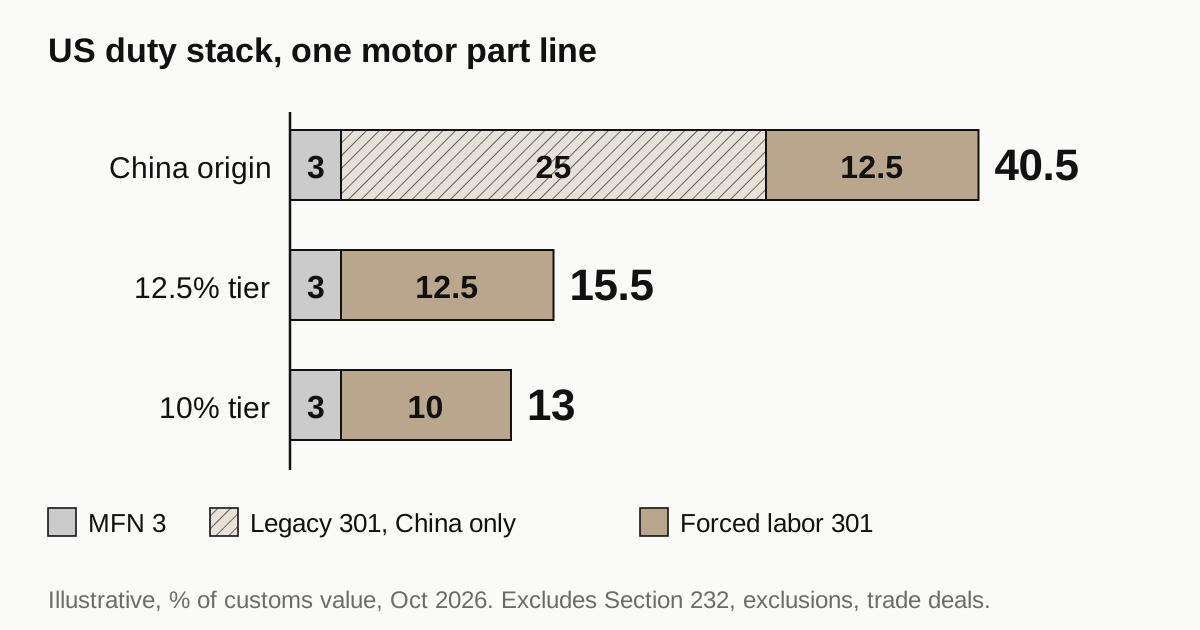
Take a machined housing with a customs value of 100 and ignore Section 232. Using the map above, a China-origin part runs at 3 plus 25 plus 12.5, or 40.5 percent. The same part from an origin in the 12.5 percent tier runs at 3 plus 12.5, or 15.5 percent, and from an origin in the 10 percent tier 3 plus 10, or 13 percent. These are my own sums to show scale, for one line, with every assumption above, and they will be wrong if an exclusion, a trade agreement or a classification change applies. What they show is that the gap between China and the alternatives is now mostly the legacy 301 layer, which is the layer still under review.
What does not move with the origin:
- Section 232 on the metal content. It follows the article.
- Freight and insurance. Neither is a duty, but both sit in the landed cost.
- The cost of qualifying a new source. A new shop needs first article inspection, gauge correlation and often a production part approval package. The PPAP guide lists the documents and the machining cost guide explains why the shop price is only part of the figure. No public survey compares shop rates for motor parts by origin, so compare quotes on the same drawing.
- Casting and forging tooling. If the blank comes from China, the origin question below applies, and a tooling transfer takes time that a tariff change does not give back.
Duty is one line of the landed number; the other lines of a housing quote are in the motor housing machining quote guide.
See also: supplying machined motor parts to US motor makers, with standards, efficiency rules and the duty layers as of October 2026.
Need a quote for this part? Get a quote for your motor part
The origin question
CBP’s informed compliance publication on origin says a substantial transformation occurs when a new article with a different name, character and use is created, and advises importers to seek a binding ruling when the case is complicated. A casting poured in one country and machined in another is such a case. The outcome depends on the facts, so do not assume the machining country is the origin on the paperwork. Ask the shop where the blank comes from and put the answer in the quote. The die casting versus gravity casting guide explains how the blank is chosen.
What to put on the RFQ
- Delivery term and whether duty is included, so that quotes compare on one basis. State DDP or EXW and who is the importer of record.
- The HTS code you expect and the country of origin you expect for the finished part.
- Where the casting, forging or bar comes from, and whether that can change.
- Whether the part has steel or aluminum content that could be a Section 232 derivative.
- A quote validity date, since the duty position changed several times this year.
- The usual drawing items, in the drawing checklist.
When the drawing is ready, send the RFQ and pick the region you want quoted. We quote the finished parts and place the work with a partner shop that machines motor parts, with a reply within 24 business hours. Confirm duty treatment with a licensed customs broker before you place an order. The shop price is only one input to the landed cost, and the duty line moves faster than a machining quote.
Sources
- USITC, Harmonized Tariff Schedule search, heading 8503
- BIS, Section 232 steel and aluminum inclusions notice, Federal Register, 19 August 2025
- USTR, forced labor Section 301 action, 23 July 2026
- Greenberg Traurig, new Section 301 forced labor tariffs, July 2026
- USTR, structural excess capacity investigations, 11 March 2026
- Global Trade Alert, from IEEPA to Section 122
- Sandler, Travis & Rosenberg, Section 301 tariffs on China
- KPMG, BIS proposes 14 more Section 232 derivative articles
- CBP, Marking of Country of Origin on U.S. Imports
Standards and references
- USITC, Harmonized Tariff Schedule search, heading 8503. General duty rate of 3 percent on 8503.00.65, parts of electric motors, and no Chapter 99 footnote on that entry.
- BIS, Adoption and Procedures of the Section 232 Steel and Aluminum Tariff Inclusions Process, Federal Register, 19 August 2025. Added derivative codes include 8503.00.65 and 8503.00.95. The tariff applies to the steel or aluminum content.
- USTR, USTR Takes Action in Forced Labor Section 301 Investigations, 23 July 2026. Tiers of 10 percent, 10 or 12.5 percent net of MFN, and 12.5 percent for all other investigated economies. Lists the exemption categories.
- Greenberg Traurig, USTR imposes new Section 301 forced labor tariffs on imports from 60 economies, July 2026. Law firm reading: China in the 12.5 percent group, stacking on existing Section 301 duties, Section 232 articles excluded, 24 July 2026 effective time.
- USTR, Initiation of Section 301 investigations on structural excess capacity, 11 March 2026. The 16 economies covered, including China, and the comment and hearing dates.
- Global Trade Alert, From IEEPA to Section 122: what changed on 20 February 2026. The Supreme Court decision on IEEPA tariffs and the 10 percent Section 122 surcharge from 24 February to 24 July 2026.
- Sandler, Travis & Rosenberg, Section 301 tariffs on China. Rates by list (25 percent on lists 1 to 3, 7.5 percent on list 4A) and the second four-year review started in May 2026. Trade law firm page, not dated.
- KPMG, BIS proposes 14 more Section 232 derivative articles, August 2026. Release date of 4 August 2026, 14 proposed articles and the comment period.
- CBP, Marking of Country of Origin on U.S. Imports. Substantial transformation test and the advice to seek a binding ruling when origin is complicated.
Figures on this page are typical ranges drawn from the standards above and from ordinary shop practice. They are not a specification for your part. The partner shop that prices your part confirms what it can hold on your geometry.
Frequently asked questions
Does moving machining out of China remove the US tariff?
It removes the legacy Section 301 layer on China-origin goods but not every layer. A new Section 301 duty of 12.5 percent from 24 July 2026 applies to most other origins too, and Section 232 can hit the steel or aluminum content of a part from any origin. Compare duty-inclusive quotes for the same drawing.
Are electric motor parts subject to Section 232?
Some are. BIS added codes including 8503.00.65 and 8503.00.95, parts of electric motors, to the steel and aluminum derivative list in August 2025, with the duty on the metal content. Later 2026 changes to the regime could not be confirmed, so check the current annexes with a customs broker.
What decides the country of origin of a machined housing?
Customs decides by substantial transformation: whether a new article with a different name, character and use is created. The test is applied case by case, so a casting made in one country and machined in another needs a broker's view or a binding ruling from CBP before you rely on the lower duty.
Are the tariffs on China motor parts final?
No. A second four-year review of the legacy Section 301 duties began in May 2026 and an excess capacity investigation covering China and 15 other economies was still open at the time of writing. Treat any duty figure as dated and confirm it before you place an order.
Need a quote for this part?
Send the drawing. We quote the finished parts, place the work with a partner shop and reply within 24 business hours.
Get a quote for your motor part