Guides / Buyer Guide
Water Jacket Housing Leak Testing: Pressure Decay or Helium?
Written by the team that reads your RFQPublished How we write these
A water jacket housing holds coolant around the stator. If the jacket leaks, coolant reaches the windings and the motor fails, often after weeks in service rather than at the first power up. That is why the drawing carries a leak test line, and why two shops can quote very different prices for what looks like the same requirement.
This guide compares the two methods buyers see most often. It explains what each one detects, what drives cost and what to write on the RFQ so the quote you get back is for the test you meant.
Where a water jacket leaks
Before choosing a method it helps to know what is being found. A water jacket is a channel between an inner wall and an outer wall, or a groove closed by a cover plate or a pressed sleeve. Leaks tend to come from four places.
- Casting porosity. Tiny voids inside the wall of a cast jacket can connect to form a path from the coolant channel to the outside. This is the most common cause on die cast and sand cast housings.
- The seal groove. A scratched or chattered O-ring groove face lets coolant bypass the seal. This is a machining defect, not a casting one.
- The cover plate or sleeve joint. A friction stir welded plate, a bolted plate with a gasket or a pressed liner can all leak at the interface.
- Threaded ports. Coolant inlet and outlet ports cut into thin walls can break through into a void.
A test method has to be sensitive enough to find the leaks that matter, and quick enough to run on every part. Those two goals pull in opposite directions, which is the whole story of pressure decay against helium.
How pressure decay works
Pressure decay is the simpler method. The tester seals the coolant ports, fills the jacket with clean dry air to a set pressure, lets it settle and then watches the pressure for a fixed time. A pressure drop above the limit fails the part.
Three things make it popular on motor housings:
- The equipment is cheap compared with tracer gas systems.
- A cycle can be short, often well under a minute for a small jacket.
- It needs no special gas and no vacuum.
The weaknesses are just as real. Air temperature changes pressure, so a part that is warm from machining will read a false loss as it cools. The settle time exists to let that effect pass, and it is the reason a decay test on a large jacket takes longer than one on a small jacket. The method also tests the whole volume at once, so it tells you the part leaks but not where.
How helium testing works
Helium is a very small molecule that passes through leak paths air cannot, and a mass spectrometer detects it at very low concentration. There are two common setups.
In a vacuum chamber test the housing sits inside a sealed chamber, the jacket is filled with helium, and the spectrometer samples the chamber. Any helium that escapes shows up as a signal. The result is a single leak rate for the whole part.
In a sniffer test the jacket is filled with helium and an operator or robot passes a probe along the surfaces. The signal rises near a leak, so this method locates the defect as well as detecting it. It is less sensitive than the chamber method and slower per part.
Helium systems cost more to buy, need helium supply and need operators who understand background signal. They reach leak rates far below what a pressure decay tester can resolve. They are used when the requirement is set by contamination, not by simple loss of coolant.
Side by side
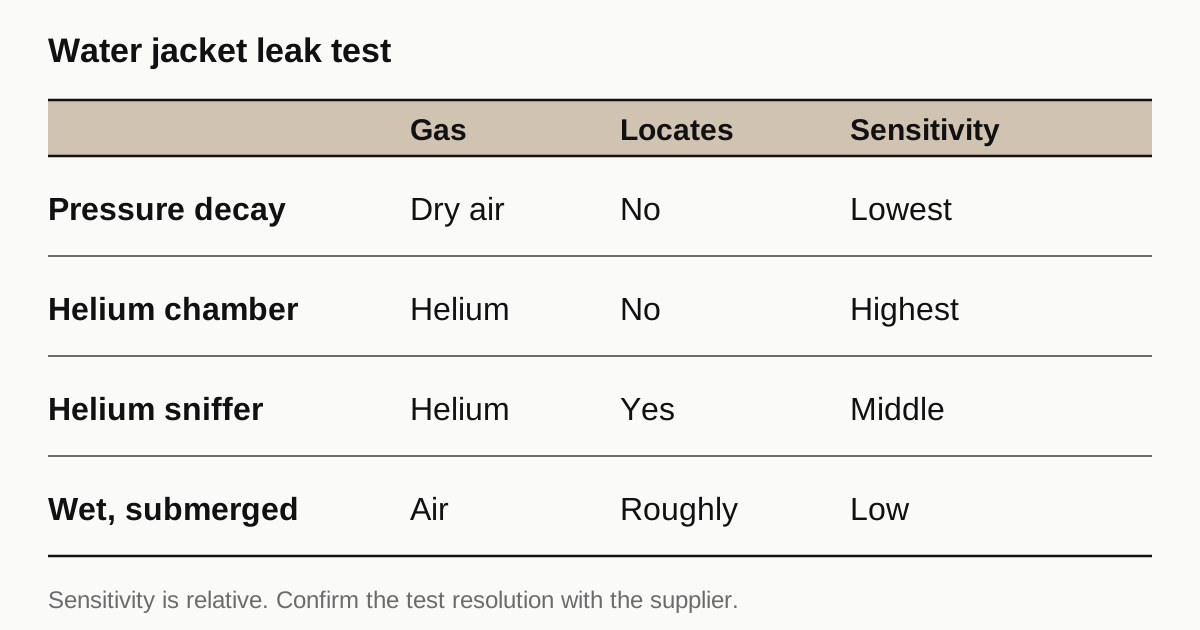
| Factor | Pressure decay | Helium vacuum chamber | Helium sniffer |
|---|---|---|---|
| Test gas | Dry air | Helium | Helium |
| Finds location of leak | No | No | Yes |
| Relative sensitivity | Lowest of the three | Highest | Middle |
| Cycle time per part | Short | Medium | Long |
| Equipment cost | Low | High | Medium |
| Sensitive to part temperature | Yes | Less so | Less so |
| Typical use | Coolant jackets in volume | Sealed or critical assemblies | Finding a leak on a rejected part |
The sensitivity ranking is general. The leak rate each system can actually resolve depends on the part volume, the test pressure, the hold time and how the tester is set up. Ask the shop for its method and its resolution on your part, not a brochure figure.
What the drawing should say
Whichever method you choose, a leak test callout needs five items to be quotable:
- The test medium. Dry air or helium.
- The test pressure. Often set above the coolant circuit working pressure by a margin the motor designer chooses. The number comes from the design, not from the shop.
- The hold or settle time. A longer hold finds smaller leaks and costs more cycle time.
- The pass limit. A pressure drop in the decay case or a leak rate in the helium case, with units.
- What happens to a failure. Scrap, impregnate and retest, or rework the groove and retest.
If any of the five is missing, a careful shop will either ask or add a margin for the risk, and a margin shows up as price.
Need a quote for this part? Get a quote for your motor part
How the method changes the rest of the job
A leak test is not a stand alone step. It reaches back into the machining plan.
Order of operations. A housing should be tested after the last operation that can open a leak, which usually means after the ports are tapped and the seal grooves are cut. Testing before final machining proves nothing about the finished part.
Cleanliness. Cutting fluid and chips sit in the jacket after machining. Wash the housing before test, because a blocked path can hide a leak and a wet jacket upsets an air test.
Impregnation. Where a casting is known to be porous, vacuum impregnation can seal the voids. Whether impregnation is allowed, and whether the part is retested afterwards, should be agreed up front. The guide on casting porosity covers that decision.
Fixturing. Every housing geometry needs its own seals and clamps for the tester. A new fixture is a one off cost and a lead time item, so a prototype run of ten housings may be cheaper to test by a simple wet check than by building a fixture.
Three mistakes that waste money on leak testing
Specifying helium because it sounds safer. Helium is not a better test in every sense. It is a more sensitive one, and sensitivity beyond what the design needs rejects parts that would have run for years. Each rejected part is a cost the buyer ends up paying through price or delay.
Testing a warm part. A housing that comes straight off a machine and goes onto an air tester will drift as it cools, and the drift reads as a leak. Either the shop lets parts stabilise or it uses a reference part to compensate. Ask which one applies.
Forgetting the plugs and seals. The tester only proves the jacket if its own seals do not leak. A worn seal on the fixture produces a failure that looks like a bad housing and a stack of scrap that was never bad. A shop that checks its tester against a known good part and a known leaking master part at the start of each shift avoids that.
See also: motor cooling jackets and sleeves compares jacket designs, sealing and the machining sequence.
Choosing a method
A short decision path works for most buyers.
- Coolant jacket, volume production, leak means a drip. Pressure decay with a stated pressure, hold time and limit.
- Sealed assembly or a limit set by contamination. Helium in a vacuum chamber.
- A batch is failing and nobody knows where. Helium sniffer on a few rejected parts to find the location, then fix the cause and go back to the routine test.
- Prototypes and small runs. Ask whether a simple pressure hold or a submerged air test meets the need before paying for a fixture.
The routine test should be the cheapest method that finds every leak that would cause a field failure. A more sensitive method than the design needs raises the price of every part for no gain.
Checklist before you send the RFQ
- State the test method, medium, pressure, hold time and limit with units.
- Say whether the shop tests in house or you test on arrival.
- State whether impregnation is permitted and whether parts are retested after it.
- Say which operations must be finished before the test.
- Ask for the shop’s test resolution on your part and its fixture cost as a separate line.
A partner shop can price against a clear test callout in one pass. Cost drivers outside the test are covered in what drives motor housing machining cost. When the drawing is ready, send the RFQ and we quote the finished parts and place the work with a partner shop, with a reply within 24 business hours.
Standards and references
- Helium mass spectrometer, overview of tracer gas leak detection. Background on how helium is detected and why it reaches smaller leaks than air.
- Die casting, overview of the process and its typical defects. Why cast jackets are the usual place leaks start.
- ISO 2768, General tolerances for linear and angular dimensions. The general tolerance note that sits beside any leak rate on the print.
Figures on this page are typical ranges drawn from the standards above and from ordinary shop practice. They are not a specification for your part. The partner shop that prices your part confirms what it can hold on your geometry.
Frequently asked questions
Can I put a leak rate on the drawing without saying which test method to use?
You can, but the number means different things under different methods and test conditions. A limit quoted in cubic centimetres per minute of air at a stated pressure is a pressure decay style limit. A limit quoted in millibar litres per second of helium is a tracer gas limit. State the number, the gas, the pressure and the hold time, and a shop can quote against it without guessing.
Is pressure decay good enough for a coolant jacket?
For many housings it is. A coolant jacket that holds water at working pressure does not need a leak rate far below what a drop of water would reveal. Helium earns its cost when the limit is set by contamination or by a sealed assembly that cannot be reopened, not by a simple wet test.
Who owns the leak tester, the buyer or the shop?
It depends on the order. Some shops run the test in house on a fixture they built for the part. Other buyers test on arrival at their own line. Say on the RFQ which of the two you expect, because a fixture is a one off cost that has to be paid by somebody.
Need a quote for this part?
Send the drawing. We quote the finished parts, place the work with a partner shop and reply within 24 business hours.
Get a quote for your motor part