Guides / Buyer Guide
Grey Iron and Ductile Iron Motor Housings: Choosing and Machining Them
Written by the team that reads your RFQPublished How we write these
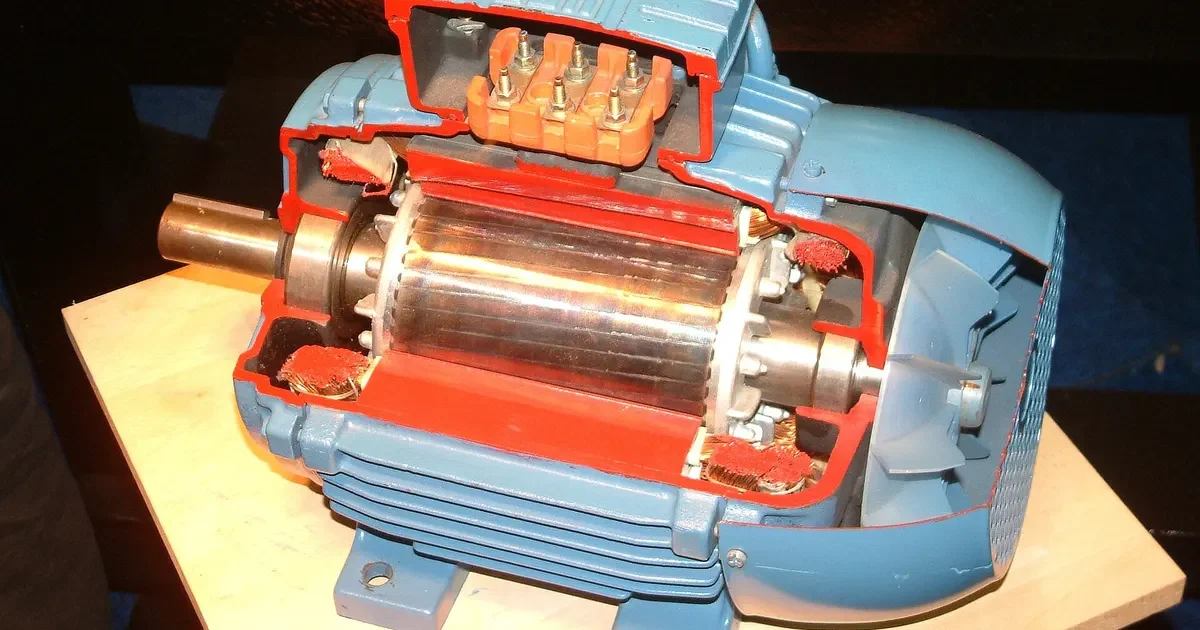
Walk through a pump house or a mill and most of the large electric motors are cast iron. The material is old, heavy and cheap, and it keeps winning for industrial frames because it does several jobs at once. It carries the stator, it holds the bearings in line, it damps vibration and it sheds heat through cast fins.
Two kinds of iron cover nearly all motor housings: grey iron and ductile iron. This guide explains how they differ, what each costs to machine and what the drawing must say so a shop can quote correctly.
What makes the two irons different
Both are iron with a few percent of carbon. The carbon sits in the metal as graphite, and the shape of the graphite sets the behavior.
Grey iron has graphite in flakes. Flakes act as tiny cracks inside the metal, so grey iron is strong in compression and weaker in tension. It is brittle, it has no real elongation and it damps vibration extremely well because the flakes absorb it.
Ductile iron, also called nodular or spheroidal graphite iron, has graphite in round nodules. Nodules do not concentrate stress the way flakes do, so ductile iron has higher tensile strength and can stretch before it breaks. It damps less than grey iron.
The ISO grade names tell you the numbers. EN-GJL-250 is a grey iron with a minimum tensile strength of 250 MPa. EN-GJS-400-15 is a ductile iron with a minimum tensile strength of 400 MPa and 15 percent elongation. The corresponding ASTM families are A48 for grey iron and A536 for ductile iron.
Side by side
| Property (typical) | Grey iron | Ductile iron | Aluminum casting for comparison |
|---|---|---|---|
| Tensile strength, minimum by grade | About 200 to 300 MPa | About 400 to 600 MPa | About 160 to 300 MPa depending on alloy |
| Elongation | Close to zero | About 2 to 18 percent by grade | A few percent |
| Vibration damping | Very high | Moderate | Low |
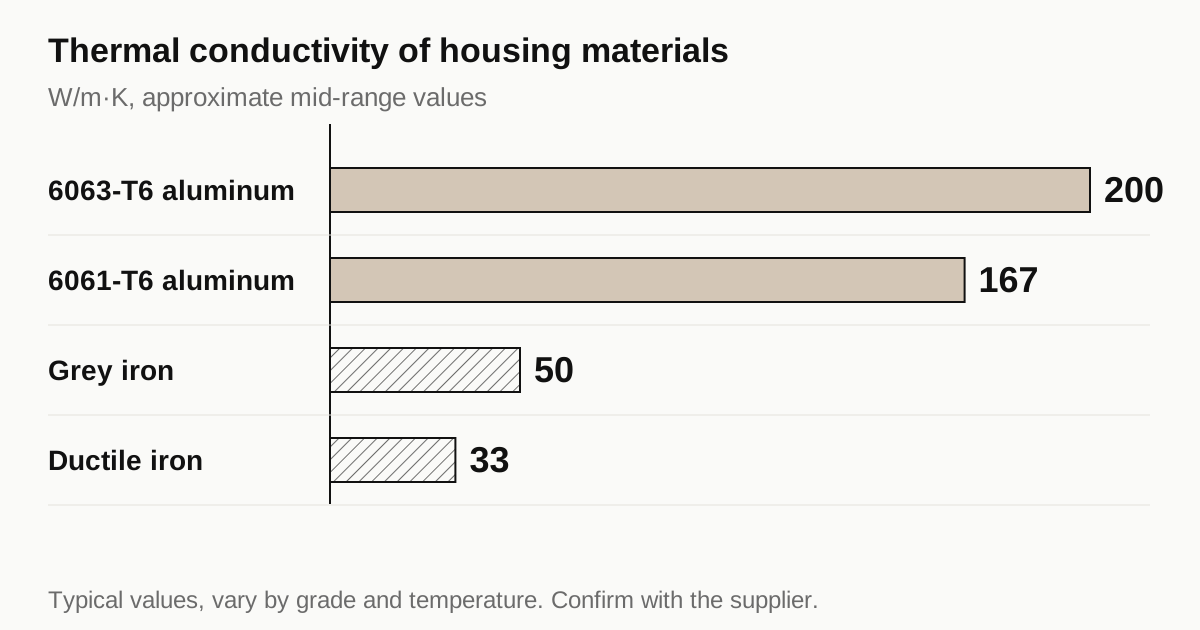
| Thermal conductivity | About 45 to 55 W/m.K | About 30 to 36 W/m.K | About 100 to 170 W/m.K |
| Relative density | About 7.1 | About 7.1 | About 2.7 |
| Machinability | Good, short chips | Fair, more tool wear | Very good |
| Typical motor use | Large industrial frames and end shields | Frames needing toughness, lifting points | Smaller and lighter motors |
All figures are typical ranges that depend on grade and section. Check the grade standard for your part. Thermal conductivity in particular varies with graphite structure and temperature, and sources differ.
When grey iron is the answer
- Stationary industrial motors where weight does not matter.
- Applications with vibration and noise concerns, where the damping of grey iron quiets the motor.
- Large frames with complex shapes, since iron casts well into thin ribs and integral feet.
- Cost sensitive designs, because grey iron is among the cheapest cast metals per kilogram.
When ductile iron is the answer
- Housings that carry mounting loads, such as feet that take torque reaction.
- Frames that may take impact, for example during installation or handling.
- Lifting eyes and structural bosses that have to survive load.
- Thinner sections where grey iron’s brittleness would be a risk.
Ductile iron costs more per kilogram than grey iron because of the metallurgy and the extra control in the foundry. It is not a universal upgrade, and a designer who picks it where grey would do spends extra for no benefit.
Machining cast iron
Iron machines differently from aluminum, and the differences affect the quote.
Cast skin. The outer skin is hard and may contain sand and scale. A cutter entering the skin wears fast, so shops take the first cut deep enough to get under it. That means leaving enough machining allowance on every surface, and the drawing and the casting pattern need to agree on it.
Chips and dust. Grey iron makes short broken chips and fine abrasive dust. Many shops machine it dry or with minimal lubricant, because coolant mixed with graphite dust makes a paste. Dust control and machine cleaning are part of the cost.
Tool wear. Ductile iron, especially pearlitic grades, wears tools faster than grey iron. Ceramic or coated carbide tools are common. The shop’s tool choice and cutting speed set the cycle time.
Dimensional stability. Castings carry cooling stress. A frame that is machined heavily on one side can move. Many iron foundries stress relieve large castings before machining, and the drawing or the order should say if it is required.
Surface finish. Grey iron gives a good finish on bores and faces. A bearing bore is normally bored, then sometimes honed or finish bored in a second pass.
What to state on the drawing
- Material grade and the standard, for example EN-GJL-250 to ISO 185 or ASTM A48 Class 35.
- Heat treatment or stress relief, if needed.
- Machining allowance on cast surfaces, or a reference to the pattern drawing.
- Which surfaces are machined and which stay as cast.
- Bearing bore tolerances, with the class and roundness. The bearing seat fit reference lists bore limits by diameter.
- Surface finish on sealing faces and fits.
- Painting or coating, since bare iron rusts quickly. The guide to housing coatings compares finishes, with the main focus on aluminum.
Frame sizes and mounting standards
Industrial motor housings are rarely free design. The mounting dimensions follow frame size standards so that a motor from one maker bolts into the base of another. In the metric world, IEC 60072 defines shaft height, foot hole spacing and shaft extension for each frame size. In North America, NEMA frame numbers do the same job. The housing machining therefore has strict targets that come from the standard, not from the shop.
That has two practical effects for a buyer.
- Datum features are fixed. The feet are machined flat and coplanar so that the shaft height meets its tolerance. The bore centerline height above the foot plane is one of the key dimensions on the print.
- Interchangeability is the goal. If the machined housing differs from the standard by a few millimeters, the motor will not bolt into the existing base. The drawing should cite the frame standard and the dimensions to be held.
Shops that machine motor frames regularly know the frame tables. Shops that do not may ask many questions or quote a long setup to find the datum.
See also: the IEC motor frame size chart lists shaft heights, shaft ends and flange codes by frame, with sources.
Need a quote for this part? Get a quote for your motor part
Casting dimensional tolerance
A raw iron casting is not as accurate as a machined part. Casting tolerance is classed in ISO 8062, which gives a grade for each process and size. Sand cast iron typically sits in the coarser grades, and the finished dimension depends on how much stock the machine shop removes.
This affects the quote in two ways.
- Allowance. The drawing has to leave enough stock on every machined surface to cover casting variation, mold shift and the first cut under the skin.
- Wall thickness. If the casting shifts, the wall can end up thinner on one side after the bore is cut. A casting drawing needs a minimum wall after machining.
If a buyer supplies the casting pattern, ask the shop to check it against the final drawing before ordering castings, because errors found after a batch of castings arrive are expensive.
Corrosion and finish
Bare iron rusts quickly. A cast iron housing gets painted, and the paint system is part of the specification. Typical elements are a primer and one or two topcoats, with a paint thickness range. The drawing or a separate specification should state the system, the color and the surfaces that must stay bare, such as machined feet and bearing bores.
A few practical notes.
- Bare surfaces need a temporary protection. Machined iron surfaces rust within days in humid air. A light oil or a rust preventive coat protects machined faces during shipping.
- Paint on mating surfaces causes fit problems. If a bearing bore or a spigot gets painted by mistake, the fit changes. Masking instructions belong on the drawing.
- Coating porosity. Iron castings have surface pits that need filling before paint if a smooth appearance is required.
Common mistakes
| Mistake | Result | Fix |
|---|---|---|
| Naming only “cast iron” on the drawing | Quotes assume different grades | State grade and standard |
| No machining allowance noted | Shop guesses, or the first cut misses the skin | Show allowance or the pattern drawing |
| Leaving out stress relief | Frame moves after machining | State if required |
| Not masking bores before paint | Fit changes | Show masked surfaces |
| Ordering ductile where grey is enough | Higher cost for no benefit | Confirm the load case |
Cost drivers specific to iron
- Pattern and core tooling. An iron casting needs a pattern, often with cores for internal shapes. The cost is paid once and shared across the batch.
- Casting yield. Iron is cheap, but scrap is not. Cracks, shrinkage and sand inclusions add loss, and the foundry builds the average into the price.
- Machining time. Large frames mean large machines and long cycles.
- Weight and freight. Iron is heavy, and shipping a batch of large frames is a meaningful part of landed cost.
The guide on casting porosity and rejects covers inspection and reject limits. The housing machining cost guide explains the rest.
Questions to ask a shop
- Which iron grades do you machine regularly?
- How do you handle the cast skin on the first cut?
- Do you stress relieve large castings or does the foundry?
- How do you control dust and cleanliness for a bearing bore?
- Can you quote the casting and the machining as a package?
Checklist before you send the RFQ
- Give the grade and standard, not just “cast iron”.
- State machining allowance and which surfaces are machined.
- Show bore tolerances and any roundness needs.
- State stress relief and coating requirements.
- Give weight and quantity so freight can be planned.
When the drawing is ready, send the RFQ and we quote the finished parts and place the work with a partner shop that machines cast motor housings, with replies within 24 business hours.
Standards and references
- Cast iron, overview of grey, ductile and other iron types. Background on graphite form and why it changes the properties.
- Ductile iron, overview of spheroidal graphite iron. How nodular graphite gives higher strength and elongation.
- ISO 185, Grey cast irons, classification. Grades such as EN-GJL-250 and their minimum tensile strength.
- ISO 1083, Spheroidal graphite cast irons, classification. Grades such as EN-GJS-400-15 and their strength and elongation.
Figures on this page are typical ranges drawn from the standards above and from ordinary shop practice. They are not a specification for your part. The partner shop that prices your part confirms what it can hold on your geometry.
Frequently asked questions
Why are big industrial motor frames still cast iron?
Cast iron is stiff, damps vibration well, casts into complex shapes with integral feet and fins and costs less per kilogram than most alternatives. Weight is the cost. For a fixed industrial motor, weight rarely matters, so the properties win.
Is ductile iron always better than grey iron?
It is stronger and tougher, but it costs more, machines with more tool wear and damps vibration less well. Grey iron is the better choice when stiffness, damping and cost matter more than impact strength.
Do cast iron housings leak like aluminum castings can?
Porosity can occur in any casting, but a cast iron frame rarely carries pressurized coolant, so the issue arises less often. Where an iron housing does hold fluid, the same leak testing and impregnation questions apply.
Need a quote for this part?
Send the drawing. We quote the finished parts, place the work with a partner shop and reply within 24 business hours.
Get a quote for your motor part