Guides / Buyer Guide
Magnesium or Aluminum Motor Housing: Weight, Corrosion, Heat and Machining Safety
Written by the team that reads your RFQPublished How we write these
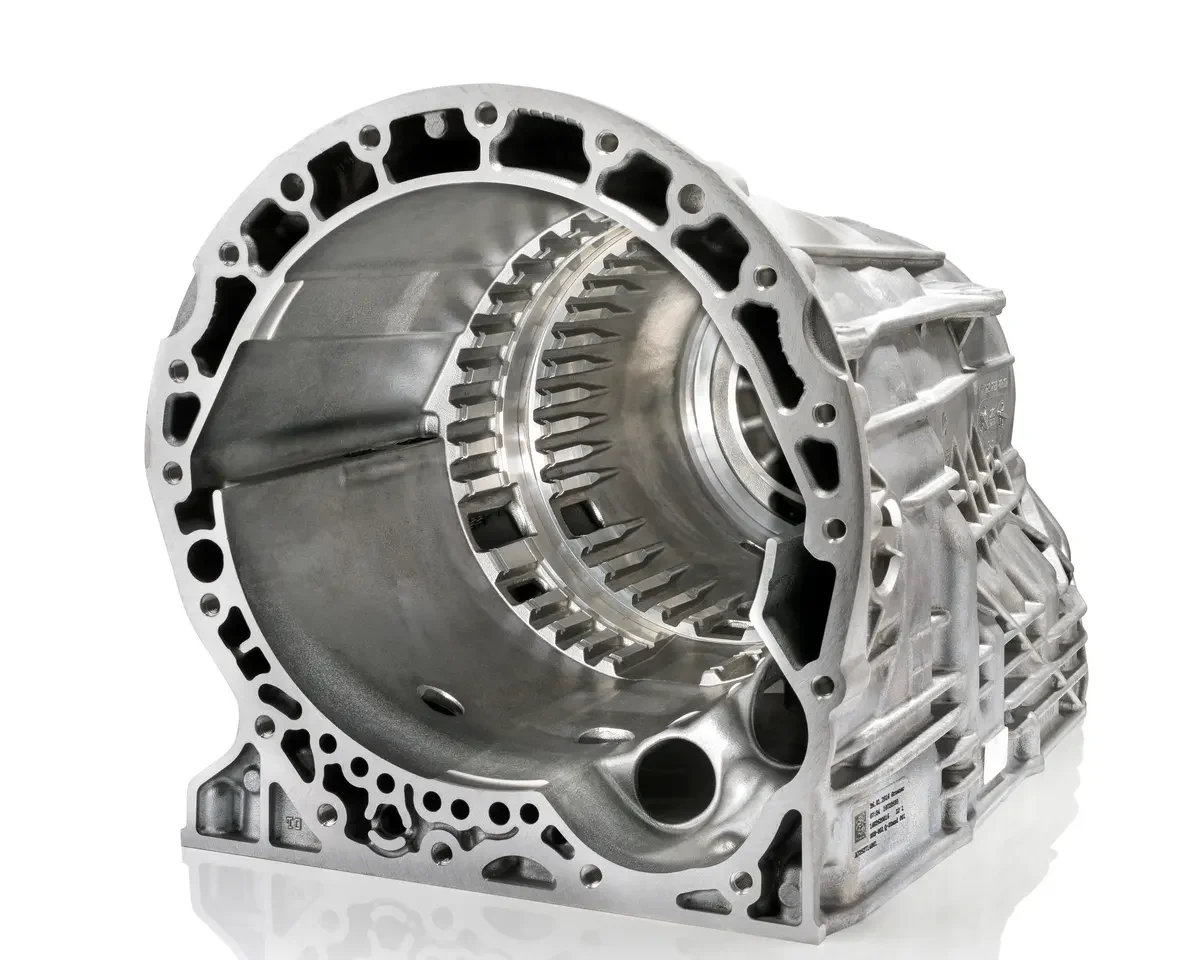
Magnesium is the lightest of the common casting metals and the first thing a weight-conscious designer reaches for. For a motor housing it is a trade. You gain about 35 to 40 percent in density. You lose thermal conductivity, stiffness, creep resistance and some corrosion margin. You add machining controls that not every shop has. Aluminum stays the default for most housings. Magnesium earns its place in small, light, dry applications where every gram counts, and there the drawing and the RFQ need extra care.
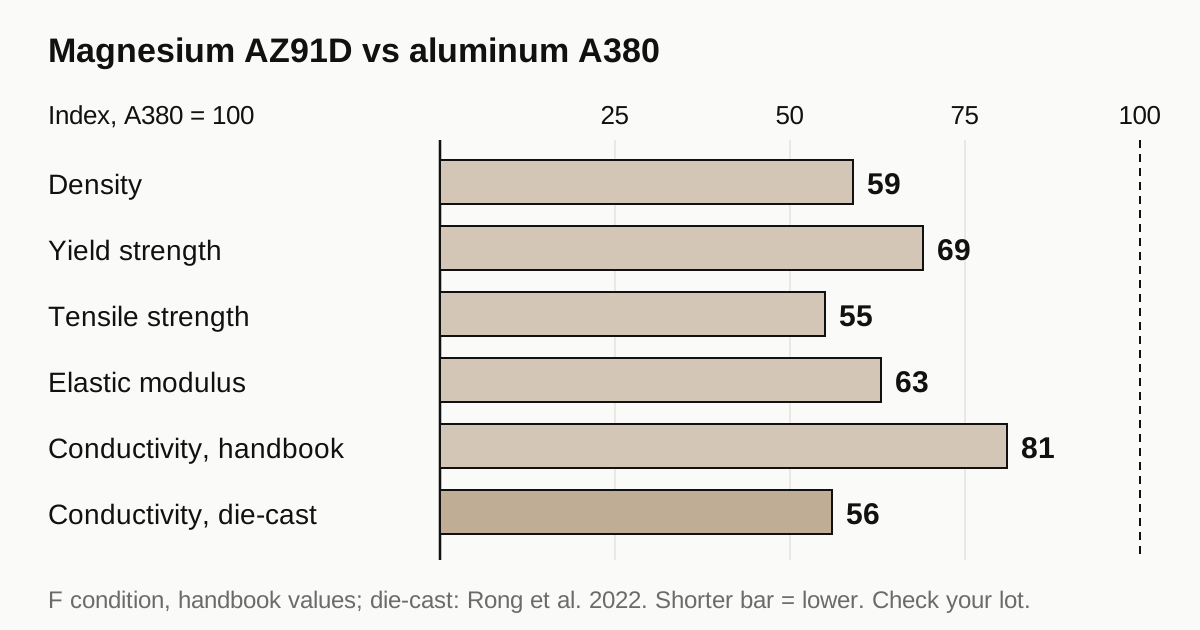
The numbers side by side
MakeItFrom lists both alloys in the as-fabricated (F) condition, which is a fair basis for a die casting before heat treatment:
| Property | AZ91D (magnesium) | A380.0 (aluminum) |
|---|---|---|
| Density | 1.7 g/cm3 | 2.9 g/cm3 |
| Yield strength | 110 MPa | 160 MPa |
| Tensile strength | 160 MPa | 290 MPa |
| Elastic modulus | 46 GPa | 73 GPa |
| Thermal conductivity | 78 W/m-K | 96 W/m-K |
| Max mechanical service temperature | 130 C | not listed on the page |
The A380 density of 2.9 g/cm3 on that page is higher than the 2.7 to 2.8 quoted for aluminum elsewhere, and Wikipedia gives magnesium at 1.737 g/cm3 and as about two-thirds as dense as aluminium. Taking the extremes, magnesium is 36 to 41 percent lighter by volume. The exact figure depends on the casting alloy, so the saving on a real housing is best shown by weighing parts, not by a table.
Strength per weight is slightly better in magnesium on these figures, 110 divided by 1.7 is 65 MPa per g/cm3 against 160 divided by 2.9 for 55. Stiffness per weight is almost equal: 46 divided by 1.7 is 27 and 73 divided by 2.9 is 25. Wikipedia makes the same point, saying magnesium alloys have a higher specific modulus. That has a consequence for a housing wall. A flat wall’s bending stiffness scales with the modulus times the thickness cubed, so a magnesium wall that matches the aluminum one needs to be (73 divided by 46) to the power one third, about 1.17 times as thick. With the lower density the mass ratio comes out near 0.68, a saving of about 32 percent and not 41. This is a derived figure for a flat panel, and a ribbed housing behaves differently, but it shows why the saving is smaller than the density difference.
AZ91 is the common magnesium die casting alloy. Wikipedia gives its composition as about 90.8 percent magnesium, 8.25 percent aluminium and 0.63 percent zinc. Die castings are specified under ASTM B94 for magnesium and ASTM B85 for aluminum, both listed on the MakeItFrom pages.
Heat: where magnesium loses
A motor housing is also a heat path. The stator sits in it, and the winding heat leaves through the housing wall to the air or the coolant. MakeItFrom’s 78 W/m-K for AZ91D is already 19 percent below its 96 W/m-K for A380. A 2022 paper on high pressure die-cast magnesium alloys measured die-cast AZ91D at 53.7 W/m-K, which is 44 percent below that A380 figure. So a die-cast part can conduct worse than the handbook says. Magnesium alloys with better conductivity exist: the same paper reports 94.4 W/m-K for an experimental alloy, but it is a research alloy and not a casting house standard.
Two more items matter. MakeItFrom gives a maximum mechanical service temperature of 130 C for AZ91D and a thermal expansion of 27 µm/m-K. Wikipedia says magnesium alloys generally have poor creep properties, with shorter creep life than aluminium alloys. A bolted housing under preload at motor temperature is the case to ask about. For the aluminum side of the heat story, see the thermal conductivity guide.
Corrosion: air, water and metal contact
Wikipedia’s page on magnesium alloys says they resist corrosion in air under standard conditions and corrode more slowly than mild steel in the same atmosphere. It says immersion in salt water is problematic, and that resistance improves when nickel and copper impurities are reduced or when coatings are applied. So an indoor dry motor can run bare, and a washdown or marine one needs a coating plan.
The contact between metals is the bigger risk. The anodic index on the galvanic corrosion page gives magnesium alloys at minus 1.75 V, cast aluminum at minus 0.90 to minus 0.95 V and 18 percent chromium stainless at minus 0.50 V. The gap between magnesium and stainless is 1.25 V, and the gap to cast aluminum is 0.80 to 0.85 V. The page’s guideline is 0.50 V as the most that controlled temperature and humidity tolerate, and 0.15 V for harsh outdoor or salt environments. Magnesium fails both guidelines against stainless.
The usual remedies from the same page are to exclude the electrolyte with paint or sealant, to isolate the metals electrically and to coat the nobler metal. Heli-Coil’s catalog asks for protection of a magnesium parent even in normal service when a stainless insert is fitted, and says that for HAE finishes on magnesium the tapped holes should be plugged first. The thread inserts guide covers how that plays out on a drawing, and the coating guide covers finishes for the aluminum case.
Need a quote for this part? Get a quote for your motor part
Machining safety: the real gate
The decision on magnesium is as much about the shop as the metal. DGUV Information 209-090, the German statutory accident insurance guidance of June 2020, sets out the hazards and the controls. Key points:
- Chips and dust. Particles with a mean diameter above 500 µm count as chips and are not considered explosive when whirled up. Below 500 µm they count as dust and are considered explosive when whirled. Grinding makes dust.
- Water-miscible fluids are a hazard. They are alkaline, often around pH 9, react with magnesium and form hydrogen, and chips wetted with them tend to self-ignite.
- Neat oils carry a fire risk too. A high temperature at the cut can start an oil fire, especially when too little oil is supplied, and strong oil mist can flash over. The guidance describes minimum quantity lubrication at an average of no more than 50 ml of lubricant per process hour and tool.
- Cleaning is part of the process. Machining centres must be thoroughly cleaned of other materials, especially ferrous ones, before magnesium is cut. Alternating magnesium and ferrous work is not allowed without prior thorough cleaning. Working areas are cleaned at least every working day, and blowing chips off with compressed air is generally not permitted.
- Storage. Chips and residues go in non-combustible containers with lids, away from other combustible material.
- Fire response. Do not use water. Suitable extinguishing agents are needed, and the guidance names fire class D agents in the casting context.
- No machine standard. The document says no specific standard applies to machines intended for machining magnesium, so the shop and its insurer set the controls. It covers alloys with more than 80 percent magnesium by weight.
Wikipedia adds three points: magnesium is hard to ignite in bulk, ribbon autoignites at about 473 C and water is not a suitable extinguishant because it forms hydrogen. Taken together, a shop that machines magnesium needs a defined fluid process (dry, oil or minimum quantity lubrication), a cleaning routine and a fire plan. Many shops that run aluminum all day have none of those, so the pool of quoting shops is smaller. The drone and robot housing guide notes the same: magnesium raises cost and machining difficulty a lot.
Which alloy for which housing
| Situation | Lean toward | Reason |
|---|---|---|
| Small, dry, weight-critical housing with low heat | Magnesium, with a coating plan | Density and specific stiffness |
| Housing that carries the main heat path | Aluminum | Conductivity |
| Washdown, salt air or condensation | Aluminum or a coated and isolated magnesium design | Corrosion and galvanic risk |
| Many steel or stainless fasteners and inserts | Aluminum, unless isolation is designed in | Galvanic gap of 1.25 V against stainless |
| Cast housing with porosity risk | Either, with a sealing plan | See the porosity guide |
This is a first filter, not a design rule. No public price survey compares machined magnesium and aluminum housings, so compare quotes on the same drawing and ask each shop to state its magnesium controls in the quote.
What to put on the RFQ
- Alloy and specification (for example AZ91D to ASTM B94) and the casting process.
- Finish and coating, with masked areas and the sequence relative to machining.
- Fastener and insert materials, and isolation requirements.
- Heat and temperature range in service, so the shop sees why bare metal fits matter.
- A request that the shop describes its chip handling, coolant and fire controls for magnesium.
- Drawing, volume and whether the parts are prototypes.
When the drawing is ready, send the RFQ and we quote the finished parts and place the work with a partner shop that machines motor housings, with a reply within 24 business hours. The partner shop page explains what is checked and what is not.
Standards and references
- MakeItFrom, AZ91D-F magnesium. Density, strength, modulus, thermal conductivity, expansion and the 130 C maximum mechanical service temperature, as-fabricated condition. Reference site.
- MakeItFrom, A380.0 cast aluminum. Density, yield, tensile strength, modulus and thermal conductivity of the usual die cast aluminum alloy, as-fabricated condition. Reference site.
- Rong et al., High thermal conductivity and high strength magnesium alloy for high pressure die casting ultrathin-walled components, 2022. Measured thermal conductivity of die-cast AZ91D, 53.7 W/m-K, in the abstract. International Journal of Minerals, Metallurgy and Materials.
- Magnesium alloy, overview. Density against aluminium, specific modulus, creep, corrosion in air and in salt water and the AZ91 die casting composition.
- Magnesium, overview. Density, ignition behaviour of ribbon and chips and why water is not an extinguishing agent.
- Galvanic corrosion, anodic index and mitigation. Anodic index of magnesium, aluminum and stainless steel, and the ways to isolate a couple.
- DGUV Information 209-090, Activities relating to magnesium (June 2020). German statutory accident insurance guidance on chips, dust, cutting fluids, cleaning, storage and fire protection when machining magnesium.
- Heli-Coil, Insert Systems catalog (corrosion protection table). Protection steps for stainless inserts in magnesium and aluminum parents. Maker document.
Figures on this page are typical ranges drawn from the standards above and from ordinary shop practice. They are not a specification for your part. The partner shop that prices your part confirms what it can hold on your geometry.
Frequently asked questions
How much lighter is a magnesium motor housing than an aluminum one?
By volume about 35 to 40 percent, since magnesium is roughly 1.7 to 1.8 g/cm3 against 2.7 to 2.9 for die cast aluminum. A wall that must match the stiffness of the aluminum one has to be thicker, because magnesium has a lower modulus. For a flat wall of equal bending stiffness the saving works out near 30 percent.
Does magnesium cool a motor as well as aluminum?
No. MakeItFrom lists 78 W/m-K for AZ91D and 96 W/m-K for A380 in the as-fabricated condition. A 2022 paper measured die-cast AZ91D at 53.7 W/m-K, so the real part can be lower than the handbook figure. Check the winding temperature before swapping the alloy.
Can any shop machine magnesium?
Not safely without controls. DGUV Information 209-090 describes fire and explosion hazards from chips and dust, a ban on mixing magnesium and ferrous machining without full cleaning, and cutting fluids that can form hydrogen. It notes no specific machine standard exists. Ask a shop how it handles chips, coolant and fire before quoting.
Will steel or stainless fasteners corrode a magnesium housing?
They can in a wet environment. The anodic index puts magnesium at minus 1.75 V and 18 percent chromium stainless at minus 0.50 V. The remedy is to exclude water, isolate the metals and coat the nobler one. Heli-Coil asks for protection of magnesium parents even in normal service.
Need a quote for this part?
Send the drawing. We quote the finished parts, place the work with a partner shop and reply within 24 business hours.
Get a quote for your motor part