Guides / Buyer Guide
VDA 19.1 Technical Cleanliness for EV Motor Housings: What the Drawing and the Shop Must Agree
Written by the team that reads your RFQPublished How we write these
VDA 19.1 and ISO 16232:2018 describe how to measure the particles left on a component. They do not tell you which limit your EV motor housing must meet. The limit lives on your drawing or in your customer specification. A machine shop needs five things from you before it can quote cleanliness work: the standard and its edition, the extraction method, the surfaces to test, the particle size classes and the limit for each. Without them a quote covers a wash step and nothing that can be verified.
What the documents cover
| Document | Focus | Question it answers |
|---|---|---|
| VDA 19.1 | Checking sampled components in the lab | How many particles are on the part, of what type and size? |
| VDA 19.2 | Clean production, clean assembly and environment | How do you keep particles from entering or forming? |
| ISO 16232:2018 | International standard for the same task | How do you apply and document the method across the supply chain? |
ISO 16232:2018 covers cleanliness inspection at initial evaluation, at incoming and outgoing inspection and during quality control of cleanliness-relevant processes. It excludes filmy contamination such as grease and oil and methods that cannot be quantified, such as visual checks or wipe tests. It states that it defines no cleanliness limit values for specific components and gives guidance for deriving them in an annex.
A trade overview describes VDA 19.2 as classifying clean zones from SaS0 to SaS3 and setting preventive measures by stage. Treat that as directional and confirm against the document your customer cites.
The VDA 19.1 text has been revised. Trade articles describe a third edition, called the Yellow Volume 2025, with these points: process-oriented monitoring now sits next to limit value testing, particle size classes extend to 3000 micrometers, dry extraction methods are described for parts that cannot take liquid, total fiber length is a new analysis criterion and blank values, rinsing procedures and recovery of test particles are mandatory in qualification studies. The sources give different publication dates for the revision, so ask which edition your customer applies.
Why EV motor housings get a cleanliness line
CleanControlling lists safety-critical requirements in e-mobility, such as high-voltage systems, among the reasons the revision exists. For a motor housing the practical reasoning is as follows. Conductive chips can bridge insulation near the windings. Ferromagnetic particles are drawn to the magnets. Chips in a water jacket can travel to the pump or the cooling plate. These points are engineering reasoning, not quotes from the standards, and the customer specification decides how much each one weighs.
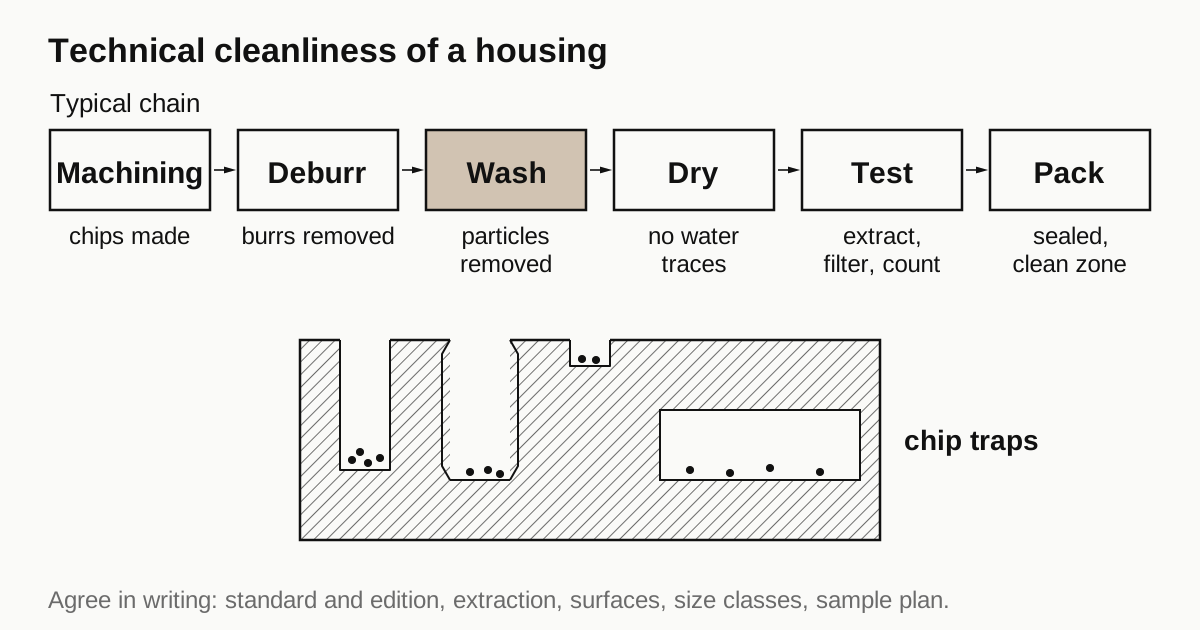
Housings have features that trap chips. Blind and cross holes, thread roots, seal grooves and water jacket channels hold particles that a simple rinse leaves behind. Cast housings add residual sand and core material to the list. The article on casting porosity and impregnation covers another casting issue that affects leaks and cleanliness checks alike.
What the customer specification must state
If the customer does not specify, agree on the method in writing before testing. Different extraction methods give different numbers for the same part. A complete specification names:
| Item | Why it matters |
|---|---|
| Standard and edition | VDA 19.1 and ISO 16232 differ between editions |
| Extraction method | Spraying, rinsing, ultrasound, agitation, air extraction and dry methods give different results |
| Surfaces or volumes tested | Defines what part of the housing counts, for example the stator bore and the cooling jacket |
| Size classes and largest allowed particle | Sets what is counted and what is rejected outright |
| Count limits per class | The limit itself, set by the customer from function and clearance |
| Particle type | Metallic, non-metallic and fibres are often judged differently |
| Test lab and sampling plan | Who tests, how often and on how many parts |
| Blank value and test conditions | Shows the lab and fluid do not add particles |
No public table of typical limits for EV motor housings exists, because limits depend on the design. Do not ask a shop to “meet VDA 19”. Give the number.
Where machining decides the result
The chain on the diagram shows the steps. The shop’s choices at each step decide how clean the part is when it reaches the test.
- Machining. Chip evacuation from blind holes and channels is the first control. Through-tool coolant, tool path and part orientation all matter.
- Deburring. A burr that breaks off later becomes a particle. Ask how burrs on cross holes and thread entries are removed and verified.
- Washing. Spray, ultrasonic or pressure rinse. The wash has to reach the features that trap chips, which a drawing can help by naming them.
- Drying and packing. A part washed clean and then packed in the open collects particles again. Packing in sealed, clean packaging is part of the specification.
Need a quote for this part? Get a quote for your motor part
Limit test or process monitoring
CleanControlling separates two jobs. A limit value test is a standardized VDA-compliant test on a representative object, used mainly for product approval. Process monitoring is a production-accompanying test that should be frequent, fast and suited to trend analysis, and for monitoring non-VDA methods are allowed when they are reproducible and applied consistently. A real-time particle counter, for example, gives a quick signal for a shift but does not verify a specification.
For a buyer this suggests two lines in the quality plan: a periodic limit test at a lab and a routine check at the shop that shows a trend between lab results. Ask the shop which it runs.
What it costs
No public price survey exists for cleanliness testing of motor housings. The cost has three parts: the wash and dry equipment the shop uses, the packaging and the lab tests, which depend on the number of parts, surfaces and size classes. Compare quotes on the same specification. A quote that does not name the method and the limit is not comparable with one that does.
Questions to ask a shop about cleanliness capability
A shop can say it works to VDA 19 and mean very little. These questions separate a controlled process from a claim:
- Which steps are done in house: washing, drying, packing, testing? Which go to a partner?
- Which wash method is used and how are blind holes and channels reached?
- Does the shop run its own extraction and particle count, or send samples to a lab? Is the lab named?
- Can it show a blank value for the test setup, so you know the fluid and the filter do not add particles?
- How are results reported: counts per size class, particle type, largest particle and the surface tested?
- What happens when a sample exceeds the limit? The 2025 revision adds guidance on evaluating exceedances, so the shop should have a defined reaction plan.
A shop that cannot answer the first three can still make a good housing. It cannot yet be asked to deliver a verified cleanliness limit. Say so early and agree who owns the cleaning and testing step, so the cost is visible and not buried in the part price. The page on how partner shops are chosen explains how we look at process capability in general.
Checklist before you send the RFQ
- Standard and edition the customer applies, with the document number.
- Extraction method, surfaces tested and size classes.
- Limits per class and the largest permitted particle, from the customer.
- Particle types treated separately, if any.
- Lab: customer-approved or shop-chosen, and sampling frequency.
- Packing method for shipment.
Housing features also affect the test. The guide on water jacket leak testing covers what happens in the same channels, and EV traction housing machining covers the volumes and tolerances. Send the specification with the drawing in an RFQ. We quote the finished parts and place the work with a partner shop and replies within 24 business hours.
Standards and references
- ISO 16232:2018, Road vehicles, Cleanliness of components and systems (AFNOR catalogue entry). Scope, exclusions and the statement that the standard defines no limit values.
- ticforall, What is VDA 19, VDA 19.1, VDA 19.2 and ISO 16232. Trade overview of what each document covers. Directional, not the standard itself.
- CleanControlling, Monitoring technical cleanliness: what the new VDA 19.1 changes. Process monitoring next to limit value testing. Vendor article, directional.
- CasoCleanCheck, VDA 19.1 Yellow Volume 2025. Size classes to 3000 micrometers, dry extraction and blank values. Vendor article, directional.
- QA Group, VDA 19.1 and ISO 16232. Extraction and analysis methods in the standard framework. Vendor glossary, directional.
Figures on this page are typical ranges drawn from the standards above and from ordinary shop practice. They are not a specification for your part. The partner shop that prices your part confirms what it can hold on your geometry.
Frequently asked questions
Is VDA 19.1 the same as ISO 16232?
They cover the same framework and are developed to be compatible, but the editions differ. Trade sources say the content of the new VDA 19.1 is being carried into ISO 16232. Do not assume equal text. Write the standard and the edition the customer cites into the quote.
What cleanliness limit does an EV motor housing need?
There is no universal value. ISO 16232:2018 states that it defines no limit values for specific components and gives guidance in an annex for deriving them. The limit comes from the customer drawing or specification, set from function, clearances and voltage. Ask for it before you quote.
What is the difference between VDA 19.1 and VDA 19.2?
VDA 19.1 is the lab method for checking particles on sampled parts. VDA 19.2 covers clean production, clean assembly and the environment, including clean zone classes SaS0 to SaS3. One tells you how to measure the part, the other how to keep it clean in the plant.
Does a machined housing need a cleanroom?
It depends on the customer specification. VDA 19.2 classifies clean zones by level, and the level follows the cleanliness requirement of the part. Many housings are washed, dried and packed in a controlled area rather than machined in a cleanroom. Ask the shop where each step happens.
Need a quote for this part?
Send the drawing. We quote the finished parts, place the work with a partner shop and reply within 24 business hours.
Get a quote for your motor part