Guides / Buyer Guide
Casting Porosity in Motor Housings: When Impregnation Saves the Part and When It Does Not
Written by the team that reads your RFQPublished How we write these
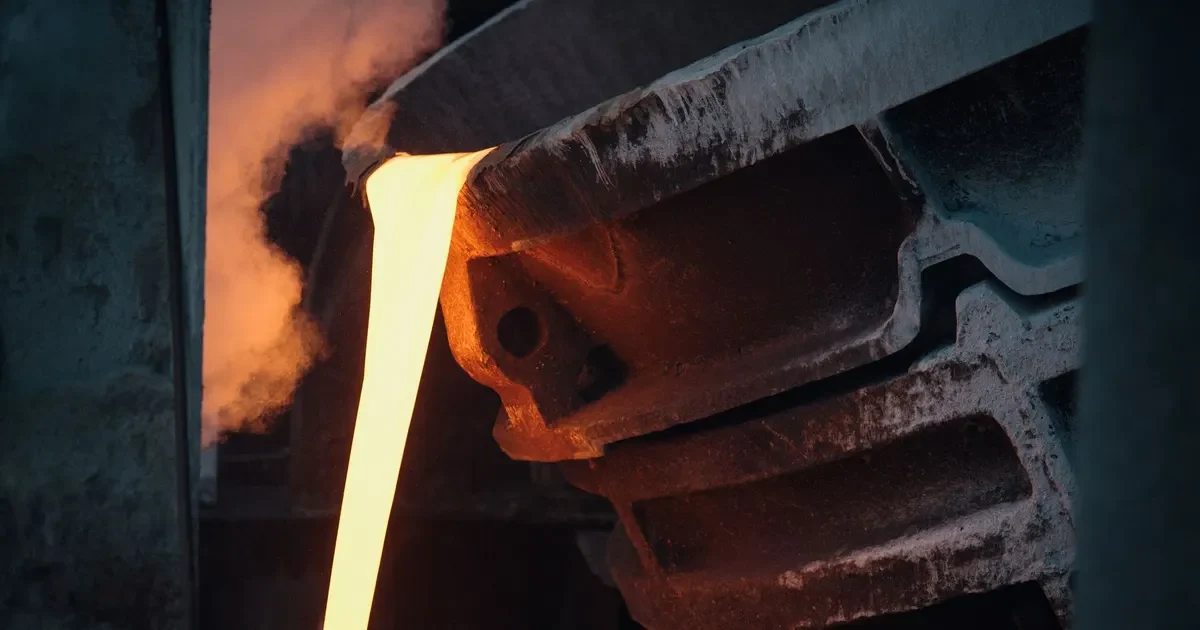
A casting looks solid on the outside and can hold small voids inside. Most of the time they cause no harm. In a motor housing that carries coolant or has a sealing face, the same voids can open to the surface during machining and create a leak path. That is why porosity is one of the common reasons a cast housing gets rejected after most of the money has been spent on it.
This guide explains what porosity is, where it matters, what impregnation can and cannot do and how to write reject limits so the shop and the foundry know what to aim for.
Two kinds of porosity
Cast aluminum has two main void types, and they come from different causes.
Gas porosity forms from air trapped in the metal as it fills the die, or from hydrogen that dissolves in the molten aluminum and comes out as it cools. The voids are usually round and smooth walled, and they show up scattered through the casting.
Shrinkage porosity forms because metal contracts as it solidifies. In thick sections, the last metal to freeze pulls away from the surrounding wall and leaves irregular, jagged voids. They concentrate in the heavy parts of a casting, such as bosses and junctions.
The difference matters because the remedies differ. Gas porosity is reduced by venting, vacuum assist and clean metal. Shrinkage porosity is reduced by die design, cooling control and feeding metal into the thick section.
Why machining makes it worse
A die cast skin is dense and tight, and it seals what lies beneath. Machining removes some of that skin. If a pore sits a fraction of a millimeter under the surface, a cutter can open it. Where a pore is close to a bore, a groove or a thread, the cut turns a hidden void into a surface hole.
That hole matters only if it breaks into a fluid path. A pore on the outside wall of a fin is cosmetic. A pore that connects the water jacket to a seal groove is a leak. The designer decides which surfaces are critical, and the drawing has to show it, since the shop cannot know.
The guide to water jacket leak testing explains how the test finds these paths once the part is machined.
What impregnation does
Vacuum impregnation seals small interconnected voids. The process is straightforward.
- The housing is cleaned and dried.
- It goes into a chamber, and a vacuum pulls air out of the pores.
- Sealant floods the chamber and a pressure phase pushes the sealant into the voids.
- The excess is washed off the surface.
- The sealant in the pores is cured, either by heat or in a hot water bath depending on the type.
After curing the pores are filled with a solid resin or silicate, which seals them against liquid and air at the pressures the part sees in service.
What impregnation does well. It seals fine, connected porosity of the kind that causes weep leaks at coolant pressure.
What impregnation does not do. It does not fix a large void, because the sealant has to stay in place and a big cavity either drains or leaves a weak plug. It does not repair a cold shut or a crack. It does not restore strength lost to porosity, only the seal.
Where impregnation fits in the route
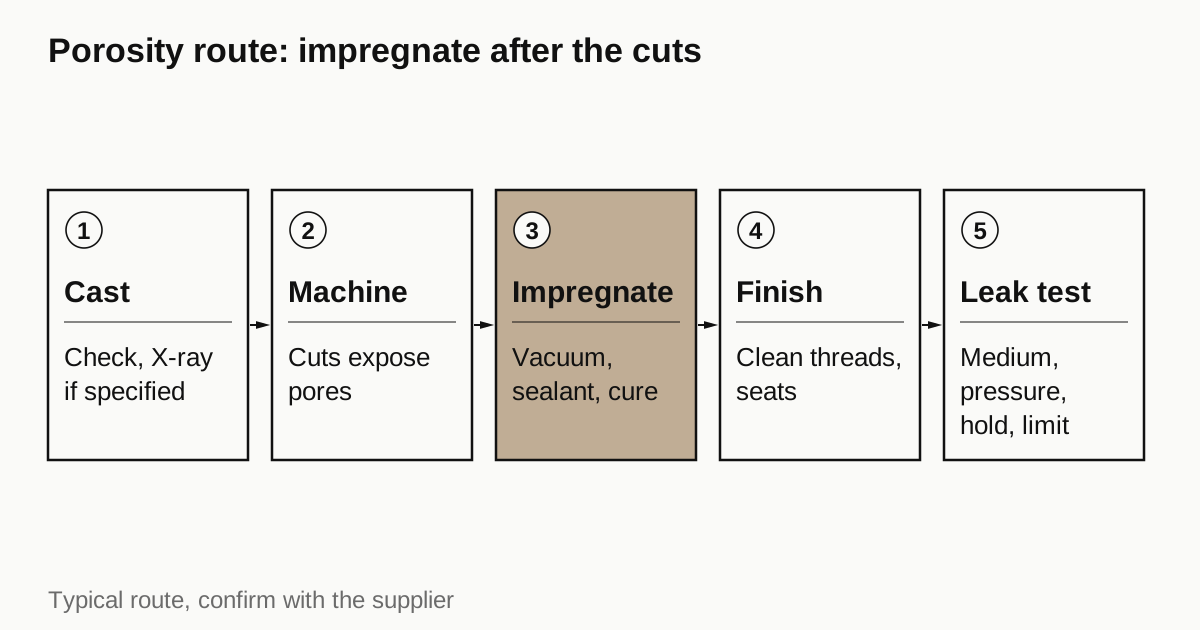
The order is machine, then impregnate, then finish the details, then test.
- Machine first. Impregnation before machining is wasted, because the cut exposes new pores.
- Protect the threads. Sealant in a tapped hole is an assembly problem. Shops plug threads or clean them after the process.
- Check the bearing seat after. Some processes leave a thin film that has to be removed from a seat or a sealing face before fit and assembly.
- Leak test last. The test confirms the part holds, and it is the only evidence that impregnation worked.
If your drawing allows impregnation, say so, and name the specification the shop follows. Many drawings cite MIL-STD-276 or a sealant maker’s procedure. If your drawing forbids it, say that too, because a shop that knows impregnation is not an option will reject marginal castings earlier and cheaper.
A table of defect, cause and handling
| Defect | Typical cause | Where it matters | Handling |
|---|---|---|---|
| Fine gas porosity | Trapped air or dissolved hydrogen | Pressure boundaries, seal faces | Impregnate after machining |
| Shrinkage voids | Thick section freezes last | Bosses, junctions | Casting design fix; impregnate small ones |
| Large void exposed by cutting | Heavy section, poor feeding | Anywhere critical | Reject, not repairable by sealant |
| Cold shut | Metal fronts meet without fusing | Thin walls | Reject |
| Surface pits | Die or lubricant issue | Cosmetic faces | Accept per drawing or fill |
Writing reject limits
A good limit says where, how big and how many.
- Define zones. Zone A is the sealing and pressure boundary, with the strictest limit. Zone B is structural and gets a looser one. Zone C is cosmetic.
- Give a size limit for visible pores. For example a maximum diameter and a minimum spacing, stated in the drawing in millimeters.
- Refer to a radiographic reference such as ASTM E505 if X-ray inspection is part of the order, and name the acceptable severity level in each zone.
- State whether impregnation is allowed and whether the part is retested afterwards.
- Say who inspects, the foundry, the machine shop or the buyer, and at which stage.
The limit has to match what the foundry can deliver. A zone A limit that no foundry can meet at the target piece price either fails the order or inflates the price, so it is worth asking the foundry before releasing the drawing.
Need a quote for this part? Get a quote for your motor part
How foundries reduce porosity at the source
Machining and impregnation are the late fixes. The cheaper fix is a casting with less porosity to begin with, and the foundry controls most of that.
- Vacuum assisted die casting draws air out of the die cavity before and during filling, which cuts trapped gas.
- Degassing the melt removes dissolved hydrogen before the metal goes into the shot sleeve.
- Gating and venting design decides how the metal fills the die. A well vented die sends air out through overflows instead of into the part.
- Local squeeze or cooling in thick sections feeds the last metal to freeze and reduces shrinkage voids at bosses.
- Die temperature control keeps the freezing pattern steady from shot to shot.
Not every foundry offers every option, and each one adds cost per casting. Buyers who need a pressure tight housing do better to ask the foundry what it does about gas and shrinkage than to hope that machining will find a way around it.
Other casting routes
Die casting is the usual route for volume. Other routes behave differently.
Gravity or low pressure permanent mold casting fills the mold slowly and tends to give lower gas porosity than high pressure die casting. Tooling is cheaper than a die cast tool and the cycle is slower, so it suits mid volume jobs. Porosity is still possible, mainly shrinkage in thick sections.
Sand casting needs the cheapest tooling and gives the roughest surface. Porosity depends on the pattern and the gating, and heavy machining allowances are normal. It suits prototypes and low volume.
Squeeze and semi solid casting apply pressure while the metal freezes and produce dense parts at higher tooling and process cost.
A buyer comparing a cast route with a machined from solid route is also comparing porosity risk against material waste. The guide on prototype housings before die cast tooling covers how the two routes relate in time and money.
Questions to ask the foundry and the shop
- What porosity level do your castings normally show in zone A, and how do you measure it?
- Do you use vacuum assist or another gas control, and is it included in the price?
- Who impregnates, and to which specification? Is it in house?
- What incoming check does the machine shop run on a new casting lot?
- What is the plan for a lot that fails the check?
A shop that has dealt with porosity before answers these quickly. If the answer is that porosity does not happen, treat it as a warning sign rather than a boast.
The cost of rejects
A casting rejected before machining costs the casting. A casting rejected after machining costs the casting and the machining. A casting rejected after impregnation and test costs all of that plus the sealing step. The later the defect shows up, the higher the cost.
That is why buyers who machine cast housings often add an incoming check on the raw casting, such as visual inspection and sampling by X-ray on a few pieces per lot. The check does not find every pore, but it catches bad lots before they absorb machine time. How much checking pays for itself depends on past scrap rates and the part price. The cost guide shows how blank choice and batch size move the price.
Checklist before you send the RFQ
- Mark the zones: pressure boundary, structural, cosmetic.
- State the porosity limit in each zone and the inspection method.
- Say whether impregnation is allowed and under which specification.
- State the leak test the finished part has to pass.
- Agree who bears the cost of castings rejected after machining.
When the drawing is ready, send the RFQ and we quote the finished parts and place the work with a partner shop that machines cast motor housings. Replies come within 24 business hours.
See also: X-ray and porosity acceptance for die cast housings for how to write limits by zone.
See also: approving a foundry or die caster for the audit points that prevent porosity rejects.
Standards and references
- Porosity, overview of voids in cast and solid materials. Background on pore types and where they come from.
- Die casting, overview of the process and its typical defects. Why gas and shrinkage voids form in cast housings.
- MIL-STD-276, Impregnation of porous metal castings and powder metallurgy products. The long standing US specification for impregnation, still named on many drawings.
- ASTM E505, Reference Radiographs for Inspection of Aluminum and Magnesium Die Castings. A shared way to describe porosity severity in X-ray images.
Figures on this page are typical ranges drawn from the standards above and from ordinary shop practice. They are not a specification for your part. The partner shop that prices your part confirms what it can hold on your geometry.
Frequently asked questions
Is some porosity normal in a die cast motor housing?
Yes. Almost every casting has some porosity. The question is whether it is small, scattered and away from sealing faces, or large, connected and on a pressure boundary. The drawing should say which areas have strict limits and which are allowed a looser standard.
Should impregnation happen before or after machining?
After the machining that can open pores, because machining exposes porosity that was hidden inside the wall. Impregnating a raw casting seals the surface, then machining cuts through it and exposes new pores. Shops normally machine, impregnate, clean the threads and then leak test.
Who pays for rejected castings?
It depends on the order terms and where the defect was caused. Porosity found after machining is a casting defect in most cases, but the shop has already spent machining time on the part. Agree before the order whether the buyer, the foundry or the machine shop absorbs that cost.
Need a quote for this part?
Send the drawing. We quote the finished parts, place the work with a partner shop and reply within 24 business hours.
Get a quote for your motor part