Guides / Tolerances
Pump and Compressor Motor End Bells: Sealing Faces, Bearing Fits and Machining
Written by the team that reads your RFQPublished How we write these
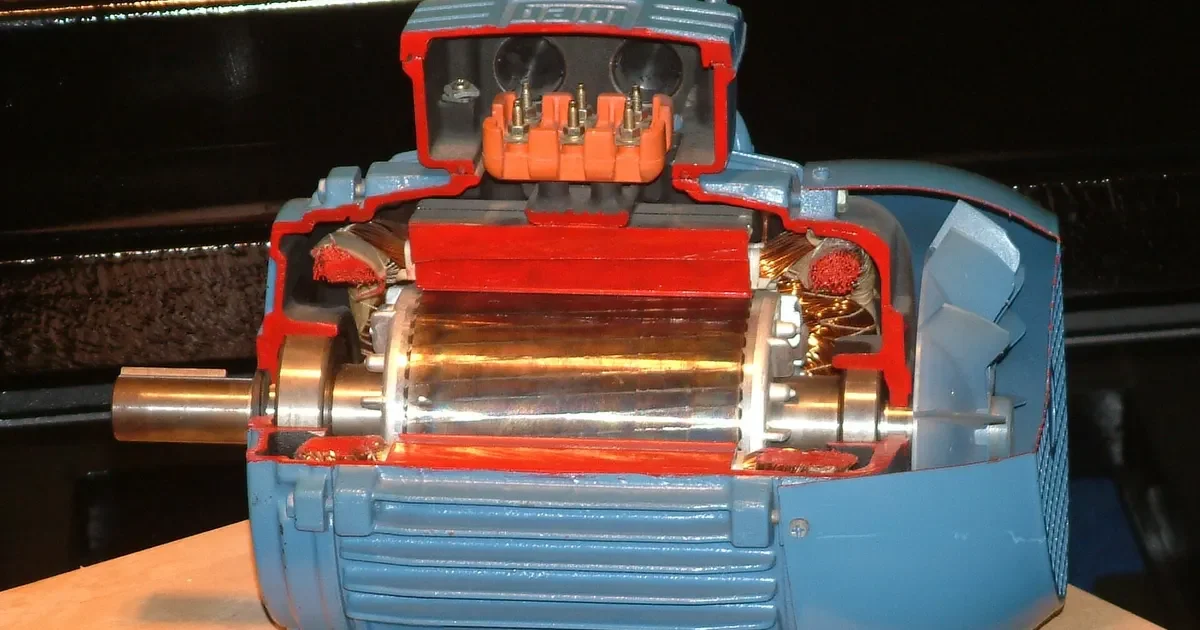
Every motor has two end bells. On a plain fan motor they are simple covers. On a pump or compressor motor they do more. The drive end bell holds the main bearing, locates the motor against the pump or compressor, resists shaft loads and keeps liquid or refrigerant from reaching the windings. The machining is not complex, but it asks for the right tolerance on the right features.
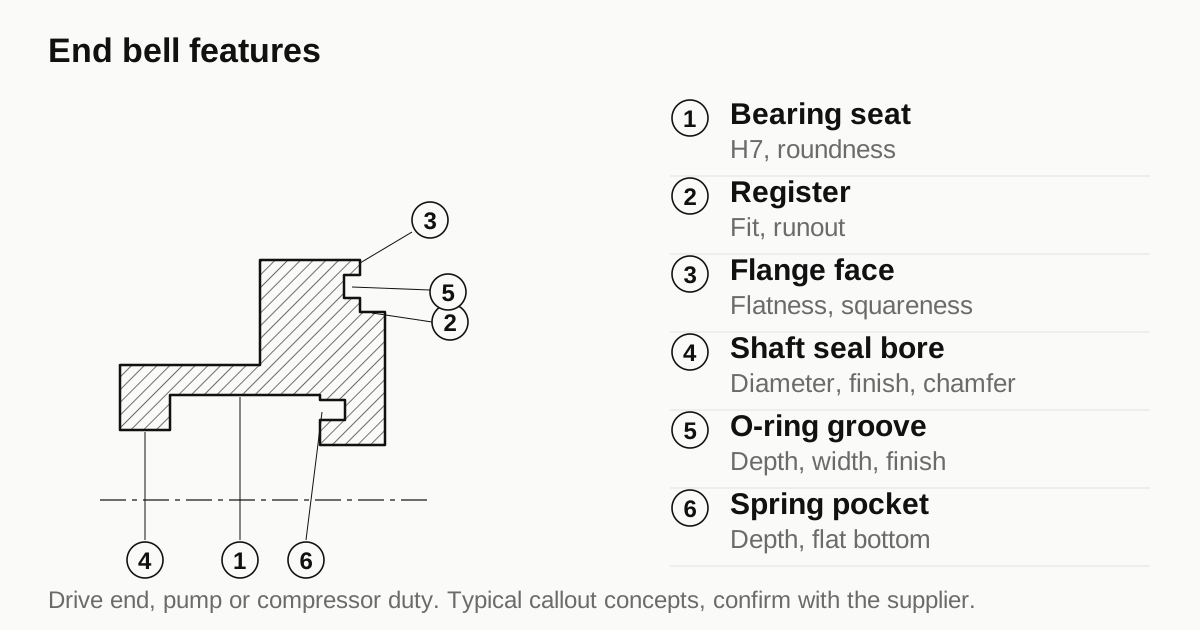
This guide covers the features of an end bell, the fits and seals that matter in pump and compressor service and the details a shop needs for an accurate quote.
What an end bell does
- Holds a bearing in a central seat, and in some designs a preload spring.
- Centers itself in the frame through a register, which is a short cylinder that fits in the frame bore.
- Mounts the motor. A flange face and bolt holes connect the drive end to a pump or a gearbox.
- Seals the interior. Seals sit at the shaft, at the register and at the flange face.
- Carries load. A pump motor takes radial and axial loads from the impeller or the coupling.
- Provides drain and ventilation paths, where the design needs them.
Drive end and non drive end
The two end bells are different.
Drive end. Carries the main bearing, which is usually fixed axially, and the shaft seal. It has the mounting flange. It sees the highest loads and has the tightest requirements.
Non drive end. Carries a floating bearing that lets the shaft grow thermally, often with a wave spring pocket to apply a light preload. It may carry a fan cover, a brake or an encoder.
Key features and what controls them
| Feature | Role | Typical callout concept |
|---|---|---|
| Bearing seat bore | Holds the outer ring | H7 class with roundness; check the bearing seat fit reference |
| Register or spigot | Centers the end bell in the frame | Fit such as H7 on the frame with a close fit on the bell; runout to the bearing seat |
| Flange face | Seats against the pump or gearbox | Flatness and perpendicularity to the bearing axis |
| Shaft seal bore | Holds a lip seal | Diameter with finish and entry chamfer |
| O-ring groove | Seals the register or the face | Depth and width with tolerance, finish on the sides |
| Spring pocket | Holds the preload spring | Depth and diameter, flat bottom |
| Drain and vent holes | Let condensate out | Position and size |
All of these cut in one or two setups on a lathe or a machining center. The aim is that the bearing seat, the register and the flange face share an axis, so the rotor ends up on the same line at both ends.
Bearing fits
A standard deep groove ball bearing such as a 6205, with a 52 mm outside diameter, sits in a bore that is a close sliding fit on the outer ring. For a stationary outer ring and a rotating inner ring, the housing bore is usually in the H7 class. The shaft side takes the interference fit. The bearing fit and runout guide explains why.
Two details matter on end bells.
- Bore roundness. A thin walled end bell can go oval when clamped. A bearing outer ring squeezed into an oval seat loses internal clearance in some positions. Measure the bore free.
- Axial position. The depth of the seat sets the bearing position. A tolerance on seat depth, together with the shoulder width, sets the bearing’s axial location and the preload.
Registers and flanges
IEC 60072-1 standardizes flange mounted motors and gives the spigot diameter, bolt circle and flange thickness for each size. The common types for pump motors are B5, where the flange has clearance holes, and B14, where it has tapped holes on a smaller flange. A pump motor drawing should state the flange type and size.
The register centers the motor on the pump. If the register is off axis or the flange face is out of square, the shaft meets the pump shaft at an angle. A coupling absorbs a little, and a close coupled pump absorbs none. The result is vibration, seal wear and bearing heat.
Seals in pump service
A pump motor faces water, steam, cleaning fluid or oil at the drive end. The end bell carries several barriers.
- Lip seal on the shaft. Seated in a bore with a stated diameter and finish. The shaft surface under the lip needs its own finish and lead restriction.
- Slinger or flinger. A disc on the shaft that throws liquid away before it reaches the seal. It needs a clearance groove in the end bell.
- Drain hole. A small hole at the lowest point that lets condensate escape. The hole must be at the right position for the mounting orientation.
- O-ring at the register. Seals the joint between the end bell and the frame. The groove depth sets squeeze, and a groove cut a few hundredths too deep leaks.
Ingress protection ratings such as IP55 or IP65 are tested on the finished motor. The end bell supplies the sealing surfaces, and the rating depends on all of them together.
Machining sequence and setups
An end bell is a revolved part with a flange and a few holes, so it suits a lathe followed by a drilling and milling step, or a single pass on a turn mill center.
- First setup. Hold the casting or the bar on a stable surface. Face the flange, turn the register and rough the bearing seat.
- Second setup. Flip the part, holding it on the finished register or on soft jaws bored to it. Face the inside, bore the bearing seat and cut the seal and spring grooves.
- Drilling and tapping. Bolt holes on the flange, tapped holes for the bearing retainer or the cover, drain holes.
- Deburr and wash. Edges of bores and holes carry burrs that a bearing or a seal can pick up.
- Inspection. Bearing bore, register, face and groove dimensions.
The weak point is the flip. A bearing seat cut in the second setup has to be coaxial with a register cut in the first. The shop controls this by holding the part on the register for the second setup, with a clamp that does not distort the bell. Ask how the part is located after the flip and what the measured coaxiality is on the first parts. The same logic as in the servo housing guide applies.
Shops that use a turn mill center with a sub spindle can transfer the part from one spindle to the other and avoid the flip. The part never loses its reference, and the coaxiality is better. The cost per part may be lower at volume, but the machine rate is higher.
Need a quote for this part? Get a quote for your motor part
Axial float and thermal growth
A motor shaft grows with temperature. If both bearings are fixed axially, the shaft is trapped, and growth loads the bearings. The usual design fixes the drive end bearing and lets the non drive end bearing float. A wave spring behind the floating bearing applies a light preload and takes up the growth.
This asks two things of the end bell.
- The floating bearing seat has a clearance fit that lets the outer ring slide. A seat that is too tight locks the bearing and defeats the design. A seat that is too loose lets the ring turn and wear the bore. The class and the surface finish of the seat decide which.
- The spring pocket has the right depth. Too shallow and the spring is over compressed. Too deep and the preload is lost. The pocket depth carries a tolerance.
When a quote for a non drive end bell seems high for a simple cover, check whether the floating seat has a tight bore tolerance and a finish requirement, since those two are the usual reason.
Failure modes that trace back to the end bell
| Symptom in service | Possible end bell cause |
|---|---|
| Bearing runs hot | Seat oval or undersize, bell misaligned with frame |
| Early bearing failure | Seat too tight, no float at the non drive end |
| Water in the winding area | Groove depth or finish wrong, seal seat damaged, drain blocked |
| Vibration | Register off axis or flange face out of square |
| Oil leak at the shaft | Seal bore out of size or rough, shaft finish wrong |
| Seized motor after cleaning | Water entered through a damaged seal face |
None of these is certain to be an end bell fault, since assembly and the bearing itself also matter. But on a returned motor, the end bell dimensions are among the first things a reliability engineer measures. A shop that records the measured values of its bearing seat, register and groove dimensions on each lot gives you evidence if a field issue appears later.
Compressor motors
Compressor motors, especially in refrigeration, face further demands.
- Refrigerant and oil compatibility. Materials and coatings have to be compatible. Anodize or paint choices may be limited by the refrigerant system maker.
- Leak tightness. Hermetic and semi hermetic designs have strict leak limits, often checked by helium. The end bell faces and grooves are part of the seal.
- Cleanliness. Particles in a refrigerant circuit damage compressors. The end bell must leave the shop clean to a stated level.
- Pressure. Some end bells are pressure retaining parts and carry a pressure rating, with casting quality requirements that follow.
For leak testing methods and casting quality, see the guides on water jacket leak testing and casting porosity.
See also: the reference page on motor end shields and end bells covers the alignment chain and setups for all motor types.
Materials and finish
Cast iron is common for large industrial pump motors, with the advantages described in the iron housing guide. Aluminum suits small and medium motors. Stainless steel serves washdown pumps, as in the stainless housing guide.
Bare cast iron end bells are painted, and the register and bearing seat are masked so the paint does not change the fit.
Checklist before you send the RFQ
- State the flange type and size, with the standard.
- Mark the bearing seat with the bearing number and fit class.
- State the register fit and its runout to the bearing seat.
- Give seal grooves and bores with depth, width, finish and tolerance.
- State drain, vent and spring pocket details and orientation.
- State leak test and cleanliness requirements for compressor parts.
- State material, finish and masking.
When the drawing is ready, send the RFQ and we quote the finished parts and place the work with a partner shop that machines motor end bells. Replies come within 24 business hours.
Standards and references
- Electric motor, overview of motor construction. Background on the stator, rotor, end shields and bearings.
- IEC 60072-1, Dimensions and output series for rotating electrical machines. Defines flange mounting types and spigot dimensions. Check the current edition.
- ISO 286-1, ISO code system for tolerances on linear sizes. Fit classes for bearing seats and registers.
- IP Code, ingress protection ratings. What ingress ratings test, relevant to pump motor end seals.
Figures on this page are typical ranges drawn from the standards above and from ordinary shop practice. They are not a specification for your part. The partner shop that prices your part confirms what it can hold on your geometry.
Frequently asked questions
What is the difference between an end bell and an end shield?
The terms mean the same part. Both name the cover at either end of the motor frame that carries a bearing and closes the housing. Drawings use either, and some call the drive end part a flange or a bracket.
Which end bell features need the tightest tolerances?
The bearing seat, the register that centers the end bell in the frame and the face that seats against the frame or pump. If these three are not coaxial and square, the rotor sits off axis and the bearing runs hot.
How is a pump motor end bell sealed against water?
By a shaft seal at the center, an O-ring or gasket at the register or flange, and sometimes a slinger or a drain. Each seal needs a groove or a seat cut to the seal maker's dimensions and surface finish, and the end bell drawing has to give them.
Need a quote for this part?
Send the drawing. We quote the finished parts, place the work with a partner shop and reply within 24 business hours.
Get a quote for your motor part