Guides / Buyer Guide
Stainless Steel Motor Housings for Washdown and Food Duty: Grades, Finish and Machining
Written by the team that reads your RFQPublished How we write these
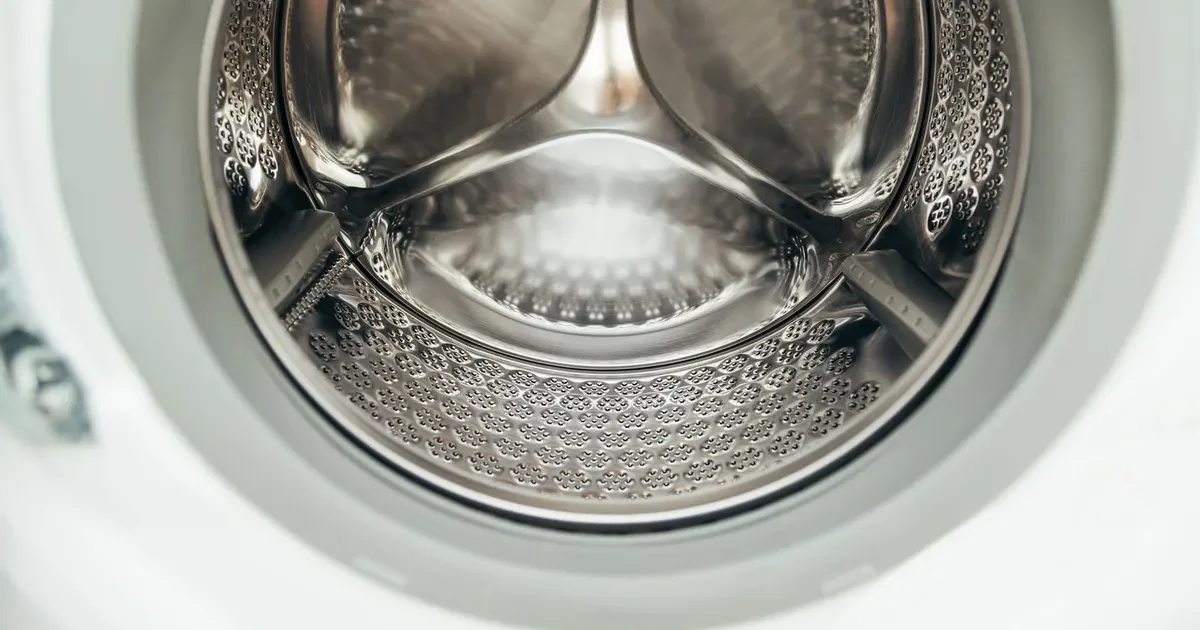
A motor in a dairy, a bottling line or a meat plant gets sprayed with hot water and cleaning chemicals every day. A painted cast iron frame chips, rusts and harbours bacteria in the damage. A stainless housing avoids those failures, which is why washdown and food duty motors are often built in stainless steel, and why their housings are a different machining job from an ordinary aluminum frame.
This guide covers the grades in common use, the shape and finish rules that come from hygienic design, the machining traps and what the drawing should state.
What washdown duty asks of a housing
A washdown motor has to do four things.
- Resist corrosion from water, cleaning agents and food residues.
- Keep water out, usually to an ingress rating such as IP66, with the motor sealed at the shaft, the joints and the conduit entry.
- Be cleanable. The outside must have no pockets, crevices or flat shelves where product and water collect.
- Survive the cleaning cycle. Thermal shock from hot spray on a cool housing, and repeated chemical exposure, must not crack seals or lift coatings.
The housing material is only part of the solution. The shape, the joints and the seals carry equal weight.
Choosing the grade
Three stainless grades cover most requests.
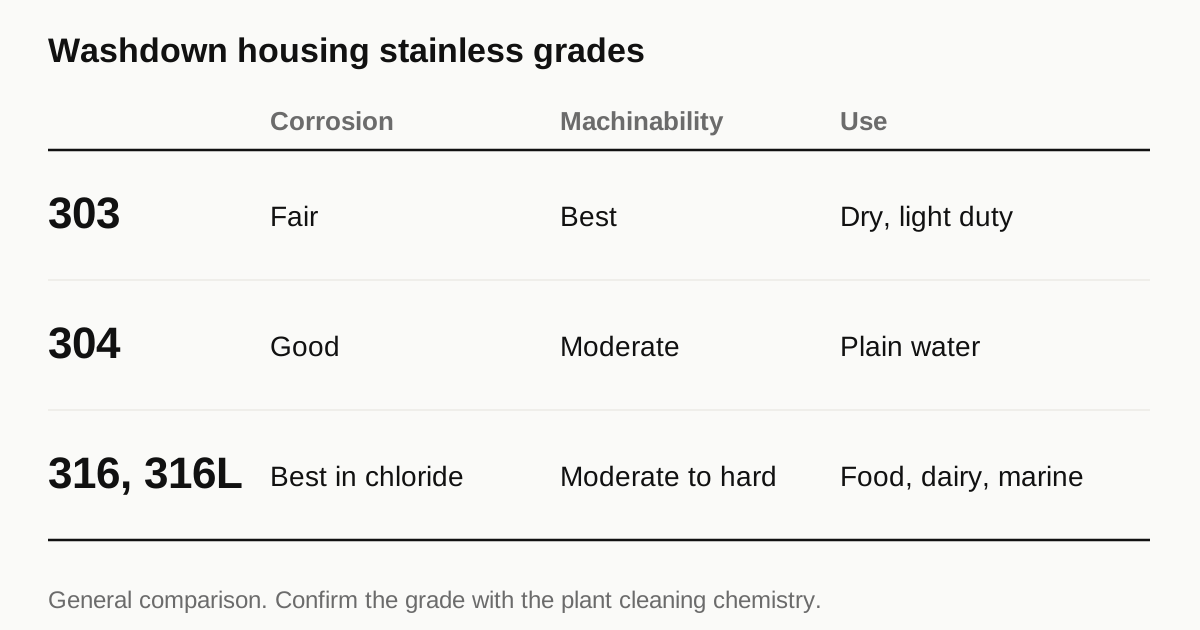
304 (EN 1.4301) is the general purpose austenitic stainless. It resists water and mild chemicals and is the usual choice for dry or lightly wet environments.
316 (EN 1.4401, or 1.4404 for the low carbon 316L) adds molybdenum, which raises resistance to pitting from chlorides. Chlorinated cleaners, brines and sanitizers all bring chlorides, so 316 is the common choice for food duty and marine environments.
303 (EN 1.4305) has added sulfur to make it free machining. It cuts easily, but it resists corrosion less well than 304 and is not welded readily. Where a housing is machined from bar and kept dry, it saves time. For a washdown part, it is rarely the right call.
| Grade | Corrosion resistance | Machinability | Typical housing use |
|---|---|---|---|
| 303 | Fair | Best of the three | Dry or light duty machined parts |
| 304 | Good | Moderate | General washdown, plain water |
| 316 / 316L | Best of the three in chloride | Moderate to difficult | Food, dairy, marine, chlorinated cleaners |
Thermal conductivity of austenitic stainless is low, around 15 W/m.K, a small fraction of aluminum. That matters for motor cooling, so stainless frames either run with lower losses or rely on a different cooling path.
Housing routes
A stainless motor housing can take several forms.
- Machined from bar or tube. Suits smaller sizes and low volume. Material waste is high and so is cycle time.
- Deep drawn or spun shell. Suits volume, with thin walls and good surface. Tooling cost is high.
- Welded from tube and plate. Suits larger frames. The weld must be continuous and ground smooth, with no crevices.
- Cast stainless. Used for complex shapes. Casting porosity can trap cleaning fluid.
The guide on thin-wall housing machining applies to the drawn and tube based forms.
Hygienic design rules that reach the drawing
Hygienic design guidelines such as those from EHEDG push the housing toward a set of shapes.
- Smooth outside. No fins that trap water, or fins shaped to drain.
- Sloped surfaces on top of the housing so water runs off.
- Radiused corners instead of sharp internal corners, which collect residue.
- No exposed threads. Fasteners with domed heads or hidden fastening.
- Continuous welds and no lap joints that hold liquid.
- Seals in accessible positions where a spray can reach and a person can inspect.
- Surface finish controlled to a stated roughness, often in the range of Ra 0.8 micrometers or finer on outside surfaces that need to be cleaned.
The right numbers for finish and shape come from the plant’s hygiene standard. A buyer should ask the end user which guideline applies before the drawing is finalized.
Machining stainless steel
Stainless is not hard to cut because it is hard. It is hard to cut because of how it behaves.
Work hardening. Austenitic stainless hardens at the surface when it is cut or rubbed. A tool that dwells or a pass that is too light rubs the surface and hardens it, and the next cut meets a harder skin. The fix is a sharp tool, a steady feed and a depth of cut that gets under the hardened layer.
Poor heat conduction. Heat stays in the chip and the tool edge. Tool life drops as speed rises, so speeds are lower than for aluminum or carbon steel, and coolant is applied generously.
Stringy chips. Chips do not break readily. Chip breakers on the insert and good chip evacuation prevent tangles that mark the surface.
Springback. Stainless springs back more than carbon steel, which affects bores and thin walls.
Tool selection. Coated carbide inserts with positive geometry are common. Interrupted cuts on castings are harder on tools than continuous cuts.
All of this raises the machining time against carbon steel and aluminum. A quote for a stainless housing will price above the same shape in aluminum, and the difference is normal.
Finishing steps
After machining, stainless surfaces need attention.
- Cleaning. Remove cutting fluid and chips.
- Passivation. An acid treatment removes free iron from the surface and restores the protective oxide. ASTM A967 describes the options, and the drawing should name the standard.
- Electropolishing or bead blasting, if a smooth or uniform surface is required. Electropolish improves cleanability and corrosion resistance but adds cost.
- Marking. Laser marking and etching change the surface locally and should be tested for corrosion on a sample.
Need a quote for this part? Get a quote for your motor part
Sealing and what it asks of the machined surfaces
An ingress rating is earned at the joints, and the joints are machined features.
- End cover spigots and O-ring grooves. A groove cut with chatter marks or a burr at the edge leaks. Groove depth and width have to meet the seal maker’s table, and the face finish matters as much as the dimensions.
- Shaft seal bores. The bore for a shaft seal needs a controlled diameter and finish, and the shaft itself needs the surface the seal specification demands.
- Conduit and cable entries. Threaded ports need clean threads and a sealing face under the gland. A stripped thread in stainless is hard to repair.
- Drain and breather features, if the design includes them, must not collect water.
IP66 means protection against powerful water jets, and the IP Code leaves IP69K, which tests with high pressure and high temperature spray, to a separate road vehicle standard. If the end user asks for IP69K, say so on the RFQ, because the seal design and the joints change.
None of these features is cheap to rework on stainless, so inspection of the sealing surfaces belongs in the first article check. A shop that machines washdown housings regularly checks groove dimensions and surface finish on the first part, not only the bore.
Welded fabrications and distortion
Larger stainless frames are often welded from tube and plate. Welding adds a second set of problems on top of machining.
- Weld distortion. Heat from welding pulls the frame out of shape, and the bore must be machined after welding, not before.
- Heat tint. Welding leaves a colored oxide band that reduces corrosion resistance. It is removed by pickling or mechanical cleaning, then the area is passivated.
- Sensitization. Standard 304 and 316 can lose corrosion resistance in the heat affected zone, which is why low carbon grades such as 316L are used for welded parts.
- Crevices. A weld that does not fill the joint leaves a crevice where cleaning fluid collects. Washdown designs call for continuous welds ground smooth.
Order of operations matters. A welded frame is stress relieved if the design allows, rough machined, relaxed and then finish machined. Shops that do this regularly know which of the steps their material and size need. If the frame is a weldment, ask the shop how it holds bore position through the process, and whether it welds in house or buys in.
Where stainless is not the answer
Stainless is not the best choice for every wet duty. A few cases favour other options.
- Light duty with occasional splash. A coated aluminum housing may be enough and costs less. The guide to coatings compares the finishes.
- Thermally demanding motors. Aluminum moves heat away much faster, and a stainless frame may force a larger motor for the same output.
- Weight sensitive mobile equipment. Stainless is heavy. Aluminum or composites suit mobile food equipment better.
A buyer who sets stainless by habit may pay a premium for protection the duty does not need, and one who skips it for cost may replace housings every year. Match the grade to the cleaning chemistry and the temperature, and test a sample.
What the drawing should say
- Grade and standard, for example 316L to EN 10088 or ASTM A276.
- Surface finish with Ra and the method of measuring.
- Passivation or electropolish, with the standard.
- Weld specification, if the housing is fabricated.
- Ingress protection target, such as IP66, and how it is to be proven.
- Bearing bore tolerances and any thermal growth allowance. The bearing seat fit reference helps with bore limits.
Checklist before you send the RFQ
- Say which cleaning chemicals and temperatures the motor will face.
- Name the grade, not just “stainless”.
- State finish, passivation and polish requirements.
- Describe weld requirements if any.
- State ingress rating and the test.
- Give quantity so the shop can price a drawn shell, a fabrication or a machined part.
When the drawing is ready, send the RFQ and we quote the finished parts and place the work with a partner shop that machines motor housings. Replies come within 24 business hours. The housing cost guide explains how material, fits and batch size move the price.
Standards and references
- Stainless steel, overview of grades and corrosion behavior. Background on austenitic grades and the role of molybdenum.
- IP Code, ingress protection ratings. What IP66 and related ratings mean, and the separate IP69K road vehicle test.
- ASTM A967, Chemical passivation treatments for stainless steel parts. A standard way to specify passivation after machining.
- EHEDG, Hygienic design principles for food equipment. Guidance on smooth surfaces, drainable shapes and crevice free design.
Figures on this page are typical ranges drawn from the standards above and from ordinary shop practice. They are not a specification for your part. The partner shop that prices your part confirms what it can hold on your geometry.
Frequently asked questions
Is 304 stainless good enough for a washdown motor housing?
It can be, in plain water washdown. Where cleaning uses chlorinated cleaners, salt or sanitizers, 316 resists pitting better because of its molybdenum content. The choice is made by the plant's cleaning chemistry, not by the housing maker.
Why is stainless harder to machine than aluminum?
It work hardens, it conducts heat poorly and its chips are tough and stringy. Heat stays at the cutting edge, so tools wear faster, and a hesitation in the cut can harden the surface and make the next pass harder. Rigid setups, sharp tools and steady feeds are the answer.
Do I need passivation on a machined stainless housing?
Usually yes. Machining can leave iron particles from the tools on the surface, which rust and show as stains. Passivation removes them and restores the protective oxide layer. Name the standard and the method on the drawing.
Need a quote for this part?
Send the drawing. We quote the finished parts, place the work with a partner shop and reply within 24 business hours.
Get a quote for your motor part