Guides / Buyer Guide
EV Traction Motor Housing Machining: How Volume Changes the Route and the Tolerances
Written by the team that reads your RFQPublished How we write these
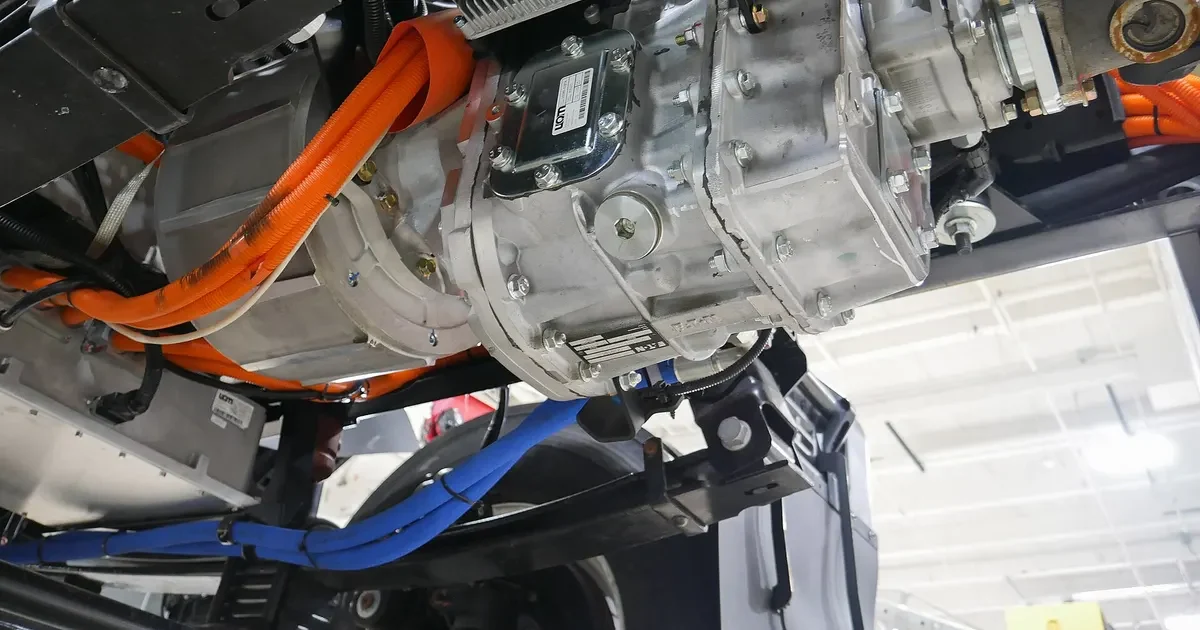
A traction motor housing has more jobs than a plain motor frame. It holds the stator, locates two bearings accurately, carries a coolant jacket, bolts to the gearbox and often takes part of the vehicle’s structure. The machining plan for one depends heavily on how many are needed, and the plan sets the price, the lead time and which tolerances are practical.
This guide describes the common routes by volume, the tolerances that decide the quality of the housing and the information a shop needs to quote one.
What the housing does
- Carries the stator in a bore, usually with a shrink fit. The bore has to be round and sized closely.
- Locates the bearings through bores or end shield seats that must stay coaxial with the stator bore.
- Holds the coolant jacket, either a cast channel or a groove closed by a sleeve or a cover.
- Mates with the gearbox or inverter through flanges, spigots and sealing faces.
- Supports mounting loads from the vehicle, so strength and stiffness matter.
Most housings are aluminum, for weight and heat transfer. The thermal conductivity guide shows how alloy choice enters the cooling path.
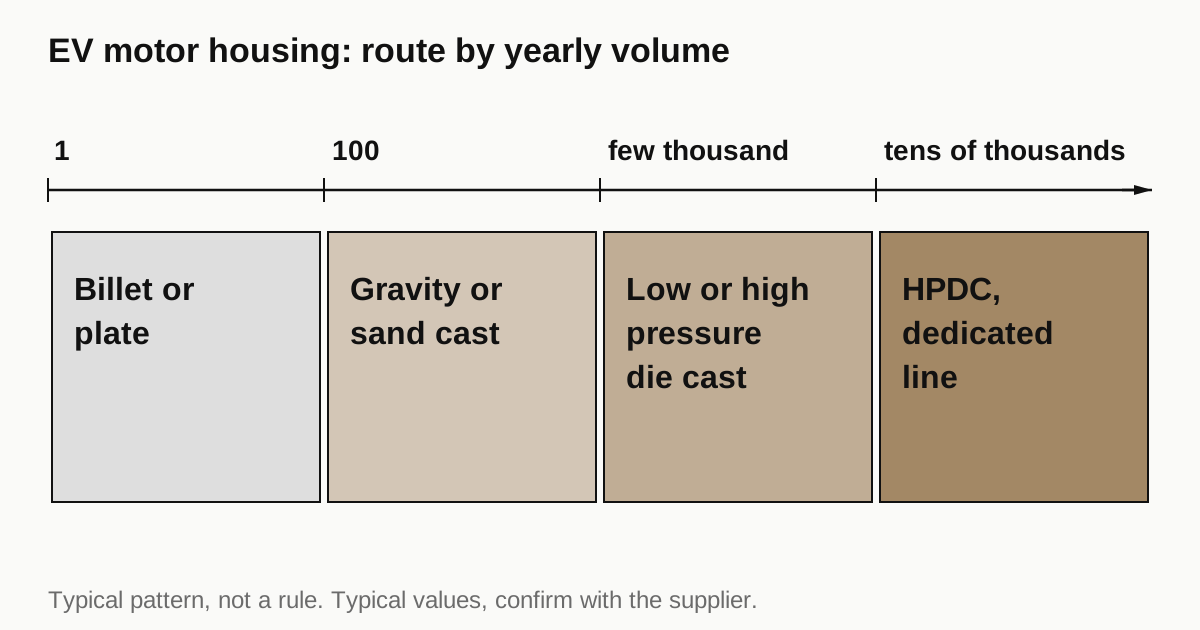
Routes by volume
| Volume per year, typical | Route | Why |
|---|---|---|
| 1 to about 100 | Machined from billet or heavy plate | No tooling, fast start, high cost per part |
| About 100 to a few thousand | Gravity, low pressure or sand cast blank, then machined; or billet with optimized stock | Lower tooling cost than a die, moderate part cost |
| A few thousand to tens of thousands | Low pressure or high pressure die cast blank, machined on machining centers | Die cost starts to pay back |
| Tens of thousands and up | High pressure die casting, machined on a dedicated line | Lowest cost per part, high investment |
These are broad patterns, since the right crossover depends on the geometry and the market. The guide on billet prototypes before die casting explains how teams move from the first row to the third.
The tolerances that decide quality
A traction housing drawing carries many callouts. Four groups carry most of the weight.
Stator bore
The bore holds the stator by interference, so size and roundness are critical. Classes in the H6 to H7 range are common, with roundness limits set as a fraction of the interference. Details are in the stator shrink fit guide.
Bearing seats and coaxiality
Two bearing seats, one at each end, have to share an axis with each other and with the stator bore. Coaxiality or runout limits in the range of a few hundredths of a millimeter are normal. The housing may carry the seats directly or hold end shields that carry them, and the tolerance chain differs between the two designs. The bearing fit and runout guide explains which callouts the bearing responds to.
Faces and flanges
Mounting faces and sealing faces need flatness and a position relative to the bore. A gearbox flange that is out of square puts the motor shaft at an angle to the gearbox input. Flatness values are often a few hundredths of a millimeter over the face.
Cooling jacket
The jacket must be leak tight at working pressure. The leak test guide covers the methods, and the porosity guide covers casting defects.
The numbers above are typical ranges to give a sense of scale. The motor designer sets the real values, and they differ between programs.
What changes at volume
Fixturing. At low volume a shop uses flexible fixtures and several setups. At high volume, dedicated hydraulic fixtures hold the housing from datums that the casting provides, and the number of setups falls to one or two.
Machine tools. Low volume runs on general purpose machining centers. High volume runs on machining centers with pallet changers, or on transfer lines, with in process gauging.
Tool management. High volume needs tool life tracking and automatic replacement, since a worn tool shifts a bore.
Inspection. Low volume housings are measured on a CMM, often every part. High volume uses in line gauges plus CMM sampling, with statistical records of capability.
Washing and cleanliness. A production housing must be clean to a specification before assembly. Washing, deburring and drying form a process in their own right.
A typical machining sequence
The exact order varies by design, but a cast aluminum traction housing usually follows a pattern like this.
- Locate and rough. Machine datum surfaces on the casting, often three pads and a locating hole, and rough the main faces. These datums carry every later operation.
- Machine the end faces and flange. Establish the faces that mate with the gearbox and the end shields.
- Bore and face in the main setup. Stator bore, bearing seats and spigots are cut in one clamping where possible, so they are coaxial by construction.
- Drill, tap and cut ports. Coolant ports, mounting holes, sensor and cable entries.
- Cut seal grooves. O-ring grooves on faces and spigots, with a finish suited to the seal.
- Deburr. Internal cross holes and port intersections need controlled deburring, since a loose burr in a coolant circuit is a field failure waiting to happen.
- Wash. A multi stage washer removes chips, cutting fluid and particles.
- Impregnate if specified, then clean the threads again.
- Leak test. The jacket is tested at the stated pressure and limit.
- Final inspection and packing.
The more features that are cut in one setup, the better the coaxiality. This is the main reason shops use multi spindle machines or turn mill centers for high volume housings, since the part is cut from fewer sides. It is also why a housing with features on many sides is costly to make at low volume, where the shop has to re-clamp the part several times and carry the error from each clamp.
Need a quote for this part? Get a quote for your motor part
How cost behaves across volume
Unit cost for a housing falls as volume rises, for four reasons.
- Tooling amortization. A die, a fixture or a dedicated gauge costs a fixed amount. Divide it by more parts and the cost per part drops.
- Cycle time. At volume, shops invest in faster machines and optimized tool paths, and cycle time falls.
- Material. A casting near net shape wastes far less metal than a billet.
- Learning. Scrap falls as the process settles and the operators learn.
The reverse is also true. A housing ordered at the wrong volume can cost much more than needed. A buyer who orders 200 pieces and plans to scale to 20,000 next year may pay more per part now for flexible machining, and the shop is right to price it that way. It helps to share the ramp plan, so the shop can decide whether to invest in a fixture that will serve later volumes or run a temporary one.
Common problems during ramp up
| Problem | Typical cause | What helps |
|---|---|---|
| Bearing bore coaxiality drifts | Fixture wear or casting datum variation | Track the datum, check the fixture, gauge in process |
| Leak test failures climb | Casting porosity lot variation | Incoming casting checks, impregnation plan |
| Dimensions differ between prototype and production | Different blank, different setup | Sample approval on the production route |
| Washing leaves chips in blind holes | Wash process not validated | Cleanliness test with particle count |
| Housing deforms in transport | Packaging not designed for the part | Agree packaging with the shop |
The first row is common. A prototype made from billet has different residual stress and different datum surfaces than a production casting, so the same program can give different results. Run sample approval on parts from the production route and do not rely on prototype data alone.
Prototype housing before production
Many EV programs spend months on prototypes before they commit to a casting die. Prototype housings are usually billet or sand cast, and the machining is done in many setups. This is slow and costly per part, and that cost is justified when it buys design confidence. A shop that understands the program can keep the design close to what a production casting would allow, such as using the same datum scheme, so that the results transfer. Raise this point on the RFQ, and ask whether the shop can machine prototypes from the same datums that the casting will provide.
Quality expectations in production
Vehicle programs normally ask suppliers for quality planning documents and capability data. Typical items are a control plan, a first sample approval and process capability indices such as Cpk on critical features. These are customer requirements, and a shop either has the systems or does not. Do not assume. Ask the shop what it has, and ask for evidence, not a claim.
For development builds, the requirement is lighter. A measurement report on the critical features is usually enough, and speed matters more than documentation.
Information a shop needs to quote
- Annual volume and total program volume, so the shop can plan fixtures and tools.
- Drawing with datums, tolerances and critical features marked.
- Material and the blank source, casting or bar, and who buys it.
- Leak test spec and cleanliness spec.
- Quality documentation level required.
- Ramp schedule, with sample dates and production start.
- Packaging and delivery, since housings are bulky and easily damaged.
Checklist before you send the RFQ
- State volume by year and the ramp.
- Mark the four critical groups: stator bore, bearing seats, faces and jacket.
- State the blank source and the casting porosity limits.
- State leak test and cleanliness requirements.
- State the quality documentation you expect.
- Ask for pricing at more than one volume.
When the drawing is ready, send the RFQ and we quote the finished parts and place the work with a partner shop that machines motor housings. Replies come within 24 business hours.
Standards and references
- Traction motor, overview of motors used for vehicle propulsion. Background on the motor types behind EV housings.
- Die casting, overview of the process used for most EV housings. Why volume housings are cast and then machined.
- ISO 1101, Geometrical product specifications (GPS), Geometrical tolerancing. The position, coaxiality and flatness callouts used on housing drawings.
- ISO 286-1, ISO code system for tolerances on linear sizes. Bore classes for stator and bearing seats.
Figures on this page are typical ranges drawn from the standards above and from ordinary shop practice. They are not a specification for your part. The partner shop that prices your part confirms what it can hold on your geometry.
Frequently asked questions
At what volume does an EV housing move from billet to casting?
There is no fixed number. The crossover depends on the size, the amount of material removed and the tooling price. A rough pattern is billet for tens of pieces, a gravity or sand casting route for hundreds to a few thousand and high pressure die casting for tens of thousands, but ask for quotes at several volumes.
Do I need a shop with automotive certification?
For a production program, most vehicle makers and tier suppliers ask for it, along with PPAP and process capability data. For prototypes and development builds the requirement is usually lighter. State what you need on the RFQ so shops can say honestly if they meet it.
Which tolerances matter most on a traction motor housing?
Stator bore size and roundness, bearing bore size and coaxiality between bearing seats, flatness and position of the mounting and sealing faces, and leak tightness of the cooling jacket. Cosmetic surfaces matter far less.
Need a quote for this part?
Send the drawing. We quote the finished parts, place the work with a partner shop and reply within 24 business hours.
Get a quote for your motor part