Guides / For Shops
Building an EV Housing Machining Cell: The Cycle Time Math Before You Buy a Machine
Written by the team that reads your RFQPublished How we write these
A volume bid for EV motor housings comes down to one sum: how many machines does the demand need, and what does each good housing cost to run through them. The sum is short, but it is where most volume quotes go wrong, because the inputs are planning numbers and a shop that uses a clean-sheet cycle time and a hopeful OEE will under-buy machines. This guide works through the arithmetic with a clearly marked example, then shows how sensitive the answer is.
Three terms, defined once
- Takt time is net available work time divided by customer demand. Wikipedia’s example: a 480 minute shift less 30 minutes lunch, 30 minutes breaks, 10 minutes briefing and 10 minutes maintenance leaves 400 minutes, and with demand of 400 units a day the takt is one minute.
- Cycle time is the time one operation takes on one machine: cutting, tool changes, probing, loading and pallet change.
- OEE is availability times performance times quality. Wikipedia takes the scheduled shift as the 100 percent reference, and warns that calling 85 percent a world class target is often incorrect. So use the figure your own machines achieve.
Quality loss, meaning scrapped castings and reworked bores, sits inside the OEE figure. Do not add a second scrap factor on top of it.
What the part asks of the cell
A published example helps show the scale. A MAPAL and NILES-SIMMONS project describes a pot-shaped, thin-walled aluminum stator housing with external cooling ribs, inner diameters of 220 to 231 mm and outer diameters of 250 to 260 mm, with IT6 on the fit diameters and concentricity down to 0.05 mm in some cases. The makers claim a 50 percent time saving against conventional turning, without stating the baseline minutes, and note enquiries of 250,000 parts per year, which is enquiries and not confirmed production. Treat that as a tool maker’s claim. It shows two things that matter for a cell: the cycle is dominated by a few critical bores, and the process route, turning against machining on a horizontal center, changes the answer by more than any scheduling tweak. The EV traction housing guide lists the tolerances a housing carries.
A worked example (illustrative inputs)
The inputs below are invented to show the structure. Use your own timed numbers.
- Demand: 60,000 housings a year.
- Calendar: 250 working days, 2 shifts of 480 minutes each, so 240,000 scheduled minutes per machine per year.
- Operation 10 (first side, stator bore, datum faces): ideal cycle 5.0 minutes including load and pallet change.
- Operation 20 (second side, bearing seats, ports and holes): ideal cycle 4.0 minutes.
- Planning OEE: 70 percent.
Takt. Demand per day is 60,000 / 250 = 240 housings. Available time per day, 960 minutes, divided by 240 gives a takt of 4.0 minutes before OEE losses. Operation 10 takes 5.0 minutes on one machine, longer than the takt, so one machine cannot keep pace on that operation.
Machines per operation. Productive minutes per machine are 240,000 times 0.70, or 168,000. Machines needed equal demand times cycle time divided by that figure:
- Operation 10: 60,000 x 5.0 / 168,000 = 1.79, round up to 2.
- Operation 20: 60,000 x 4.0 / 168,000 = 1.43, round up to 2.
That is four machines. Operation 10 runs at 89 percent of its planned capacity with two machines, and operation 20 at 71 percent. Operation 10 is the bottleneck, so an improvement on its cycle time is worth more than the same improvement on operation 20.
Cost per good housing. Because OEE already includes yield, scheduled minutes per good part are the ideal cycle divided by OEE: 5.0 / 0.70 = 7.14 and 4.0 / 0.70 = 5.71 minutes, which is 12.9 minutes, or 0.214 hours, per good housing across both operations. Multiply by your own machine rate per scheduled hour. No public survey gives a shop rate for these machines, so a rate in a quote must be your own.
How sensitive the answer is
| Case | OP10 machines | OP20 machines | Total |
|---|---|---|---|
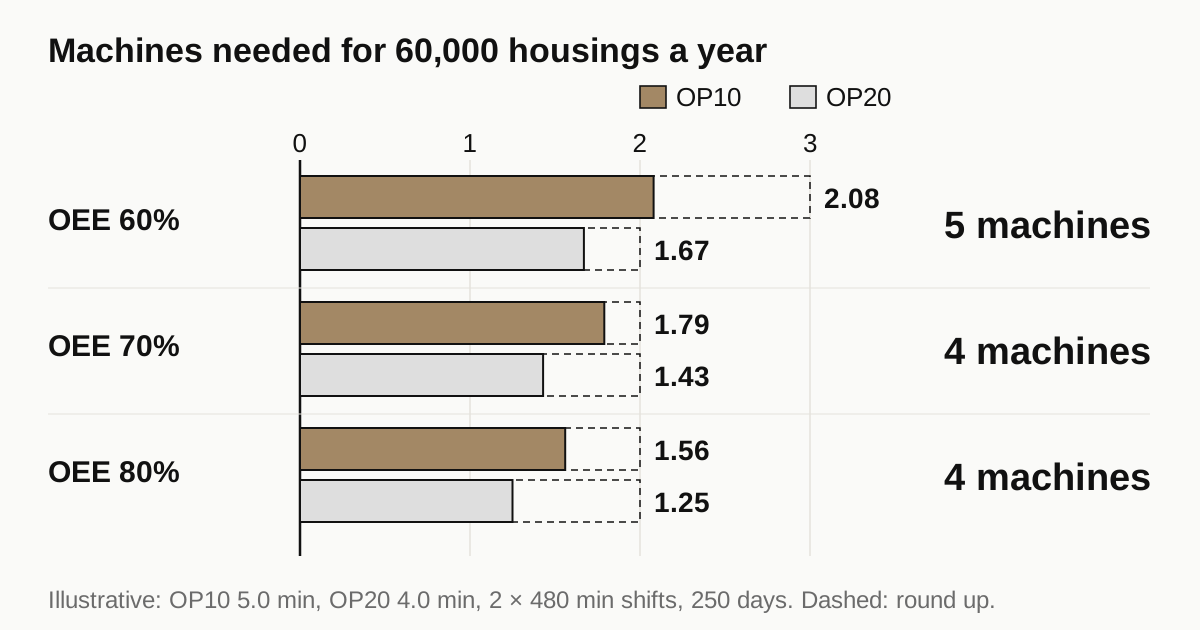
| Base: OEE 70 percent | 1.79, so 2 | 1.43, so 2 | 4 |
| OEE 80 percent | 1.56, so 2 | 1.25, so 2 | 4 |
| OEE 60 percent | 2.08, so 3 | 1.67, so 2 | 5 |
| Volume up 20 percent, OEE 70 | 2.14, so 3 | 1.71, so 2 | 5 |
| OP10 cycle 5.5 min, OEE 70 | 1.96, so 2 | 1.43, so 2 | 4, but at 98 percent load |
Two lessons. A 10 point drop in OEE or a 20 percent rise in volume each add a whole machine, and the last case shows a cell that fits on paper with no margin. Check the ramp-up assumption as well: a new part on new fixtures seldom opens at the OEE of a mature line, so a bid that survives only at 80 percent is fragile.
Need a quote for this part? Get a quote for your motor part
Balance the operations before you add a machine
The example is out of balance on purpose: operation 10 needs 5.0 minutes and operation 20 only 4.0, so the first pair of machines runs hotter than the second. Moving 0.5 minute of work from operation 10 to operation 20, for instance a rough boring pass or a set of drilled holes, brings both to 4.5 minutes. With two machines each, the load on operation 10 falls from 89 to 80 percent and operation 20 rises from 71 to 80 percent, which gives the cell the same margin on both operations. The move is only free if the datum scheme allows it: a feature cut in the second operation is located from what the first one produced, so anything that must share an axis with the stator bore stays in the same setup. Check this with the drawing before you rebalance on paper.
The stations that are not machining
The cell does not end at the second operation. A housing line carries wash, deburring, a leak test and final inspection, each with its own takt. If the part has a coolant jacket, a pressure decay or helium leak test takes time per part and needs its own station or capacity. Customers who specify technical cleanliness add a cleaning and verification step, covered in the VDA 19 guide. In-process gauging of the bearing bores, discussed in the bearing bore coaxiality guide, adds probing time inside the cycle. Count each station in the same table and look for the slowest.
What to do before you bid
- Time a real or representative part, cutting data and all non-cutting time, and write down the ideal cycle for each operation.
- Take OEE from your own history and show the bid at three values.
- Compute machines per operation, round up and show the load of each.
- Add the non-machining stations to the same table.
- State the volume range the price holds for, and what changes outside it.
- Quote only what you can run: a PPAP package and capability data on the bearing bores are part of the job at this volume.
If a shop is considering volume work in motor housings, apply as a partner shop to receive work requests and quote the ones you want. There is no fee to join, no charge per request and no promise of orders. The partner shop page lists the checks a shop clears first.
Sources
- Takt time, overview
- Overall equipment effectiveness, overview
- MAPAL and NILES-SIMMONS, stator housing process case study (vendor, directional)
Standards and references
- Takt time, overview. Takt time as net available work time divided by customer demand, with the 480 minute shift example.
- Overall equipment effectiveness, overview. OEE as availability times performance times quality, the scheduled shift as the 100 percent reference and the warning that 85 percent is not a universal world class target.
- MAPAL and NILES-SIMMONS, stator housing machining process for e-mobility, 22 August 2022. A pot-shaped thin-walled aluminum stator housing with IT6 fit diameters, a claimed 50 percent time saving against conventional turning and the volume the makers quote for enquiries. Tool and machine maker case study, directional only.
Figures on this page are typical ranges drawn from the standards above and from ordinary shop practice. They are not a specification for your part. The partner shop that prices your part confirms what it can hold on your geometry.
Frequently asked questions
How do I calculate how many machines an EV housing line needs?
Multiply annual demand by the ideal cycle time of the operation, then divide by scheduled minutes per machine times your OEE. Round each operation up. Takt time, net available time divided by demand, tells you whether the cell meets the customer's pace; the machine count tells you how much capacity that pace needs.
What OEE should I plan with for a new housing line?
Use a figure you can defend from your own machines, and show the quote at more than one value. OEE is availability times performance times quality, and Wikipedia warns that treating 85 percent as a world class target is often wrong. A new part on a new cell usually runs below a mature one.
Is cycle time the same as takt time?
No. Takt time is set by customer demand and the time you have. Cycle time is how long one operation takes on one machine. If cycle time per machine is longer than takt time, you need more than one machine on that operation, or a shorter cycle.
Do public benchmarks exist for minutes per EV motor housing?
Not that we could find. The published figures are tool maker claims such as a 50 percent time saving against a baseline that is not stated. Build the number from your own cutting data and measured non-cutting time, and quote a cycle you have timed on a trial part.
Need a quote for this part?
Send the drawing. We quote the finished parts, place the work with a partner shop and reply within 24 business hours.
Get a quote for your motor part