Guides / For Shops
Casting Defects Found at Machining: Who Pays the Scrap on a Motor Housing
Written by the team that reads your RFQPublished How we write these
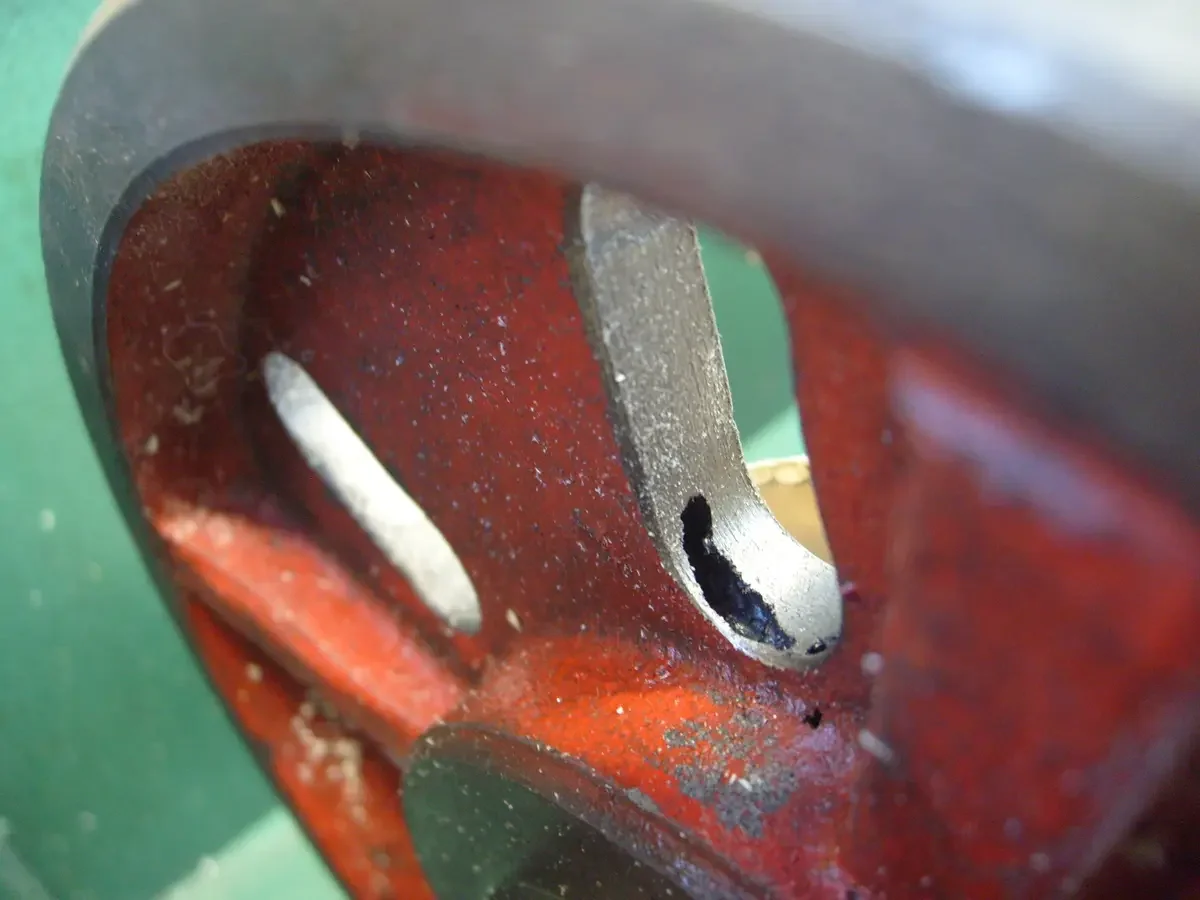
A cast housing arrives, you cut the bore and the cutter opens a cavity that was invisible from outside. Whether you or the buyer pays for that part is decided by the purchase order, and most purchase orders are silent about it. The answer below is not a rule, because no public standard says who pays. It is a way to price the risk, agree it in writing and keep the evidence that makes the conversation short.
Why the defect appears at machining
Cast metal can hide its flaws. Gas porosity forms from air or dissolved gas, and shrinkage porosity forms inside the casting where feed metal cannot compensate. According to the casting defect overview, a blowhole is often surrounded by a skin of sound metal, which makes it hard to detect, and methods named for finding them include ultrasonic, magnetic and X-ray analysis, including industrial CT.
Die casting makes porosity a normal part of the process rather than a rare event. Wikipedia notes that even in a highly refined process some porosity remains in the centre of the casting, and that vacuum assistance reduces it. A peer reviewed study of high pressure die cast aluminum found the largest defects toward the inner region of large specimens, and warned that 2D radiography may not be reliable for defect evaluation because projections depend on orientation and overlap. Micro-CT gave more accurate 3D data but is costly and not always available.
So a casting can pass an incoming visual check and a sampled radiograph and still open a pore when you cut a bearing seat or a water jacket. The porosity guide for buyers covers impregnation and how reject limits are written.
The cost layers of one rejected housing
A reject is not just the casting. By the time a bore opens, the part carries:
- The casting price, if you bought it, plus freight and any duty.
- Machining time on every operation completed.
- Fixture wear, tool wear and coolant for that time.
- Inspection time, including the measurement that found the problem.
- Handling, tagging and a place to store the reject until the buyer decides.
Wikipedia’s article on the cost of poor quality calls scrap and rework internal failure costs, and notes that failure damage grows as the failure point moves from the supplier to the manufacturer to the customer. The same logic applies inside your own routing: the later the defect appears, the more machining has been spent.
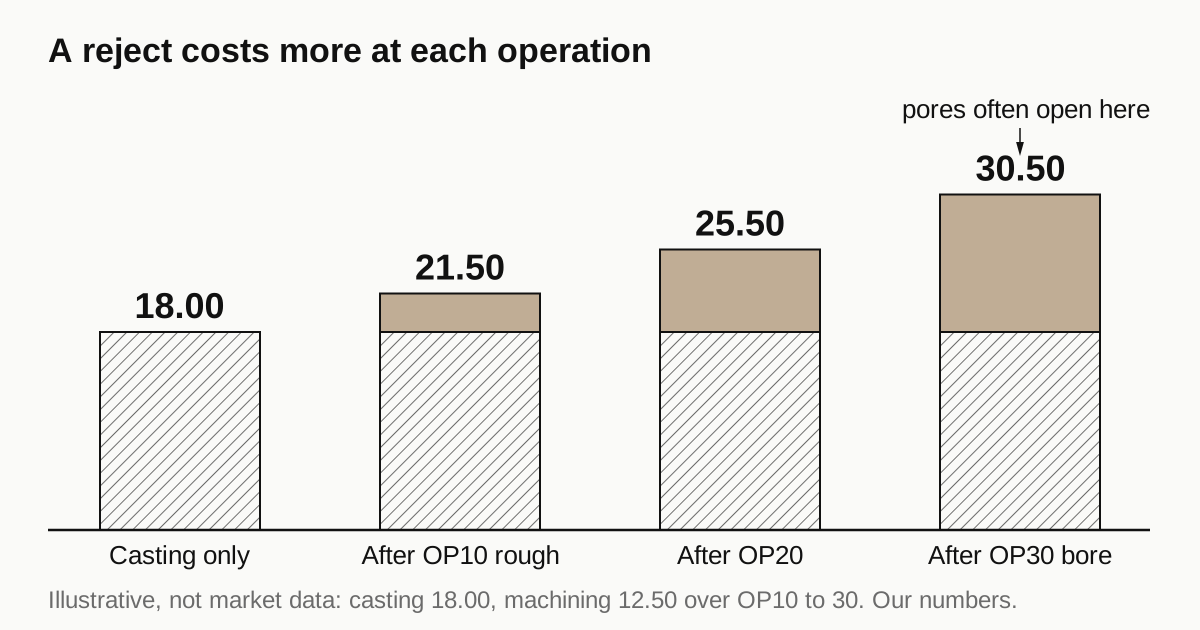
An illustrative example, not market data. A casting costs 18.00. Operations 10, 20 and 30 cost 3.50, 4.00 and 5.00, a total of 12.50, and the bore cut in operation 30 is the first cut that can open a pore. If the defect opens during operation 30, you have 30.50 in the part. If 60 parts of a 2,000 piece lot are rejected there, that is 1,830 in total. If the pore-exposing cut were moved to operation 10, the same reject would cost 21.50 per part and 1,290 in total. Where the first cut that can open a pore sits in your routing is a lever you control, and moving it early cuts the cost of each reject.
Who supplied the casting changes the argument
| Case | What you can fairly say | What to agree in writing |
|---|---|---|
| Buyer free-issues the casting | The casting is the buyer’s, and the defect is in the buyer’s material | Machining time paid on rejects up to a cap, return of the part, who owns the foundry claim |
| You buy the casting for the buyer | You carry the casting supplier risk and the cash | Credit from the foundry, how much of the machining the buyer shares, and the foundry named on the order |
| Buyer names the foundry, you buy from it | The buyer chose the source | Who deals with the foundry, and whether a defect in a named source is the buyer’s risk |
| You choose the foundry | The risk sits mostly with you | A scrap allowance in the price, review after the first batch |
These are negotiating positions, not norms. Shops and buyers settle them in many ways. What matters is that the case is written on the order before the first part is cut.
The buyer’s view of the same question, who supplies the blank and what to agree before the first cut, is in the motor housing machining quote guide.
Need a quote for this part? Get a quote for your motor part
Agree the acceptance limit before the first cut
Most disputes are about whether a pore is a defect at all. Settle this in the order:
- Which surfaces have strict limits. A sealing face, a bearing bore and a water jacket are different from a cosmetic wall.
- How severity is judged. ASTM E505 supplies reference radiographs of aluminum and magnesium die casting discontinuities in four graded levels of severity, offered as nomenclature for acceptance standards, specifications and drawings. A drawing can name a level for a zone. Without a named method each side will judge by eye.
- How many are inspected. Acceptance sampling accepts or rejects a lot from a sample with an acceptance number. Agree the sample and the number, or you will argue about it after a bad lot.
- Whether impregnation is allowed, and at what point in the routing. See the water jacket leak test guide for what the test then looks for.
- What counts as a reject and what happens to a part that is rejected after machining.
Find it earlier
You can shift the cost without waiting for a better foundry:
- First article cut-up or sectioning of one casting from each new lot, at the zones that will be machined.
- Early cuts first. Put the operation that exposes the likely pores before the operations that add the most time.
- Sampled radiography or CT on the first lots from a new casting source, if the buyer pays for it.
- Casting marking that links every part to cavity and lot, so one bad die cavity can be isolated.
The guide to quoting from a casting drawing lists the checks to make before you price, including porosity and who supplies the casting.
Keep an evidence package
When a bad casting appears, collect the following before you move the part:
- Photographs of the defect in place, with a scale and the part marking.
- The operation number and machining minutes already spent.
- The date and time found, and the time and method the buyer was told.
- The lot or cavity marking and the supplier of the casting.
- The measurement report if the defect shows as a dimension problem.
Agree a notification window with the buyer, and keep to it. A buyer who hears about a reject the day it is found can still find the cause. A buyer who hears at the end of the month is likely to dispute it.
What to say in the quote
State the case your price assumes in the first line: free-issue or purchased casting. State the scrap allowance as a number you can defend, or say there is none and why. Name the acceptance method for porosity. Offer a review after the first batch. A buyer reads that as an experienced shop. A quote silent on scrap leaves the argument for after the loss.
Where this site fits
If you machine motor housings and want work requests with the casting information stated, apply as a partner shop. There is no fee to join, no charge per request and no promise of orders. You quote us, and we place the purchase order if price and lead time work. The checks a shop clears first are written on the partner shop page.
Sources
- Casting defect, overview
- Die casting, overview
- Characterization and analysis of porosities in high pressure die cast aluminum
- ASTM E505, store entry
- Acceptance sampling, overview
- Cost of poor quality, overview
Standards and references
- Casting defect, overview. Gas porosity, shrinkage porosity and blowholes, why a blowhole can sit under a skin of sound metal, and the methods used to find them.
- Die casting, overview. Some porosity remains in the centre of a die casting even in a refined process, vacuum assistance reduces it, and porosity limits heat treating and welding.
- Characterization and Analysis of Porosities in High Pressure Die Cast Aluminum by Using Metallography, X-Ray Radiography, and Micro-Computed Tomography (PMC). Peer reviewed study. Gas and shrinkage pores, larger defects toward the inner region of large specimens, and the limits of 2D radiography against micro-CT.
- ASTM E505, Reference Radiographs for Inspection of Aluminum and Magnesium Die Castings (store entry). A radiograph set with graded severity levels, offered as nomenclature for acceptance standards, specifications and drawings.
- Acceptance sampling, overview. Accepting or rejecting a lot from a sample, with an acceptance number.
- Cost of poor quality, overview. Internal failure costs such as scrap and rework, and how failure cost grows as it moves down the supply chain.
Figures on this page are typical ranges drawn from the standards above and from ordinary shop practice. They are not a specification for your part. The partner shop that prices your part confirms what it can hold on your geometry.
Frequently asked questions
Who pays when a casting is scrapped during machining?
No public rule settles it, so it depends on the purchase order. The question is who supplied the casting, what acceptance limit was agreed and whether the shop tells the buyer in time. Without written terms the shop usually holds the sunk machining cost, so agree it before the first order.
Why do casting defects show up only during machining?
Blowholes can sit under a skin of sound metal, and shrinkage porosity forms inside the casting. A cutter opens that metal for the first time. Radiography and CT can find some of it earlier, but a 2D radiograph can mislead because defects overlap and depend on orientation.
How many porosity rejects should a quote allow for?
There is no public benchmark. Pick an allowance from your own history on that casting source, state it in the quote and offer to review it after the first batch. If you have no history, say so and ask for a first article from the foundry before you commit to one number.
What evidence should a shop keep when it finds a bad casting?
Photographs of the defect in the part, the operation number and the machining time already spent, the lot or cavity marking on the casting, the date found and the time the buyer was told. That package turns a dispute into a cost calculation.
Need a quote for this part?
Send the drawing. We quote the finished parts, place the work with a partner shop and reply within 24 business hours.
Get a quote for your motor part