Guides / For Shops
Getting Approved as a Tier 2 Motor Parts Supplier: What the Tier 1 Will Ask
Written by the team that reads your RFQPublished How we write these

A shop becomes an approved Tier 2 automotive supplier by satisfying its Tier 1 customer, not by collecting a certificate in the abstract. What the Tier 1 asks is set by its own supplier manual, the car maker’s customer-specific requirements and the risk of the part. What follows are the pieces that most often appear: a quality system pathway that starts with third party ISO 9001, the core tools, material data reporting, a process audit and a part approval package. Read this as a map of what to ask for, and confirm every item with the customer.
What Tier 2 means for your paperwork
A Tier 1 supplies parts or systems directly to a vehicle maker. A Tier 2 supplies the Tier 1, for example a shop that machines motor housings and end bells that the Tier 1 assembles into an e-axle or pump motor. The vehicle maker’s requirements still reach you, because IATF 16949 expects the Tier 1 to manage its own suppliers. Customer-specific requirements are an important part of the standard, and IATF Global Oversight publishes them. The shop that supplies a Tier 1 sees them as flow-down clauses in a purchase order and a supplier manual.
The quality system pathway
Wikipedia describes IATF 16949 as built on ISO 9001:2015. A certificate comes from a recognized certification body, lasts three years and is confirmed at least annually. The same article says suppliers without a valid certificate have little chance of supplying a Tier 1 directly. That is a statement about Tier 1 supply, and it does not mean a Tier 2 shop must be certified on day one.
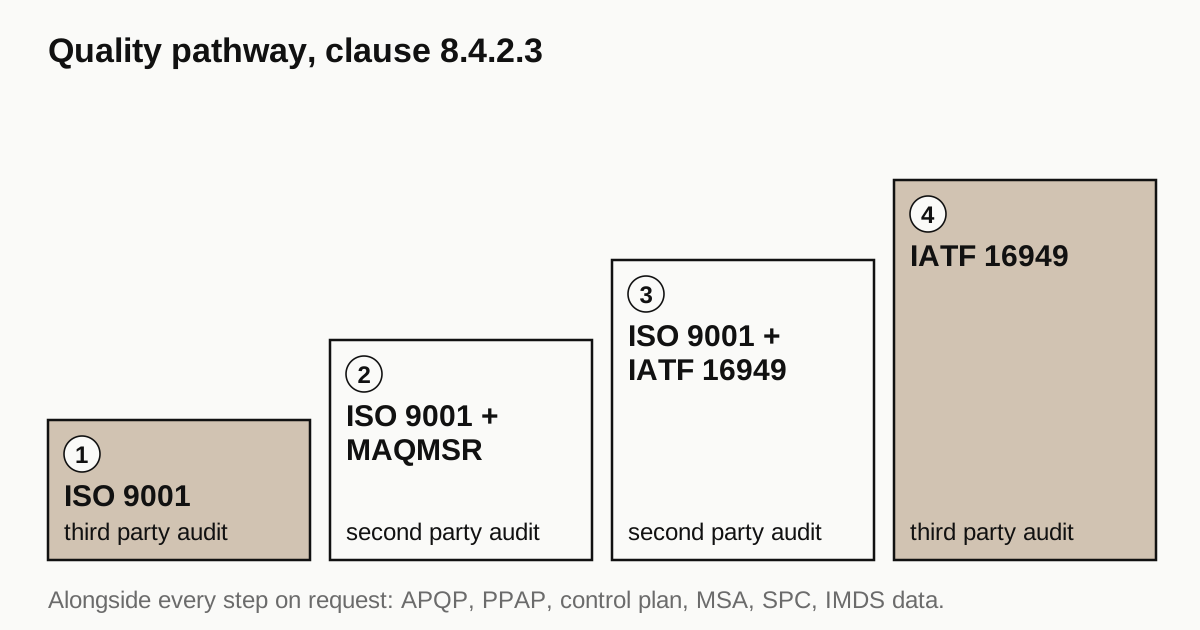
For sub-tier suppliers, clause 8.4.2.3c describes a pathway that a certification body and a standards vendor both give in the same four steps:
- Third party ISO 9001 certification.
- ISO 9001 plus compliance with MAQMSR, verified through second party audits.
- ISO 9001 plus compliance with IATF 16949, verified through second party audits.
- IATF 16949 certification through third party audits.
DQS adds that the Tier 1 sets minimum and target development levels for each supplier using risk-based thinking. It also notes that some customers write their own variations. In its reading, FCA expects non-exempt suppliers to show at least ISO 9001 and MAQMSR compliance, and GM allows certain elements to be waived for very small suppliers under written criteria. These are customer-specific rules quoted from one certification body’s blog. Check the current text with the customer.
For most shops the practical first step is ISO 9001 certification from a certification body that holds accreditation. Only claim a certificate once you hold it, and name the scope and the issuing body when you do.
MAQMSR, and what auditors find missing
A vendor page describes MAQMSR as released in September 2017 for lower tier suppliers who struggle to meet IATF 16949, to be used with ISO 9001:2015. The same page lists six IATF 16949 requirements that organizations most often failed to meet:
- Contingency plans (clause 6.1.2.3).
- Internal auditor competency (7.2.3).
- Supplier monitoring (8.4.2.3c).
- Control of production and service provision (8.5.1).
- Control plan (8.5.1.1).
- Total productive maintenance (8.5.1.5).
Treat that list as a self-check for a machine shop rather than the text of MAQMSR. Ask for the document from the customer or from IATF Global Oversight and read it yourself.
The core tools you will be asked to show
IATF 16949 expects APQP, PPAP, FMEA, MSA and SPC to be integrated. In shop terms:
| Tool | What the customer expects from a machining shop |
|---|---|
| APQP | A plan for the new part: phases, owners, dates. AIAG publishes a five phase model. |
| FMEA | A process FMEA for your operations. The 2019 AIAG and VDA handbook uses action priority in place of the risk priority number. |
| Control plan | Per operation: characteristic, gauge, sample size and frequency, reaction plan. |
| MSA | Gauge R&R or equivalent on gauges used for special characteristics, such as the bearing bore. See the air gauge and CMM guide. |
| SPC | Control charts and capability on the characteristics the customer flags. See the SPC reporting guide. |
| PPAP | The part approval package. Five levels, 18 elements, defined by AIAG with customer additions. |
The PPAP guide for machined motor parts lists the 18 elements and which level to expect for a housing or shaft.
Material data and the IMDS
Many Tier 1 customers ask for material data on the parts you sell them. IMDS, the International Material Data System, is a repository for the materials in vehicles, started by a group of vehicle makers in 1999. Each supplier submits data for the parts it sells to its direct customer, and Wikipedia says data entry is often a contractual requirement of PPAP. Suppliers declare all substances in a material data sheet to a resolution of 1 gram or better. For a machined housing the main input is the alloy and its certificate, plus any coating or treatment. Ask the customer whether it wants IMDS, a different system or a simple declaration.
Need a quote for this part? Get a quote for your motor part
The process audit
If the chain runs through a German vehicle maker, the Tier 1 may audit you to VDA 6.3. It is a process audit, not a certification, and the current edition is VDA 6.3:2023. Two vendor summaries describe the same structure: elements P1 to P7 from potential analysis and project management through supplier management and series production (P6, the core element) to customer care, with each question scored in steps of 0, 4, 6, 8 or 10. They agree that an A grade is 90 percent or more of available points. They disagree on where B ends and C begins, one giving 80 percent and the other 75, so confirm the grading with the customer rather than trusting a number from the internet. Both say a zero on a key question can pull the grade down whatever the average, and that a C result usually triggers escalation. For a machining shop, P6 is where the audit is won or lost, so walk your own floor against it before the customer does.
A readiness checklist
- Get the Tier 1’s supplier manual and customer-specific requirements before quoting, and ask which of them apply to the part.
- Hold third party ISO 9001, or ask the customer in writing what it will accept while you work toward it.
- Write a control plan and process FMEA for the actual part, not a template.
- Hold gauge R&R results for the gauges on special characteristics.
- Hold calibration records for gauges, masters and the CMM.
- Keep traceability from material certificate to part lot.
- Prepare an IMDS or material declaration if the customer asks.
- Prepare for a second party audit on risk, and keep corrective action records.
- Decide who is the named contact for quality in the first reply.
What not to say
Do not say you are IATF 16949 certified unless a certification body has issued the certificate to your site. Do not say you are PPAP approved in general: PPAP approval is per part number and per customer. Do not promise approval dates that depend on a customer’s engineering team. A plain statement of what you hold and what you are working toward is stronger than a list of acronyms.
Where this site fits
The shop guide on winning motor part work explains how to answer a first RFQ. If you machine motor housings or shafts and want work requests that fit your machines, apply as a partner shop. There is no fee to join, no charge per request and no promise of orders. You quote us, and we place the purchase order if price and lead time work. The checks a shop clears first are written on the partner shop page.
See also: IATF 16949 for motor housing suppliers, on which sites can hold a certificate and how to check one.
Sources
- IATF 16949, overview
- IATF Global Oversight
- DQS, expectations for IATF supply chain management, section 8.4
- 16949store, MAQMSR for sub-tier suppliers (vendor, directional)
- Production part approval process, overview
- Advanced product quality planning, overview
- International Material Data System, overview
- Certivo, VDA 6.3 overview (vendor, directional)
- mobile2b, VDA 6.3 process audit (vendor, directional)
- Failure mode and effects analysis, overview
Standards and references
- IATF 16949, overview. Builds on ISO 9001:2015, certificates issued by recognized certification bodies, three year validity, and the core tools it expects: APQP, PPAP, FMEA, MSA and SPC.
- IATF Global Oversight. How certification runs through IATF-recognized certification bodies, and where customer-specific requirements are published. The page makes no general rule that every sub-tier supplier must hold a certificate.
- DQS, Expectations for IATF supply chain management, section 8.4. Clause 8.4 as read by a certification body: risk-based supplier QMS development, second party audits and customer-specific variations. Certification body blog, secondary.
- 16949store, Minimum Automotive Quality Management System Requirements for Sub-Tier Suppliers. The four step pathway in clause 8.4.2.3c and MAQMSR as an intermediate step. Vendor page, directional only. The MAQMSR document itself is the authority.
- Production part approval process, overview. Five submission levels, the 18 elements and who defines them.
- Advanced product quality planning, overview. The five phase model published by AIAG.
- International Material Data System, overview. What suppliers declare in IMDS and why it is often tied to PPAP.
- Certivo, VDA 6.3 overview. Vendor summary of VDA 6.3:2023, P1 to P7, the 0/4/6/8/10 scoring and grade thresholds. Directional only, because the B and C cut-offs differ from other summaries.
- mobile2b, VDA 6.3 process audit. Second vendor summary of the same audit. Agrees on the A grade at 90 percent, differs on B and C. Directional only.
- Failure mode and effects analysis, overview. The 2019 AIAG and VDA handbook and action priority replacing RPN.
Figures on this page are typical ranges drawn from the standards above and from ordinary shop practice. They are not a specification for your part. The partner shop that prices your part confirms what it can hold on your geometry.
Frequently asked questions
Does a Tier 2 machine shop need IATF 16949 certification?
Not as a general rule. IATF Global Oversight states no blanket requirement for sub-tier suppliers. Clause 8.4.2.3 asks the Tier 1 to move its suppliers along a pathway that starts at third party ISO 9001. What you need is set by your customer's supplier manual and its customer-specific requirements.
What is MAQMSR?
Minimum Automotive Quality Management System Requirements for Sub-Tier Suppliers, an intermediate step used alongside ISO 9001 for lower tier suppliers. Customers check it through second party audits. It is a stepping stone toward IATF 16949, not a certificate you can print on a letterhead.
What is the difference between IATF 16949 and PPAP?
IATF 16949 is the quality management system standard a site is certified against. PPAP is a part approval package sent to a customer for one part number before series production. A site can hold the first and still owe a PPAP for every new part.
How long does supplier approval take?
No public figure exists. The time depends on the Tier 1, the part risk and what you already hold, so ask the Tier 1 for its approval steps and expected dates in writing before you promise delivery dates to your own customer.
Need a quote for this part?
Send the drawing. We quote the finished parts, place the work with a partner shop and reply within 24 business hours.
Get a quote for your motor part