Guides / Choosing a Supplier
PPAP for Machined Motor Parts: Which Level to Ask For and What the Package Holds
Written by the team that reads your RFQPublished How we write these
PPAP, the production part approval process, is a package of evidence that a supplier can make a part to the drawing, repeatedly, at production rate. It has 18 elements and five submission levels, and the customer decides how much of the package comes to them. For a machined motor housing or shaft the heart of it is the dimensional report, the control plan and the capability study on the bearing seats. If a PPAP is needed, say so on the RFQ with the level, because a shop that discovers it after quoting will either add cost or step back.
When PPAP applies
Wikipedia states that suppliers must obtain approval whenever a new or modified component is introduced to production, or the manufacturing process changes. It can also apply to parts processed by external subcontractors. The Part Submission Warrant, the cover sheet, lists the reasons a submission is made. InspectionXpert gives them as:
- initial submission
- engineering change
- tooling transfer, replacement, refurbishment or additional tooling
- correction of a discrepancy
- tooling inactive for more than one year
- change to an optional construction or material
- sub-supplier or material source change
- change in part processing
- parts produced at an additional location
Several of these matter for a sourcing buyer. Moving a housing to a new shop is a change of location or source, and a new shop that adds a second machine or changes the clamping method has changed the process. The PSW is required for each part number unless the customer says otherwise.
The five levels
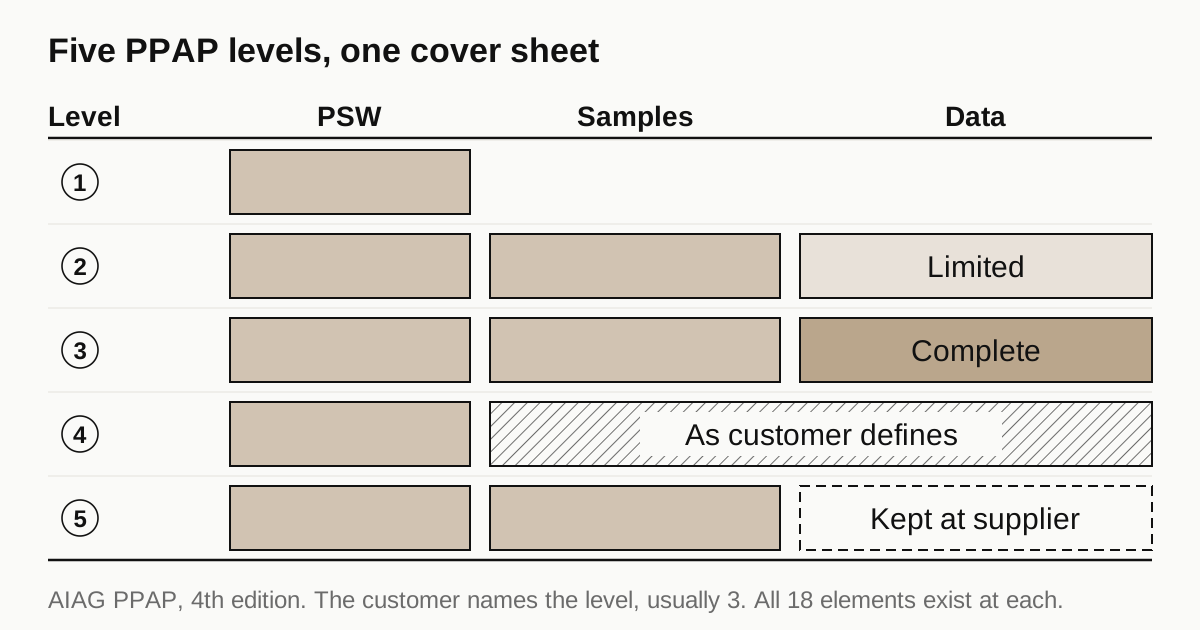
The levels decide what the customer receives. Wikipedia and InspectionXpert, which cites the AIAG PPAP 4th edition, give the same set:
| Level | Sent to the customer |
|---|---|
| 1 | Warrant only |
| 2 | Warrant, product samples and limited supporting data |
| 3 | Warrant, product samples and complete supporting data (the default level) |
| 4 | Warrant and whatever else the customer defines |
| 5 | Warrant, product samples and complete supporting data available for review at the supplier’s manufacturing location |
InspectionXpert says the customer usually specifies the level and that Level 3 is the default. It adds that Level 1 may also include an appearance approval report. The article quotes the AIAG manual as saying that all elements should be completed. The level only decides which of them are sent.
Sources disagree on one detail. InspectionXpert says Level 3 leaves out elements 15 and 16, the master sample and checking aids. Other summaries treat the elements in Level 3 differently. Read the customer’s requirement sheet and do not rely on a general table.
The 18 elements for a machined part
The Wikipedia list runs from design records to the warrant. For a machined housing or shaft the elements look like this:
| Element | What it looks like on a machined motor part |
|---|---|
| 1 Design records | The customer drawing at the current change level, plus a ballooned copy |
| 2 and 3 Engineering change and approval | Change notices and any customer engineering sign-off |
| 4 DFMEA | Belongs to whoever owns the design. Settle on the RFQ who supplies it |
| 5 Process flow diagram | The route: saw, rough turn, finish bore, deburr, wash, inspect, pack |
| 6 PFMEA | Risks in each step, for example a bore that distorts when the clamp is released |
| 7 Control plan | What is measured, how often and with which gauge, for each key feature |
| 8 MSA studies | Proof that the gauges used on the bearing seats can resolve the tolerance |
| 9 Dimensional results | Every dimension on the ballooned drawing measured on the sample parts |
| 10 Material and performance tests | Mill certificates, hardness, coating thickness, leak test results |
| 11 Initial process studies | Capability, for example Cpk, on the key characteristics |
| 12 Qualified laboratory documentation | Evidence that outside testing was done by a suitable lab |
| 13 Appearance approval | For visible anodized or painted housings, a signed appearance report |
| 14 Sample production parts | The parts from the run, sent at Levels 2, 3 and 5 |
| 15 Master sample | One signed part kept as the reference |
| 16 Checking aids | Fixtures and gauges used for the check |
| 17 Customer-specific requirements | For example a cleanliness spec, see the VDA 19 guide |
| 18 PSW | The summary form, with a signed declaration |
The element titles are the Wikipedia list. The right-hand column is explanation of what each one means in a machine shop and not text from the manual.
Need a quote for this part? Get a quote for your motor part
Dimensional results on a motor housing
InspectionXpert is specific here. The report needs a ballooned drawing, with item numbers matching the results table, and a spreadsheet that lists every dimension and specification beside the measured value. Reference dimensions are excluded. One of the measured parts is identified as the master sample. The AIAG manual does not give a sample size according to that article, and common industry practice is 6 pieces from the first production lot. Wikipedia says usually a minimum of 6 pieces is reported per product and process combination. A customer can ask for more.
For a motor housing the dimensions that matter most are the ones in the bearing chain: the bearing seat bores, the stator bore, the spigot and the flange face. The bearing bore coaxiality guide and the fits and runout guide explain how those callouts are measured and why they are the features worth the capability study.
Process capability and Cpk
The initial process study reports how stable and capable the process is on the key characteristics. The usual measure is Cpk, which Wikipedia defines as the lower of the upper and lower one-sided indices, so it penalizes a mean that sits off center. The Wikipedia entry quotes textbook minimums from Montgomery: 1.33 for an existing process, 1.50 for a new one, 1.50 for an existing safety or critical characteristic and 1.67 for a new safety or critical one, for two-sided limits. It adds that targets are a matter of opinion that varies by industry and says automotive guidelines come from the AIAG manual without listing the values.
So the honest answer to “what Cpk do I need” is whatever the customer’s own sheet says. If the sheet is silent, ask for the target in writing before the shop quotes, because 1.33 against 1.67 changes how many parts the shop has to measure and how tight the process has to be.
What it does to the quote
No public survey gives the cost of a PPAP package for machined parts. What can be said is where the cost sits: measuring all dimensions on the sample parts, building the control plan and the process studies, the gauge study and the people time to compile the warrant. A shop that already works to a quality system will have much of this on file. A shop that does not will have to build it. The machining cost guide calls inspection the quiet cost driver and says a PPAP is more work than a first article inspection report.
Practical steps:
- Decide the level and state it on the RFQ. “PPAP Level 3” is quotable. “PPAP if needed” is not.
- Give the customer’s requirement sheet if one exists, and name any element that differs from the default.
- Mark the key characteristics on the drawing so the capability study covers the right features.
- Say who supplies the DFMEA and who owns the design record.
- State the sample quantity and whether it comes from the first production lot.
- Ask for a prototype route separately. A first article report is often enough for the early builds.
The guide to choosing a machining shop lists the paperwork questions to ask before a quote. For how we choose the partner shop for an RFQ, see how partner shops are chosen.
Where PPAP sits next to a first article report and a pilot lot for a new housing supplier is covered in the motor housing machining quote guide.
When the drawing and the PPAP level are settled, send the RFQ and we quote the finished parts and place the work with a partner shop, with a reply within 24 business hours. A shop that cannot supply the level you name can say so before it quotes.
Standards and references
- Production part approval process, overview. The 18 elements, the five submission levels, when approval is required and the usual 6 pieces for dimensional results.
- InspectionXpert, What are the PPAP submission levels? Levels as set out in the AIAG PPAP 4th edition, Level 3 as the default and the note that all elements should be completed. Software vendor article.
- InspectionXpert, How to create a PPAP dimensional results report. Ballooned drawing, which dimensions are reported, sample size convention and master sample. Software vendor article.
- InspectionXpert, PPAP Part Submission Warrant (PSW). Reasons for submission, requested level, part weight and the signed declaration. Software vendor article.
- Process capability index, Cp and Cpk. Definition of Cpk and the textbook minimums of 1.33, 1.50 and 1.67 by case, with the note that targets vary by industry.
Figures on this page are typical ranges drawn from the standards above and from ordinary shop practice. They are not a specification for your part. The partner shop that prices your part confirms what it can hold on your geometry.
Frequently asked questions
Which PPAP level should I ask for on a machined part?
The customer names the level, and Level 3 is the default: the warrant, product samples and complete supporting data. Level 1 sends the warrant only. Level 5 keeps the data at the supplier's site for review. Pick the level before quoting, because it sets the paperwork.
How many parts are measured for the dimensional results?
The AIAG manual does not set a sample size according to InspectionXpert. Wikipedia and common practice say a minimum of 6 pieces per product and process combination, and a customer can ask for more. All dimensions are reported except reference dimensions, on a ballooned drawing.
Do prototype motor parts need PPAP?
Wikipedia describes PPAP as approval for production, required when a new or modified component is introduced to production or the process changes. Prototype builds are often covered by a first article report or a certificate of conformance instead, and the customer decides. Say which one you want on the RFQ.
What Cpk does PPAP require?
There is no single value. The Wikipedia entry quotes textbook minimums of 1.33 for an existing process, 1.50 for a new one and 1.67 for a new safety or critical characteristic. It says automotive guidelines come from the AIAG manual without listing them, so ask the customer for the target in writing.
Need a quote for this part?
Send the drawing. We quote the finished parts, place the work with a partner shop and reply within 24 business hours.
Get a quote for your motor part