Guides / Buyer Guide
Thread Inserts in Aluminum Motor Housings: Which Type to Specify and What the Drawing Must Say
Written by the team that reads your RFQPublished How we write these
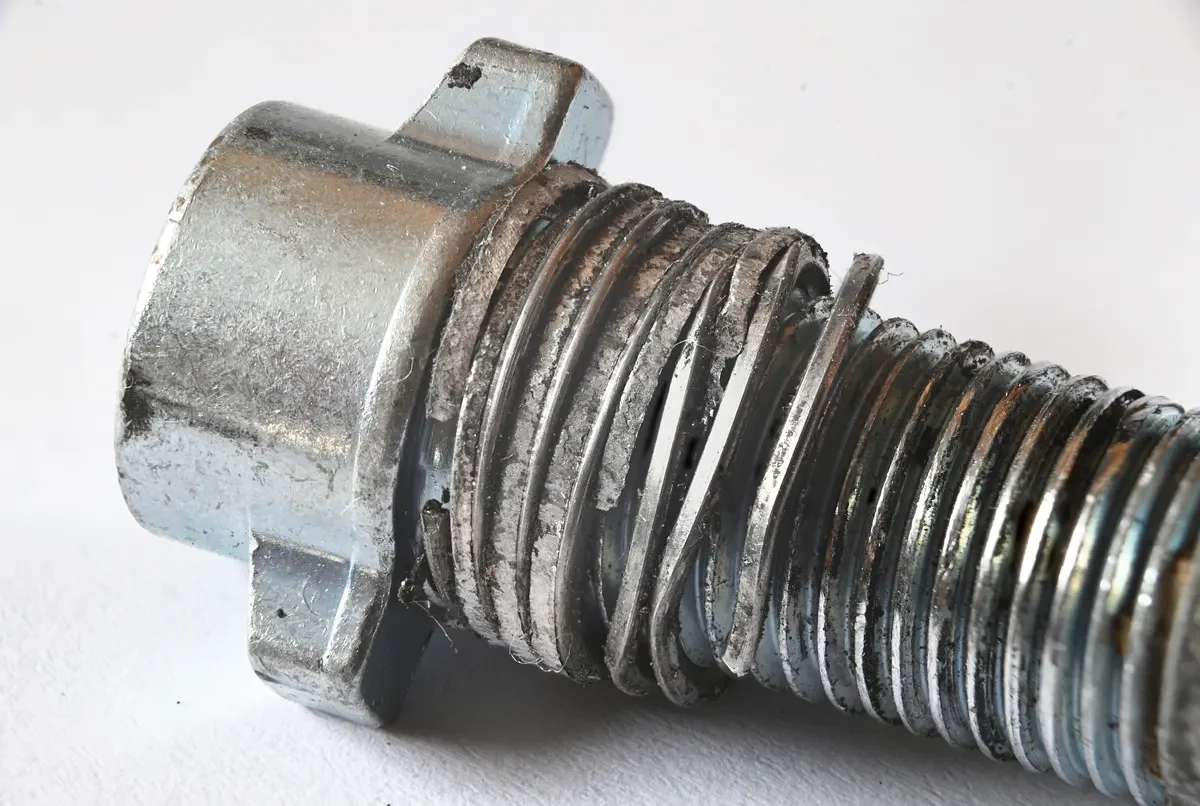
When a bolt is removed and refitted many times, or loaded hard, a thread tapped straight into aluminum is the weak link of the joint. The usual fix is a thread insert: a steel or stainless part that carries the thread so the aluminum only has to hold the insert. For a motor housing the common choice is a stainless wire coil insert, with press-in and key-locking inserts for special cases. Whichever type is used, the drawing has to name it, because the thread callout alone does not tell a shop what to cut.
Why a plain tapped thread in aluminum is the weak point
A bolted joint should be designed so that the screw breaks before the threads strip. Nord-Lock states that as the basic design rule, and gives a rule of thumb for how much thread must be engaged to get there: about 1 times the nominal diameter in steel and about 2 times in aluminum. The same page warns that for softer tapped materials and special alloys those values may not be enough.
A motor housing often cannot give 2 diameters of depth. The end cover bolts go into a thin rim, the foot bolts into a rib and the bearing cap screws into a boss next to a bearing seat. Many of these joints are opened at service or when the motor is swapped, and every refit wears the aluminum thread a little. The housing drawing then needs an insert instead of more depth.
Heli-Coil, the best known wire insert maker, describes the design logic in its catalog: assembly strength depends on the shear area and the shear strength of both the bolt and the parent material, and the insert length is chosen to balance bolt tensile strength against the shear strength of the parent metal, so the bolt fails before the housing does.
The insert types
| Type | How it is held | Where it fits a motor housing | Watch for |
|---|---|---|---|
| Direct tapped thread | Cut in the aluminum | Light, rarely removed joints with 2 diameters of depth | Strips first, no repair except an insert |
| Wire coil (helical) insert | Diamond section wire, wound into an oversize tapped hole, spring tension holds it | Frequently opened covers, thin bosses, repair of stripped holes | Needs its own tap, the driving tang is broken off after fitting |
| Press-in solid insert | Knurled or ribbed body pressed into a plain hole | Soft castings where the maker’s hardness limit is met | Hole size and hardness limit, vendor torque claims |
| Self-tapping insert | External thread cuts its own way into a drilled hole, often with a locking element | Production where a tapping step is to be avoided | Installation torque and hole size control |
| Key-locking insert | Keys driven into grooves cut through the threads, which locks it permanently | Joints where the insert must never turn or back out | Permanent once locked, so rework is hard |
Wikipedia describes each of these. For the coil type it notes that the wire is stainless steel or phosphor bronze, coiled to form inner and outer threads, sold in kits with matched taps and insert tools, with the driver tang broken off and discarded after installation. For press-in inserts it says they are pressed into a plain hole with a knurled outer surface, used in soft materials too weak to hold threads. Key-locking inserts, known by the Keenserts trademark, have keys hammered into grooves cut through the threads.
The Bossard page on the PEM CastSert gives a hardness limit for one press-in family: stainless inserts for die-cast and extruded aluminum and die-cast magnesium, rated for material up to HRB 70 or HB 125. Its torque-out claim (a 12.9 bolt breaks before the insert spins) and the 80 percent saving claims come from the vendor with no test conditions shown, so treat them as marketing until the insert maker supplies data for your alloy.
Choosing for a motor housing
There is no public study that ranks these types for motor housings. The reasoning below is the usual way a designer narrows the choice, and the designer has the last word.
- How often is the bolt removed? An end cover or terminal box that is opened at service points to a coil insert. A foot or flange bolt that is fitted once may stay as a tapped thread if depth allows.
- How thick is the boss? Heli-Coil says its inserts allow smaller bosses than other insert types and can often be fitted in an existing design without enlarging the boss. That is a maker claim, but the point stands: a coil insert adds only wire thickness to the hole, while a solid insert adds a wall.
- What is the casting? Press-in inserts have a hardness limit, so the housing alloy and temper matter. A hard housing may suit a coil insert better. Porous castings need care for any insert, see the casting porosity guide.
- Is the hole a leak path? A through hole into a coolant passage is a risk with any thread. Heli-Coil recommends blind holes wherever possible for corrosion reasons, and the same choice helps a liquid cooled housing. The water jacket leak test guide shows how such housings are proven.
Need a quote for this part? Get a quote for your motor part
Stainless in aluminum: the corrosion question
A coil insert is stainless steel, and the housing is aluminum, so the two metals touch inside the thread. Wikipedia names three conditions for galvanic corrosion: dissimilar metals, electrical contact and an electrolyte. A dry indoor motor misses the third condition. A motor that sees washdown, salt air or condensation does not.
The anodic index on the same page lists 18 percent chromium stainless at minus 0.50 V, cast aluminum alloys at minus 0.90 and minus 0.95 V, and magnesium at minus 1.75 V. The gap between stainless and cast aluminum is about 0.40 to 0.45 V. The page’s guidelines allow up to 0.50 V in controlled temperature and humidity, 0.25 V in normal storage and only 0.15 V in harsh outdoor or salt environments. By that yardstick the pair is acceptable in a controlled setting and weak in a harsh one.
Heli-Coil’s catalog gives a protection table by parent metal and service. For aluminum it lists none for normal service, and methods 1 and 2 for severe and extremely severe service. Method 1 is protecting the parent metal with an oxide coating such as anodize or Alodine. Method 2 is coating the insert, with cadmium or a dry film lubricant, and the catalog marks cadmium as not recommended for new designs because it is toxic. For magnesium housings the catalog asks for protection even in normal service, which is one reason magnesium is a different decision, see the magnesium versus aluminum guide.
The drawing should therefore say whether the tapped hole is protected, and in what order. If the housing is anodized, the tapping, the insert and the coating are three steps, and each shop in the chain needs the sequence. The coating guide for motor housings covers masking and thread allowances.
What the drawing must say
- Thread and class, for example M6x1 with the tolerance class of the finished internal thread.
- Insert type and standard. Heli-Coil lists NASM 33537 for standard assembly dimensions in inch sizes and MA1565 and MA1567 for metric helical coil inserts. Name the standard the shop is to follow, or state that an equal insert is accepted.
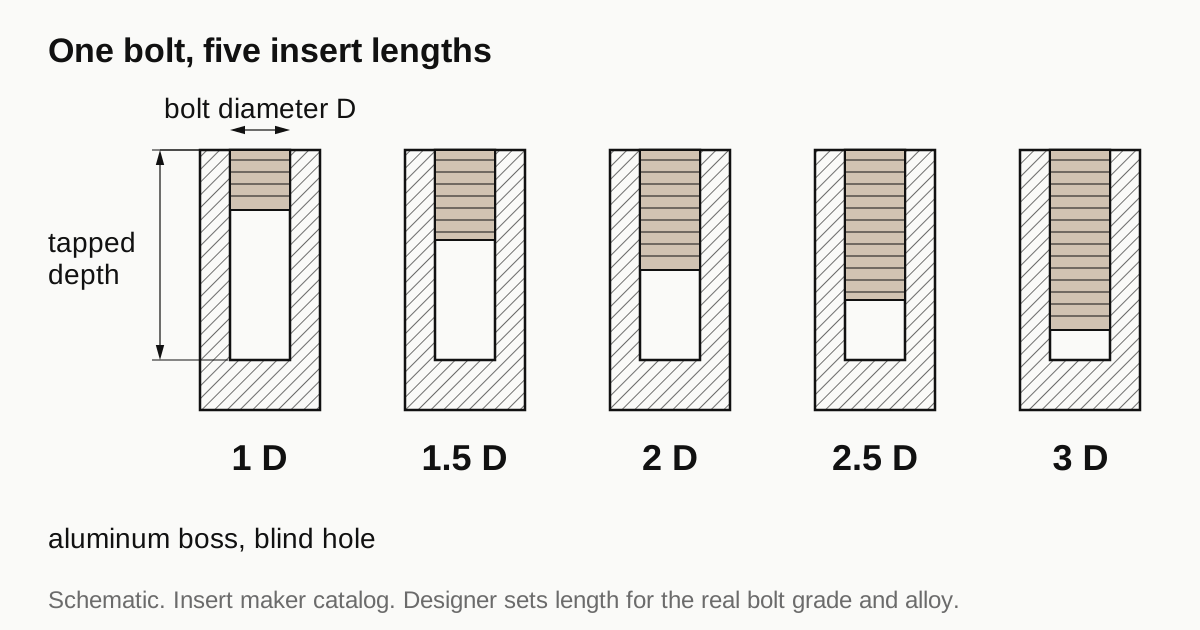
- Insert length, as a multiple of the bolt diameter (1, 1.5, 2, 2.5 or 3 in the Heli-Coil system), and the minimum tapped depth the insert needs.
- Hole preparation. The special tap that matches the insert, since insert kits come with their own tap, plus any countersink at the mouth and deburring. Follow the insert maker’s sheet for the chosen size.
- Who supplies and who installs the inserts, and whether the shop returns the housing with inserts fitted and inspected.
- Inspection. How the installed thread is checked, which gauge and on what share of holes.
- Protection. Coating sequence, plugging of holes during finishing and any anti-corrosion treatment of the insert.
- Material of the insert. Stainless is the default for coil inserts, but the catalog lists other wire materials for special duty, so state it.
A drawing with that list is quotable. A drawing that only says “6 x M6 tapped” leaves the shop to guess whether an insert is wanted at all.
Questions to ask a shop
- Which insert system do you use, and do you hold the tap for this size?
- Do you fit inserts in house or send them out?
- How do you check the thread after the insert is fitted?
- What is your plan for porous or thin walled bosses?
- Can you quote with and without inserts so the difference is visible?
No public price survey exists for fitting inserts in motor housings, so the only reliable way to see the cost is to quote the same drawing both ways. Thin wall housings need extra care when drilling and tapping near the rim, see the thin wall distortion guide.
When the drawing is ready, send the RFQ and we quote the finished parts and place the work with a partner shop that machines motor housings, with a reply within 24 business hours. The processes page explains how housings, end bells and shafts are machined.
Standards and references
- Threaded insert, overview of helical, self-tapping, press-in and key-locking inserts. Types, how each is retained and the use of helical inserts in soft metals such as aluminum, zinc die castings and magnesium.
- Nord-Lock, The Experts: Thread engagement in a tapped hole. Rule of thumb of about 1 times the nominal diameter in steel and 2 times in aluminum, and the warning that it can fall short in softer or special alloys.
- Heli-Coil, Insert Systems catalog (design data, corrosion protection and standards pages). Five insert lengths from 1 to 3 times the bolt diameter, the bolt against parent material strength balance, the corrosion protection table for aluminum and magnesium, and the standards list. Maker document.
- Bossard, PEM CastSert press-in inserts for castings and soft metals. Press-in stainless insert for die-cast aluminum and magnesium, HRB 70 or HB 125 limit. Performance claims are the vendor's own.
- Galvanic corrosion, anodic index and mitigation. Anodic index values for magnesium, cast aluminum and stainless steel, and the voltage guidelines by environment.
Figures on this page are typical ranges drawn from the standards above and from ordinary shop practice. They are not a specification for your part. The partner shop that prices your part confirms what it can hold on your geometry.
Frequently asked questions
How long should a thread insert be in an aluminum housing?
The Heli-Coil catalog offers coil inserts at 1, 1.5, 2, 2.5 and 3 times the bolt diameter and picks the length by balancing bolt tensile strength against the shear strength of the parent metal. The designer sets it. For a plain tapped hole in aluminum, Nord-Lock gives about 2 times the diameter as a minimum rule of thumb.
Are coil inserts stronger than threads tapped directly into aluminum?
Wikipedia says helical inserts give stronger threads than direct tapping in soft materials such as aluminum. Heli-Coil explains it by the coil's flexibility, which spreads the load along the engaged length. No public figure applies to every alloy and bolt, so ask the designer for a pull-out check on the real housing.
Can a stainless steel insert corrode an aluminum housing?
It can, in a wet environment. The anodic index lists 18 percent chromium stainless at minus 0.50 V and cast aluminum at minus 0.90 to minus 0.95 V, a gap of 0.40 to 0.45 V. Heli-Coil lists protection steps for aluminum in severe service. Dry indoor motors are far less exposed.
Should the drawing name the insert or leave it to the shop?
Name it. The drawing should give the thread, the insert type and standard, the insert length and the tapped depth. Leaving it open lets each quote assume a different part, and the quotes then cannot be compared. Also state who supplies the inserts and who installs them.
Need a quote for this part?
Send the drawing. We quote the finished parts, place the work with a partner shop and reply within 24 business hours.
Get a quote for your motor part