Guides / Buyer Guide
Small BLDC Motor Housings for Drones and Robotics: Bells, Bases and Machining Needs
Written by the team that reads your RFQPublished How we write these
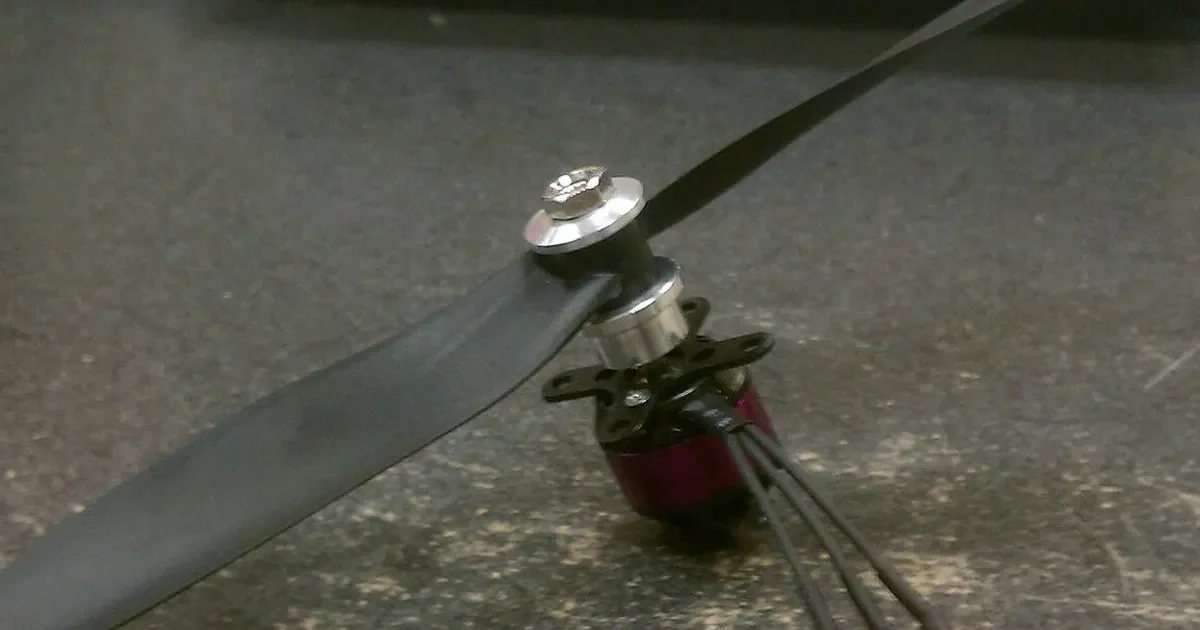
A drone motor weighs tens of grams and spins at many thousands of revolutions per minute. A robot joint motor is bigger and slower, but also compact and light. Both are brushless DC motors with small housings, and both ask a lot of the machine shop in relation to the size of the part. Thin walls, small bearing seats and a need for low weight make them harder to machine than their size suggests.
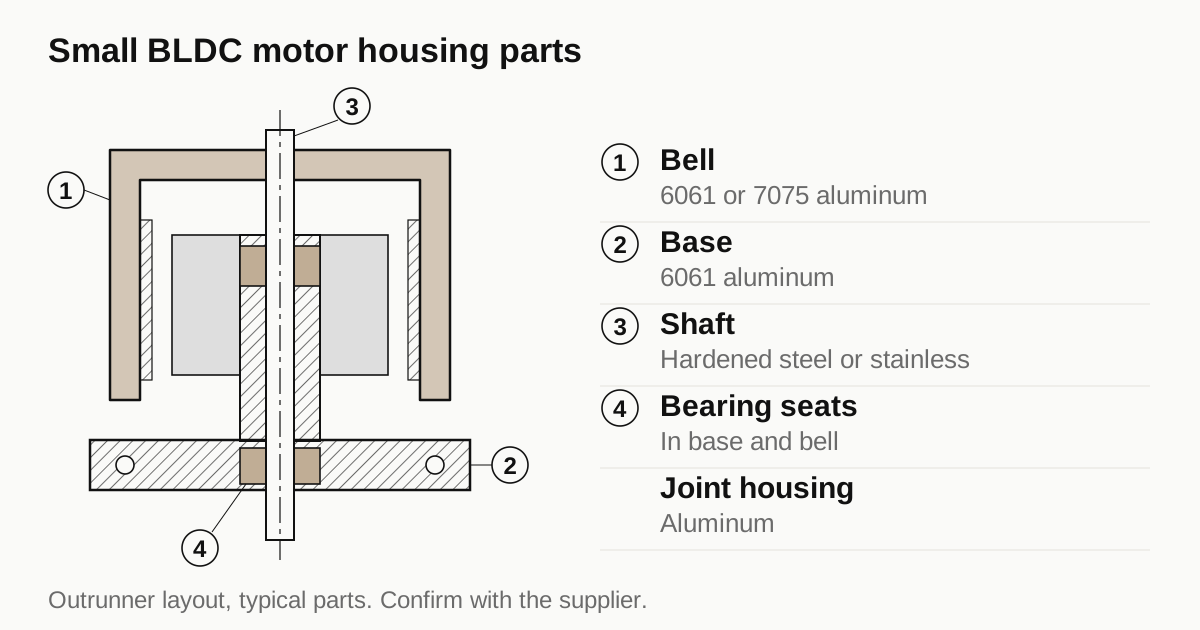
This guide describes the parts, the features and tolerances that matter, the materials in use and what to put on the RFQ. It is written for civil products such as camera drones, agricultural and inspection platforms and robot actuators.
Two layouts: outrunner and inrunner
Outrunner. The rotor is the outer part, called the bell, and it carries the magnets on its inner wall. The stator sits fixed in the middle on a base. Most drone motors use this layout, since it gives high torque for a small diameter.
Inrunner. The rotor spins inside a fixed stator, and the housing is a fixed sleeve. Inrunners suit very high speeds and are common in small geared actuators.
Robot joint actuators often combine a flat outrunner style motor with a gear reducer and an encoder, in an aluminum housing that also serves as the structure of the joint.
The parts
| Part | Role | Typical material |
|---|---|---|
| Bell | Rotating outer cup that carries magnets | 6061 or 7075 aluminum, sometimes steel ring inside |
| Base or stator mount | Holds the stator and the bearing, carries the mounting holes | 6061 aluminum |
| Shaft | Carries the propeller or the drive, runs in bearings | Hardened steel or stainless |
| Bearing seats | Hold small deep groove bearings | Part of the base and bell |
| Cover or housing, in robot motors | Encloses the motor, carries the encoder | Aluminum |
Sizing from the motor number
Many small motors follow the stator size naming. A motor called 2207 has a stator about 22 mm in diameter and 7 mm in height. A 2806 has a 28 mm stator, 6 mm tall. The bell inner diameter is just larger than the stator plus the magnets and the air gap, and the bell height is just larger than the stator stack. These numbers give a shop the order of magnitude of everything on the drawing.
The bell
The bell is a thin walled cup with an inner seat for the magnets and an end plate with a hole for the shaft. Machining it asks for three things.
- A round, concentric magnet seat. The air gap between magnets and stator is a fraction of a millimeter, so any ovality shows up as noise and uneven pull.
- Thin walls. To save weight, the wall is often under a millimeter in places, and the bell may have cutouts or ribs for cooling and balance. The thin-wall guide covers clamping and finish passes.
- A shaft hole or press seat that holds the shaft square to the bell axis.
Holding a thin bell for machining usually means a mandrel that fits the inside or soft jaws bored to the outside. Turning the inside and the outside in the same setup, or turning the outside on a mandrel that grips the finished inside, keeps them concentric.
The base
The base has a bearing seat, a seat for the stator, mounting holes and sometimes a cable slot. Details that matter:
- Bearing seat bore in the H7 range for small bearings, with roundness a fraction of the tolerance.
- Stator seat, a cylinder that the stator presses onto, with an interference or a clearance fit and adhesive.
- Mounting pattern. Common square patterns such as 16 by 16 mm or 19 by 19 mm with M3 holes are used on drone frames. The pattern must match the frame, so it comes from the buyer.
- Face flatness and squareness to the bearing axis, so that the motor shaft sits square to the propeller plane.
Materials and weight
Aluminum dominates, because the parts are light and machinable.
- 6061-T6 is the standard choice for bases and bells.
- 7075-T6 is stronger and used where the load is higher or the walls are thinner. It is less forgiving to anodize and costs more.
- Titanium and magnesium show up in a few specialist parts. They raise cost and machining difficulty a lot.
Weight is a design driver. A few grams saved per motor matter on a drone with four or more of them. Designers use pockets and thin ribs, which makes machining harder and more expensive. A buyer who sees a high quote on a small part should check whether the weight pockets are what drives it.
Robot joint housings
A robot joint motor is larger than a drone motor and slower, and its housing does more. It is usually a flat, wide motor with a hollow center, joined to a reducer and an encoder in one compact unit. The aluminum housing carries the stator, the bearings, the encoder, the reducer interface and the mounting to the arm segments.
For machining this means more features and tighter relationships.
- Hollow bore. A central through hole carries cables or a shaft. Its diameter and concentricity to the bearing seats matter, since the bore may hold a sensor or a seal.
- Large diameter thin section bearings. The seats are large and thin walled, and distort easily. Roundness has to be measured on the free part.
- Reducer interface. The face and spigot where a harmonic or planetary reducer bolts on need flatness and concentricity.
- Encoder seat. The encoder reads position at the output, so its seat is concentric with the main axis.
- Cooling or sealing. Some joints are sealed to keep dust out and carry a groove for a seal.
Because the joint is a structural part, stiffness and mass are both design targets. The shop will see pockets and ribs that cut weight, and the cutting order for these features follows the same relax and finish logic described in the thin-wall guide.
Need a quote for this part? Get a quote for your motor part
Magnet seat preparation and cleanliness
Magnets are glued into the bell, and the bond depends on the seat. A seat with oil, cutting fluid or a thin film of anodize can fail in use when a magnet lets go at speed. The consequence is severe, since a loose magnet at high rpm can destroy the motor.
- Clean seats. The bell leaves the shop clean and dry, with no cutting fluid residue. Shops that machine magnet seats know to wash and to handle the parts with gloves.
- Surface condition. A lightly textured seat bonds better than a polished one. Some designs call for a bead blast or a grooved pattern in the seat.
- No coating on the seat. Anodize and paint reduce adhesive grip. The seat is masked, or the bell is machined after coating.
- Magnets and magnetic fields. Magnets attract chips and swarf once they are installed. Cleanliness after magnet installation is the motor builder’s job, but the machined parts should arrive clean so that fewer chips find their way in.
If the shop installs the magnets, say which adhesive and cure schedule applies. Many small motor makers install magnets themselves and ask the shop for only the bare bell.
Shaft and bearing arrangement
The shaft of a small motor is usually hardened steel or stainless, with a diameter of a few millimeters, and it runs in two small bearings. The arrangement of bearings affects the housing.
- Two bearings in the base, with the shaft passing through and the bell pressed onto it. The base carries both seats, so they are cut in the same setup.
- One bearing in the base and one in the bell, a design that saves height. The two seats are in different parts, and the stack up of the tolerances adds, so each has to be tighter.
- A retaining ring or a shim sets axial position. The ring groove on the shaft or the shoulder in the housing needs a stated width and depth.
Bearing seats on parts this small are tiny. A 3 mm shaft bearing sits in a bore of 8 mm or so. The H7 tolerance band is only a few micrometers wide, and it is measured with an air gauge or a small bore gauge. Ask the shop how it measures a bore this small, and how often.
Balance
Small motors spin fast, so balance matters. The permissible unbalance in gram millimeters is tiny because rotor mass is small. For a 30 g rotor at 12,000 rpm and grade G2.5, the formula gives an allowed unbalance of about 0.06 g.mm in total, which shows how small the numbers get. The balancing guide explains the formula.
Shops help by holding bell and shaft concentricity and keeping wall thickness even. Balancing itself is done after the magnets and shaft are assembled. Balance correction on small bells is often done by removing a little metal from the rim or adding a spot of adhesive.
Fits and finishes
- Bearing seat to bearing, a light interference or a transition fit for the shaft and a clearance fit for the housing in the usual small motor design, set by the designer from the bearing maker’s tables.
- Anodize for appearance and wear, with masking on the fits. The coating guide covers thickness and masking.
- Surface finish on the magnet seat, so adhesive grips.
Checklist before you send the RFQ
- State the motor size designation and give the full drawing.
- Mark bearing seats with the bearing number and fit class.
- State the concentricity of the magnet seat to the bearing axis.
- State minimum wall thickness and weight target.
- State material, temper and finish with masking.
- State quantity, and whether the batch is for prototypes or a production run.
When the drawing is ready, send the RFQ and we quote the finished parts and place the work with a partner shop that machines small motor parts. Replies come within 24 business hours.
Standards and references
- Brushless DC electric motor, overview of inrunner and outrunner layouts. Background on the outer rotor design used in most small drone motors.
- ISO 286-1, ISO code system for tolerances on linear sizes. Fit classes for small bearing seats and the bell bore.
- ISO 21940-11, Mechanical vibration, Rotor balancing, Procedures and tolerances for rotors with rigid behaviour (replaces ISO 1940-1). Balance grades for small high speed rotors.
- Aluminium alloy, overview of wrought alloys such as 6061 and 7075. Background on the alloys that small motor parts are usually made from.
Figures on this page are typical ranges drawn from the standards above and from ordinary shop practice. They are not a specification for your part. The partner shop that prices your part confirms what it can hold on your geometry.
Frequently asked questions
What do numbers such as 2207 mean on a drone motor?
By common convention the first two digits give the stator diameter in millimeters and the last two give the stator height in millimeters. A 2207 motor has a stator about 22 mm across and 7 mm tall. The housing parts are sized to match, so the number tells a shop the scale of the bell and base.
Why are small motor bells usually CNC turned from bar?
At low and medium volume it needs no tooling, gives accurate round surfaces and lets the designer change dimensions between batches. The bell is thin walled, so the shop uses careful clamping and light finish cuts to keep it round.
How tight is the balance requirement on a small motor?
Tight in relative terms, because small motors spin fast. Rotor mass is tiny, so the allowed unbalance in gram millimeters is small too. The designer sets the grade, and the machined bell and shaft help by keeping runout low and mass even.
Need a quote for this part?
Send the drawing. We quote the finished parts, place the work with a partner shop and reply within 24 business hours.
Get a quote for your motor part