Guides / Buyer Guide
Stainless Steel Motor Shafts: Choosing Between 416, 420 and 17-4 PH
Written by the team that reads your RFQPublished How we write these
For a stainless motor shaft the usual answer is 416 when the shaft carries many machined features and sits in a dry or mild environment, 420 when a hard wear surface matters more than machinability, and 17-4 PH when strength and corrosion resistance both have to be high. All three are martensitic, so all three are magnetic and all three are heat treated, which means the drawing must name the heat treatment condition as well as the grade. A drawing that says only “stainless steel” gets quotes in the wrong grade.
The three grades side by side
| 416 | 420 | 17-4 PH | |
|---|---|---|---|
| Family | Free-machining martensitic | Martensitic | Precipitation hardening martensitic |
| Main alloying | 12 to 14% Cr, sulfur 0.15% min | 12 to 14% Cr, carbon 0.15% min, sulfur 0.030% max | 15 to 17.5% Cr, 3 to 5% Ni, 3 to 5% Cu |
| Machining | Best of the stainless grades | Harder to cut than 416, not free-machining | Similar to 304 and 410, slower when aged hard |
| How it hardens | Quench and temper | Quench and temper | Solution treat, then age at 900 to 1150 F for 1 to 4 hours |
| Corrosion | Atmospheric, below 304L | Mild environments | Comparable to 304 |
| Uses listed by suppliers | Axles, shafts, gears | Gears, needle valves, instruments | Pump shafts, gears, valve stems |
| Spec examples | ASTM A582, AMS 5610 | Confirm with the supplier | ASTM A564, AMS 5643 |
The chemistry and spec rows come from the Rolled Alloys and Aircraft Materials sheets. They describe the grades in general. Always take the numbers for your lot from the mill certificate.
416: when machining decides
Rolled Alloys describes 416 as a free-machining martensitic stainless with 12 to 13 percent chromium and the best machining of the stainless family. United Performance Metals rates it at about 85 percent of free-machining carbon steel. The sulfur does the work: manganese sulfide inclusions break the chip and lubricate the cut. The price is corrosion resistance, since Rolled Alloys places 416 above mild steel but inferior to 304L or 17-4. The same sheet notes that free-machining grades are typically not welded.
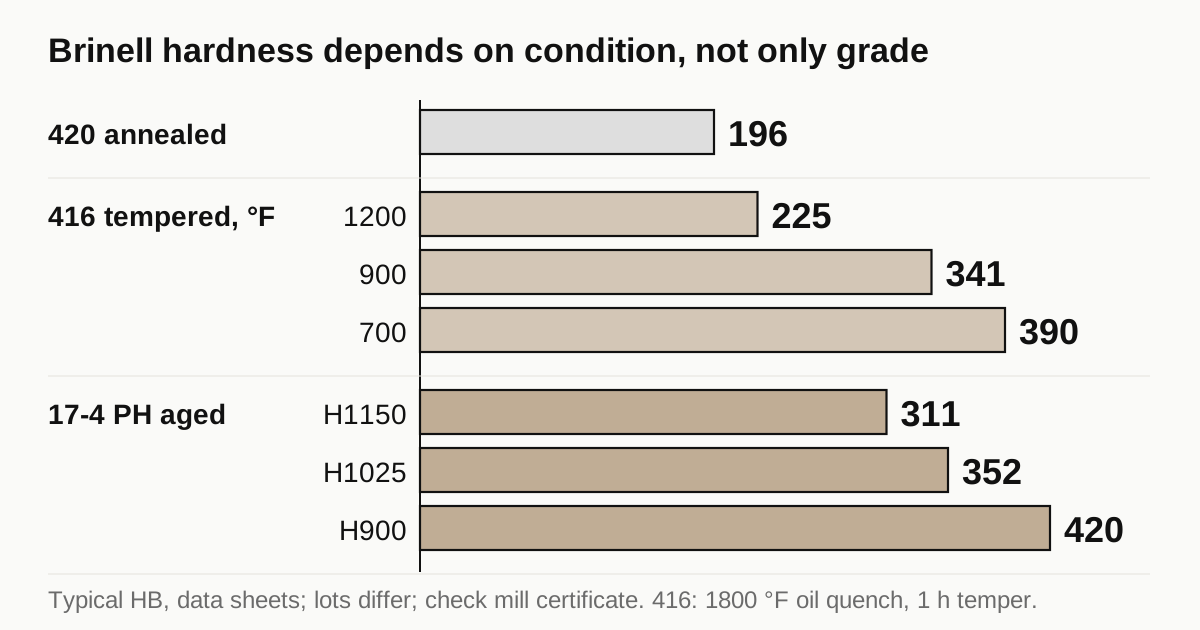
Aircraft Materials gives the response to heat treatment for a 1 inch bar hardened at 1800 F and tempered for one hour. The values depend heavily on the tempering temperature:
| Tempering temperature | Tensile strength | Brinell hardness |
|---|---|---|
| 300 F (149 C) | 1344 MPa | 390 |
| 700 F (371 C) | 1310 MPa | 390 |
| 900 F (482 C) | 1158 MPa | 341 |
| 1100 F (593 C) | 862 MPa | 262 |
| 1200 F (650 C) | 758 MPa | 225 |
The same page lists axles, gears, pinions and lead screws among the uses of 416, and advises against it for vessels holding gases or liquids under high pressure. The warning is aimed at pressure vessels and not at shafts, but the designer should read it before choosing the grade.
420: when the surface must be hard
420 has 0.15 percent minimum carbon, and the Wikipedia entry on martensitic stainless steel says that carbon is there for improved strength. The Aircraft Materials sheet gives the annealed condition: 196 HB, tensile strength 655 MPa and yield 345 MPa. Hardened values depend on the temper, and the sources checked for this guide contradict each other, so none is printed here. Ask the supplier for the hardness range after the tempering step that your design needs.
Two points matter for a shaft. 420 is not treated here as a free-machining grade, since its sulfur limit is 0.030 percent against a minimum of 0.15 percent for 416, so features cost more to cut. The Aircraft Materials page also labels its AMS 5620 entry free machining, which conflicts with its own sulfur limit, so confirm the exact specification with the supplier. And 420 is a mild-environment stainless: the Wikipedia entry says martensitic grades resist corrosion generally only in relatively mild environments.
Need a quote for this part? Get a quote for your motor part
17-4 PH: strength and corrosion together
Rolled Alloys describes 17-4 as an age-hardening martensitic stainless that combines high strength with the corrosion resistance of stainless steel, hardened by a short, simple low-temperature treatment. West Yorkshire Steel says its corrosion resistance is comparable to 304 and better than 431, 420 and 410.
The aging condition sets the properties. The Rolled Alloys representative longitudinal values:
| Condition | Tensile strength | Yield strength | Brinell hardness | Charpy V-notch |
|---|---|---|---|---|
| H900 | 200 ksi (1379 MPa) | 185 ksi (1276 MPa) | 420 | 15 ft-lb (20 J) |
| H1025 | 170 ksi (1172 MPa) | 165 ksi (1138 MPa) | 352 | 35 ft-lb (47 J) |
| H1150 | 145 ksi (1000 MPa) | 125 ksi (862 MPa) | 311 | 50 ft-lb (68 J) |
Higher strength costs toughness. Rolled Alloys describes H900 as maximum hardness with low toughness and sensitive to stress corrosion cracking. It also says that for most applications 17-4 should not be used in condition A, since the structure is untempered martensite with low fracture toughness and poor resistance to stress corrosion cracking. So the drawing must say H1025, H1150 or another aged condition, not just “17-4”.
West Yorkshire Steel says 17-4 machines much like 304 and 410, with H900 hardest to cut, so run at about 60 percent of the condition A rate. No source checked for this guide gives a size change on aging, so none is printed. Ask the shop whether it rough turns before aging and finishes after, and what allowance it leaves.
Choosing, in one pass
| If the shaft | Look first at |
|---|---|
| Carries splines, keyways, cross holes and runs dry or in mild air | 416 |
| Needs a hard journal or seal surface and sees mild moisture | 420 |
| Sees washdown, carries load and needs toughness | 17-4 PH in H1025 or H1150 |
| Sees strong chemicals or chlorides | Outside this comparison, ask the designer |
The last row is a limit, not a recommendation. The sources only place 17-4 at 304 level, and the housing case in the guide on stainless motor housings for washdown shows how quickly the grade question becomes an environment question.
What to put on the drawing
- Grade and standard, for example 17-4 PH to ASTM A564 or AMS 5643 and 416 to ASTM A582, with the 420 specification confirmed by the supplier.
- Heat treatment condition and hardness range, since the grade name alone does not fix them.
- Which surfaces are ground after heat treatment, and the journal tolerance. The guide on grinding versus hard turning for bearing journals compares the finishing options.
- Splines and keyways, and whether they are cut before or after hardening, see shaft splines and keyways.
- Mill certificate with the heat treatment condition.
- Magnetic or non-magnetic requirement, to avoid a mix-up later.
When the drawing is ready, send the RFQ and we quote the finished parts and place the work with a partner shop that machines motor parts, with a reply within 24 business hours.
Standards and references
- Rolled Alloys, 17-4 stainless data sheet (Bulletin 1740USe). Composition, aging conditions, representative tensile, hardness and Charpy values, and the warning against using condition A.
- Rolled Alloys, 416 stainless data sheet (Bulletin 416USe). Free-machining martensitic grade, sulfur content, corrosion note against 304L and 17-4, shaft applications.
- United Performance Metals, 416 stainless steel datasheet. Machinability of about 85 percent of free-machining carbon steel through sulfide inclusions.
- Aircraft Materials, Type 416 (AMS 5610). Properties after oil quench from 1800 F and tempering from 300 to 1200 F, and the pressure vessel warning.
- Aircraft Materials, Type 420. Composition, sulfur limit and annealed properties of the grade, and its listed uses.
- West Yorkshire Steel, 17-4PH. Machining guidance, corrosion comparison with 304 and 420, and aging temperatures.
- Martensitic stainless steel, overview. Family description, ferromagnetism and the limit on corrosion resistance.
Figures on this page are typical ranges drawn from the standards above and from ordinary shop practice. They are not a specification for your part. The partner shop that prices your part confirms what it can hold on your geometry.
Frequently asked questions
Which stainless steel is easiest to machine for a motor shaft?
416. It is a free-machining martensitic grade, and United Performance Metals rates it at about 85 percent of free-machining carbon steel, because sulfide inclusions act as chip breakers. Keyways, splines and cross holes cost less in 416 than in 420 or 17-4 PH.
Is 17-4 PH more corrosion resistant than 416?
Yes. Rolled Alloys calls 416 inferior to stainless such as 304L or 17-4, and West Yorkshire Steel puts 17-4 PH comparable to 304 and better than 420 and 410. Neither grade is a seawater grade, so the environment still has to be named.
Can I use 17-4 PH in the as-supplied condition A?
Rolled Alloys advises against it for most applications. Condition A is untempered martensite with low fracture toughness and poor resistance to stress corrosion cracking. Specify an aged condition such as H1025 or H1150 on the drawing.
Are 416, 420 and 17-4 PH magnetic?
All three are martensitic grades, and the Wikipedia entry on martensitic stainless steel says the family is ferromagnetic. If the design needs a non-magnetic shaft, none of the three fits, and that is a different material discussion.
Need a quote for this part?
Send the drawing. We quote the finished parts, place the work with a partner shop and reply within 24 business hours.
Get a quote for your motor part