Guides / Buyer Guide
Motor Shaft Splines and Keyways: Which Process Cuts Them and What It Costs
Written by the team that reads your RFQPublished How we write these
Torque has to get from the rotor shaft into whatever the motor drives. Two connections do most of the work: a keyway with a parallel key, and a spline. They look similar on a drawing, since both are features cut into the shaft, but they use different processes, different tools and different price logic. A buyer who understands the difference can ask better questions and read the quotes more easily.
This guide covers the four processes that cut these features, where each one fits and what the drawing has to say so that shops quote the same job.
Keyway or spline
A keyway is a rectangular slot along the shaft that holds a key, and the key also sits in a slot in the hub. It is simple and cheap. It also weakens the shaft slightly, because the slot is a stress raiser at the corner, and it puts the load on one side of the shaft.
A spline is a series of teeth around the shaft that mesh with matching teeth in the hub. It spreads the torque around the whole circumference, handles higher loads for the same diameter and centers the hub on the shaft. It needs special tooling and tighter control of the pitch.
Motor designers pick a keyway for ordinary industrial and fan motors and a spline where the load is higher, where the hub has to slide along the shaft or where the drive has to center accurately, as in many traction and gearbox motors.
The four ways to cut them
Milling
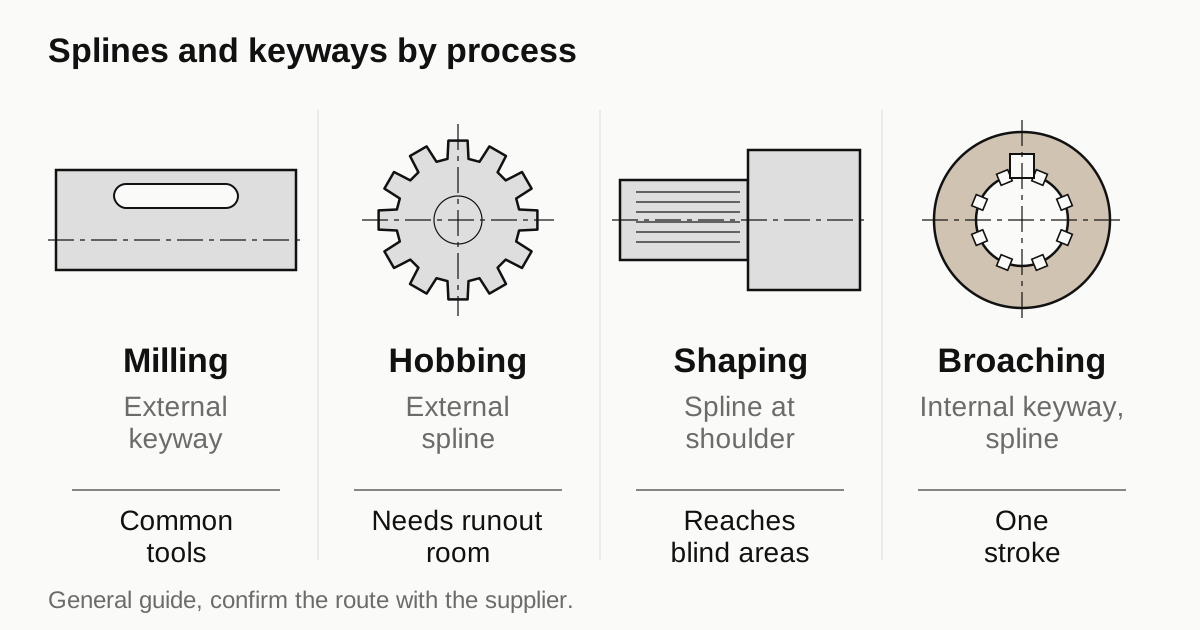
A keyway on a shaft end is usually milled. A slot drill or a disc cutter on a milling machine cuts the slot to the width and depth on the drawing. A Woodruff keyseat is cut with a small disc cutter. The process is fast and the tools are common, so almost any shop can do it.
Hobbing
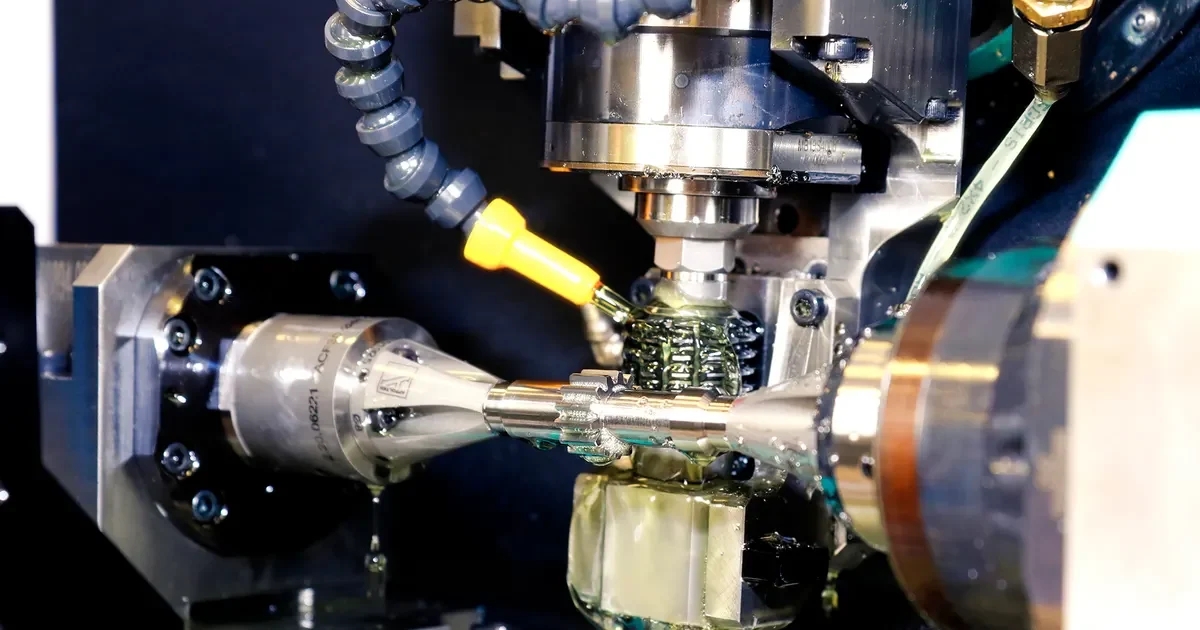
Hobbing generates external splines and gear teeth continuously. A hob, which is a worm shaped cutter, and the shaft rotate in sync while the hob feeds along the shaft. Each tooth form is cut as the two rotate, so the result is accurate in pitch and the cycle is short.
Hobbing needs room for the hob to run out at the end of the tooth, which means an undercut or a long enough neck beside the spline. It also needs a hob for each module and pressure angle. This is the usual choice for external involute splines in volume.
Shaping
Shaping and slotting use a reciprocating cutter that moves along the spline while the shaft indexes. It is slower than hobbing but it can cut right up to a shoulder, where a hob cannot run out. It also handles internal splines in a blind hole. When a motor shaft has a spline close to a bearing shoulder, shaping may be the only generating route.
Broaching
A broach is a long tool with rising teeth that is pushed or pulled through a part to cut the whole form in one stroke. Broaching is the classic way to cut an internal spline or an internal keyway in a hub. On a shaft it is less common, but external broaching is used in some high volume runs.
A broach is made for one form and one size, and its cost is high. At low volume that cost dominates, and at high volume it disappears into the part price.
Which process fits which job
| Process | Typical use on a motor shaft | Strength | Limit |
|---|---|---|---|
| Milling | External keyway, Woodruff keyseat | Cheap, flexible, common tools | One slot at a time |
| Hobbing | External involute spline | Fast, accurate pitch | Needs runout room beside the spline |
| Shaping | Spline against a shoulder, internal spline | Reaches where a hob cannot | Slower cycle |
| Broaching | Internal keyway or spline in a hub | One stroke, very repeatable | High tool cost per form |
The cost shape follows tooling. Milling has almost none. Hobbing and shaping need cutters per form. Broaching needs a broach per form and size. A prototype batch of ten shafts is cheap to mill and expensive to hob, unless the shop already owns a hob for that module.
Spline fit types in plain words
The fit type decides which surfaces locate the hub and which surfaces only carry load. The three common types behave differently.
Side fit. The flanks of the teeth touch and carry the torque, and a small clearance sits at the major and minor diameters. This is the usual choice for involute splines, because the tooth form tends to center itself. The flank tolerance is the critical one.
Major diameter fit. The outside diameter of the shaft teeth centers the hub, with clearance at the flanks. It suits splines that must run true and carry a light load, and it makes the major diameter the dimension to control.
Minor diameter fit. The root of the shaft locates the hub. It is used for straight sided splines where the minor diameter can be ground accurately after hardening.
If the drawing names the standard and the fit type, a shop knows which surfaces to hold tightly and which to leave at a normal tolerance. If the fit type is missing, a careful shop assumes the tighter case and prices it.
Tooling lead time and ownership
Spline tooling is not always on the shelf. A hob for a common module and pressure angle may be in stock at a gear shop. A less common form needs to be ordered, and the lead time is measured in weeks. A broach is made to order. When the tool belongs to the buyer, it travels with the job, and the shop only has to maintain and sharpen it.
There are three situations to separate on the RFQ.
- The shop already owns a suitable tool. The quote includes only cutting time, and the first parts can start quickly.
- The tool has to be bought. The quote shows a one off tooling line and a lead time. This is fair and expected, and a buyer should ask who owns the tool afterward.
- The buyer supplies the tool. The shop quotes the cutting only and states how it will store, sharpen and return the tool.
A request for quotes that does not say which case applies produces quotes that cannot be compared. One shop includes tooling and another leaves it out, and the cheaper looking quote turns out higher.
Need a quote for this part? Get a quote for your motor part
Why torque capacity favors splines
A keyed joint transfers torque through the side of the key and the side of the keyway. The contact area is small and sits on one side of the shaft. A spline shares the load across every tooth, so the same shaft diameter carries more torque with less local stress. The effective use of the whole circumference also keeps the hub centered, where a key tends to push the hub off center slightly.
For a buyer this matters because it explains why the same shaft diameter can be specified with either feature and why the price differs. A designer may move from a key to a spline to gain torque capacity without growing the shaft. The machining cost goes up, but the rest of the motor stays the same size. Treat any suggestion to swap one for the other as a design change that needs the motor designer’s approval, not a shop’s cost saving.
What the drawing has to say
For a keyway
- Shaft diameter and the key size. ISO 773 and its relatives list key width and height by shaft diameter. For example, a shaft in the 22 to 30 mm range commonly takes an 8 by 7 mm key. Check the standard rather than rely on memory.
- Keyway width tolerance class. Normal and close fit classes exist, and the close class costs more to hold.
- Keyway depth, length and the shape of the ends, which can be square or radiused to suit a milling cutter.
- Position, usually in relation to a flat on the shaft or to another feature.
For a spline
- The standard, such as ISO 4156, ANSI B92.1 or DIN 5480.
- Module or pitch, number of teeth and pressure angle.
- Tolerance class and fit type: side fit, major diameter fit or minor diameter fit.
- Inspection method. Spline measurement uses pins or balls, a go and no go gauge or a gear measuring machine.
- Length of the spline and the shape of the runout.
A spline callout that leaves out the inspection method leads to a surprise at first article, when the shop measures one way and the buyer another.
Order of operations and heat treatment
Cut splines and keyways while the steel is soft. After heat treatment, the shaft moves, and the soft features move with it. If the spline flank has to hold a tight tolerance after hardening, the route may need a finishing step such as grinding the flanks, or a design that hardens only the journals and leaves the spline area soft.
The guide to induction hardened shaft journals explains how hardening is localized, which affects where a spline can safely sit. The allowance left on the journals for finishing is covered in the comparison of grinding and hard turning.
Common sources of quote differences
- Whether the shop owns the hob, shaper cutter or broach. A shop with the tool quotes a part price. A shop without it quotes tooling plus part, and the total looks higher at low volume.
- Runout room. A spline too close to a shoulder rules out hobbing, which pushes the job to shaping and its slower cycle.
- Tolerance class. A tighter class often means a finishing step.
- Inspection. Gauges and measuring machines cost money per spline form.
- Heat treatment sequence, which can add a finishing operation.
Checklist before you send the RFQ
- Say whether the feature is a keyway or a spline and give the standard.
- Give all spline parameters, not only the number of teeth.
- Name the fit type and tolerance class.
- Show runout room beside the spline or accept that a different process may be needed.
- State the inspection method you will use on arrival.
- Say when in the route the feature is cut relative to heat treatment.
When the drawing is ready, send the RFQ and we quote the finished parts and place the work with a partner shop that machines motor parts, with replies within 24 business hours.
Standards and references
- Spline (mechanical), overview of spline types and uses. Background on involute, straight sided and serrated splines.
- Hobbing, overview of the gear and spline generating process. How a hob cuts teeth continuously, the basis of section 2.
- Broaching (metalworking), overview of the process. Why broaching suits internal splines and keyways.
- Keyway, overview of keyed shaft connections. Terms used for shaft and hub keyways in section 4.
- ISO 4156, Straight cylindrical involute splines, metric module, side fit. The standard that defines module, pressure angle and tolerance class for involute splines.
Figures on this page are typical ranges drawn from the standards above and from ordinary shop practice. They are not a specification for your part. The partner shop that prices your part confirms what it can hold on your geometry.
Frequently asked questions
Should the spline or keyway be cut before or after heat treatment?
Usually before, while the steel is soft and easy to cut. Heat treatment then distorts the shaft slightly, and a finishing step brings critical surfaces back. If the spline flanks need hardness and tight tolerance, some designs finish them by grinding or by cutting after a light hardening. The route should be agreed before the RFQ closes.
Which spline standard should the drawing name?
The one the mating part was designed to. ISO 4156 is common for metric involute splines, ANSI B92.1 for inch involute splines in the US and DIN 5480 in many European designs. The drawing should name the standard, the module or pitch, the number of teeth, the pressure angle and the tolerance class.
Is a keyway cheaper than a spline?
Usually, because a keyway is a single slot cut with a standard tool. A spline needs a dedicated hob, shaping cutter or broach, and a setup that holds the indexing. The cost balance flips at high volume, where the hob cost is spread across many shafts.
Need a quote for this part?
Send the drawing. We quote the finished parts, place the work with a partner shop and reply within 24 business hours.
Get a quote for your motor part