Guides / For Shops
Quoting a Motor Housing From a Casting Drawing: What a Shop Should Check Before Pricing
Written by the team that reads your RFQPublished How we write these
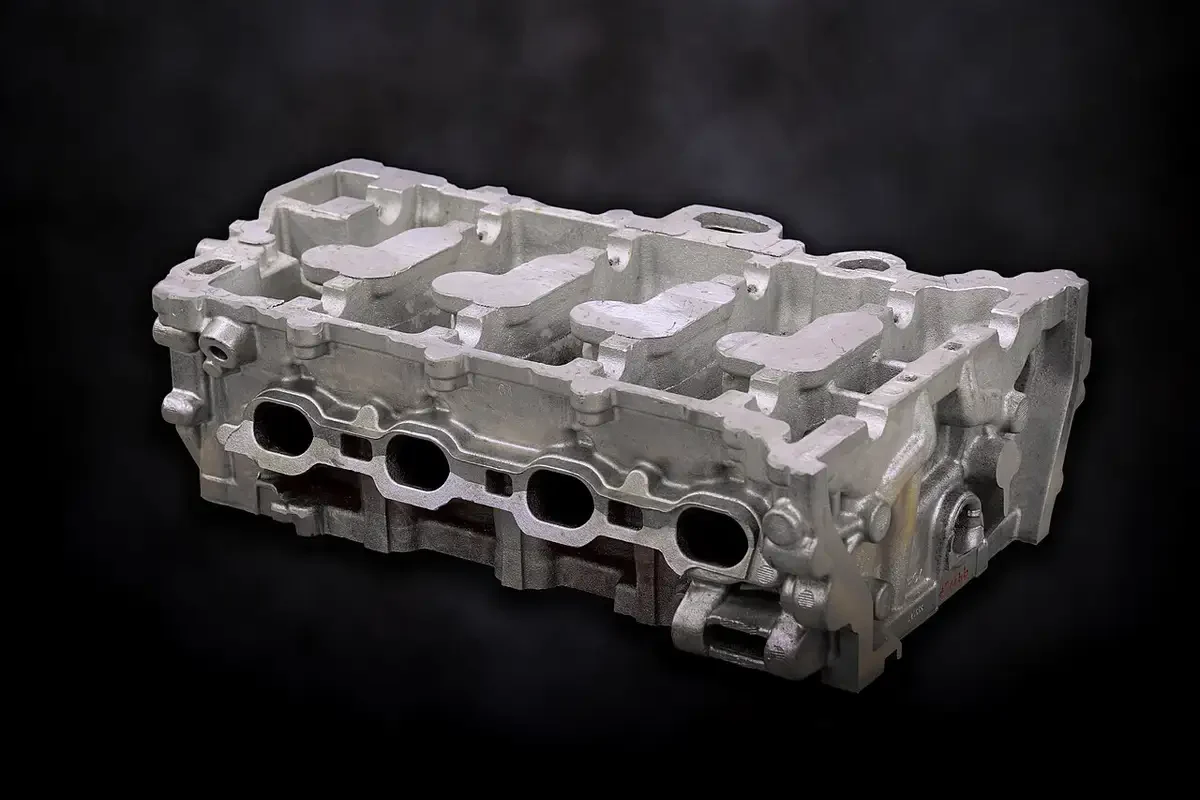
A buyer sends a casting drawing for a motor housing and wants a machined price. The drawing is a different kind of document from a billet drawing: part of the geometry is already there, the surfaces you must reach are covered by variation you did not make and the first operation has to find its datums on rough metal. A quote that treats it as a normal turning and milling job tends to lose money on the first batch. Here is what to check before you price one, in the order that avoids surprises.
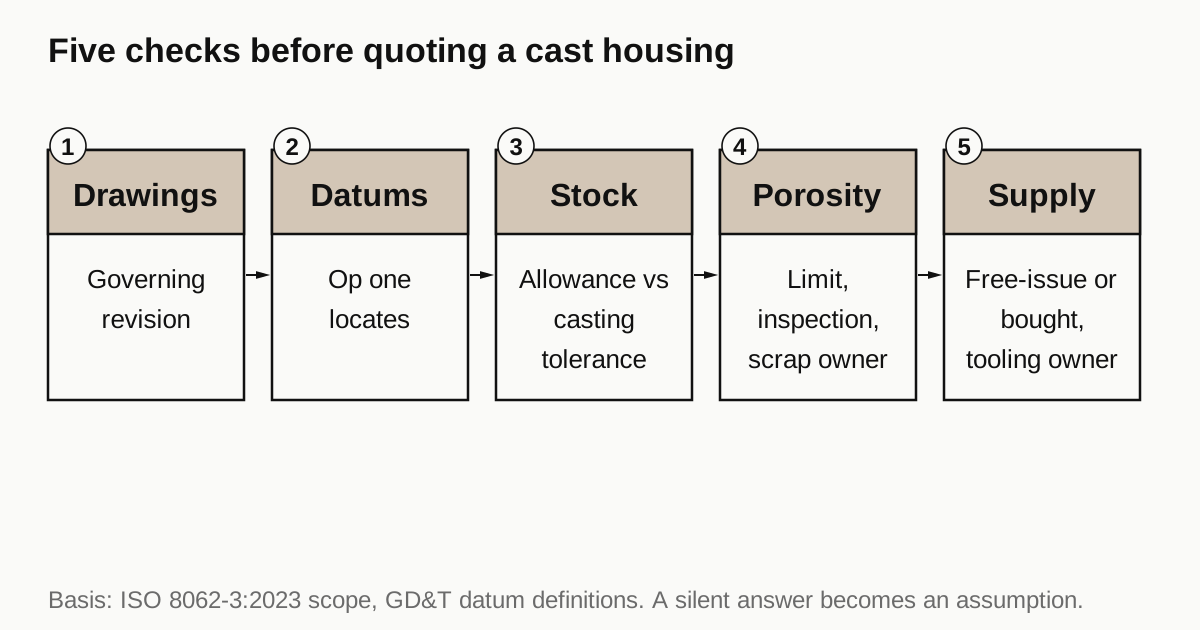
1. Get both drawings, at the right revision
Most cast parts have two drawings or two views: the casting drawing, which shows the as-cast shape, draft, parting line and gate and ejector positions, and the machining drawing, which shows the finished part. You need both, with the same revision letter. Ask which one governs when they disagree, and who owns the casting tooling and drawing. The tooling owner decides whether a change request is even possible.
Then check what the casting drawing says about general tolerances. ISO 8062-3:2023 sets general dimensional and geometrical tolerances and machining allowance grades for castings that use plus-minus tolerances on indicated dimensions. It covers linear dimensions and the geometrical tolerances straightness, flatness, roundness, parallelism, perpendicularity, symmetry and coaxiality. It does not cover position tolerances, angular dimensions or cylindricity. So a position or cylindricity requirement on a cast feature must be written on the drawing; the general tolerance will not give it to you. If the drawing quotes no casting grade at all, ask for one before you price.
2. Find the datums for operation one
Operation one cuts on a cast surface, and every later operation refers back to what it produced. A datum is a theoretically exact plane, line, point or axis, and a datum feature is the physical feature that stands in for it. On a casting the datum features are often drawn as machined faces that do not exist yet. Ask where the first setup locates, and look for datum targets, small areas or points on the cast surface that the foundry and the shop both use.
Without targets, expect a different fixture on every batch, because rough surfaces vary. With targets, ask whether the foundry checks them. Then decide how many setups the part needs: one if all the critical features can be cut from one side and one clamping, two or more if they cannot. The bearing seats that must share an axis are the feature to plan around, and the bearing bore coaxiality guide shows how the drawing should state it.
3. Stock: allowance minus casting tolerance
The machining allowance is what the casting drawing adds on a face or bore for you to cut away. The stock you can count on is the allowance minus the variation of the casting. Vendor guidance from a casting and machining supplier says allowance should be assigned by feature, not by one universal value, so read it face by face.
A worked case, with illustrative numbers. Wikipedia gives a typical die casting dimensional accuracy of 0.1 mm for the first 2.5 cm plus 0.02 mm for each additional centimetre. On a 150 mm dimension that is about 0.35 mm. If the drawing allows 2.0 mm of stock on a face, the real stock you may see ranges across a band of about that width, so the thinnest part of the batch still has to clean up with a finish pass. Where stock is thin, the casting is at risk of black spots, areas left uncut. Where it is thick, you cut more than you priced, and you reach deeper into the metal. Ask the buyer for a sample casting or a first article inspection report of the casting before you commit to a price on thin allowances.
Draft also matters. Wikipedia gives minimum draft for aluminum die castings of about 1:100, or 0.6 degrees, on surfaces parallel to the die opening. A drafted bore or wall is not a straight cylinder, and the stock changes along its length. Check it on the section view.
4. Porosity: price the risk, and say who carries it
Machining opens the casting. Gas porosity forms as dissolved gas comes out of solution, and in aluminum hydrogen is the gas of concern. Shrinkage porosity forms inside the casting where feed metal cannot compensate. According to the casting defect overview, blowholes can sit under a skin of sound metal and need ultrasonic, magnetic or X-ray inspection to find. Air entrapment in die casting leaves a small amount of porosity in standard processes, so some is normal.
For a quote that means you do not know the pores until the tool cuts through the skin. Ask the buyer for the acceptance limit for porosity on the machined surfaces, the inspection method and who does it, whether the casting is impregnated before machining and what happens to a part that fails after you have spent machining time on it. The casting porosity guide covers impregnation and how to write reject limits. If the answer is silent, put your assumption in the quote.
Need a quote for this part? Get a quote for your motor part
5. Who supplies the casting
| Case | You price | You carry |
|---|---|---|
| Free-issue castings from the buyer | Machining only | Scrap you agree to absorb, handling and incoming check |
| Castings bought by the shop | Machining plus casting, freight and inspection | Casting supplier risk, lead time, scrap allowance and cash tied up |
| Castings bought from a buyer-named foundry | Machining plus agreed casting price | Lead time without control, a dispute path if the foundry is the cause |
Whichever case your quote assumes, write it as the first line. A buyer who thinks casting is free-issue and a shop that quoted it purchased are two different prices for the same part.
Buyers weighing a casting route can see how the blank choice fits the whole quote in the motor housing machining quote guide.
6. Build the number
A cast housing quote has the same parts as any machined part quote, with two additions: casting-related scrap and the first-operation fixture.
- Cycle time per operation. Time each operation from the model with your own feeds, including tool changes, probing and loading. There is no public rate survey for motor housings, so use your own machine hour rate.
- Setup and fixture. Fixture design and build is a one-time cost. Divide it by the batch you expect and state the batch. The machining cost guide shows why fixture amortization moves the price at low volume.
- First article and inspection time. Bearing bores and sealing faces need measured data, not a pass note.
- Scrap allowance. Choose one for the casting risk and state it. If it is a number you cannot defend, say so and offer a review after the first batch.
- Casting cost, if you buy it. With freight, duty and incoming inspection.
- Tool wear. A casting skin cuts differently from bar stock. Record tool life on the first batch and revise the next quote from it.
Laid out as a line-item quote, the buyer can see where the price sits and where you would move if an assumption changes. The guide for shops on winning motor part work explains why that kind of quote reads well.
7. When to say no
Decline, with the reason, when the drawing has no datum scheme and the buyer will not add one, when critical features have no stock and the casting cannot change, or when porosity limits are tighter than the casting process you are given can meet. A clear no with a reason is worth more than a quote you lose money on.
Questions to send back with the quote
- Revision of the casting and machining drawings, and which governs.
- Casting alloy and process, and the casting grade under ISO 8062-3 if used.
- Datum targets on the casting, and whether the foundry checks them.
- Porosity acceptance, inspection method and impregnation.
- Free-issue or purchased castings, and who owns the casting tooling.
- Sample casting available for a first article before the quote is final.
If you machine motor housings and want work requests that fit your machines, apply as a partner shop. There is no fee to join, no charge per request and no promise of orders. You quote us, and we place the purchase order if price and lead time work. The checks a shop clears first are written on the partner shop page.
Sources
- ISO 8062-3:2023, catalogue entry
- Casting defect, overview
- Die casting, overview
- Geometric dimensioning and tolerancing, overview
- ForceBeyond, machining allowance guide (vendor, directional)
Standards and references
- ISO 8062-3:2023, Geometrical product specifications (GPS), Dimensional and geometrical tolerances for moulded parts, Part 3. Scope: general dimensional and geometrical tolerances and machining allowance grades for castings, with the list of geometrical tolerances covered and those excluded. Catalogue entry.
- Casting defect, overview. Gas and shrinkage porosity, how pores sit under a skin of sound metal and why they can be hard to detect, and cold shuts and misruns.
- Die casting, overview. Typical dimensional accuracy of 0.1 mm for the first 2.5 cm plus 0.02 mm per additional centimetre, draft angles and the porosity from air entrapment.
- Geometric dimensioning and tolerancing, overview. Datums, datum features and datum reference frames, and the relation between ASME Y14.5 and ISO 1101.
- ForceBeyond, Machining allowance for castings and forgings (design guides index). Foundry and machining vendor view that allowance should be assigned by feature, not by one value. Vendor guide, directional only.
Figures on this page are typical ranges drawn from the standards above and from ordinary shop practice. They are not a specification for your part. The partner shop that prices your part confirms what it can hold on your geometry.
Frequently asked questions
What is the first thing to check on a casting drawing before quoting?
Which features are cast and which are machined, and which cast features the first operation can locate on. If the datums are machined faces that do not exist yet, ask the buyer for datum targets or locating points on the casting. Without them, setup time and scrap are guesses.
How much machining stock should a casting have?
There is no single public number. ISO 8062-3 sets machining allowance grades for castings, and vendor guidance says allowance should be assigned by feature. Read the allowance on the casting drawing for each face and bore, then subtract the casting tolerance to see the stock you can rely on.
Who pays when machining exposes porosity in a casting?
It depends on the purchase order and on who supplied the casting. Settle it before the first order: the porosity acceptance limit, the inspection method, the count of rejects you absorb and what happens above it. A quote that is silent on this leaves the argument for after the scrap.
Should I quote free-issue castings differently from castings I buy?
Yes. With free-issue castings you price machining only and state the scrap you will absorb. With castings you buy you add the casting price, freight, incoming inspection and the scrap allowance, and you carry the supplier risk. Write which case your price assumes.
Need a quote for this part?
Send the drawing. We quote the finished parts, place the work with a partner shop and reply within 24 business hours.
Get a quote for your motor part